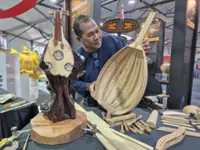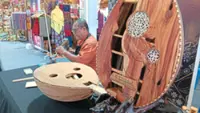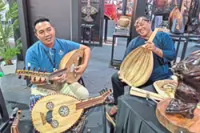
JOHOR BARU: For nearly six decades, the gentle curves of the gambus are a familiar sight in Halidan Ithnin’s hands, each instrument carrying echoes of heritage, memory and quiet perseverance.
At 59, the father of three – two sons and a daughter, all in their 20s – is one the few remaining master craftsmen in Johor dedicated to preserving the traditional art of gambus-making.
Halidan’s journey into the world of traditional musical instruments began in his childhood, growing up under the care of his late uncle in Batu Pahat.
His uncle, a skilled craftsman, played a pivotal role in shaping his life and future, introducing him to the discipline and patience required in traditional craftsmanship.
According to Halidan, his uncle had learned the art of making the gambus from an Arab immigrant from Yemen in the late 1950s in Singapore, a period when Arab traders brought Middle Eastern musical traditions to Johor.
The gambus, he said, originated from the Middle East before becoming an integral part of Johor’s cultural landscape through ghazal and zapin performances.
“Back then, gambus was an essential instrument when performing ghazal or zapin, which are closely associated with Johor’s identity,” he said.
As a young boy, his involvement in instrument-making was limited to assisting with the making of kompang and gendang, while the crafting of the gambus remained his uncle’s main responsibility.
Nevertheless, Halidan closely observed the process, watching every step as his uncle shaped, carved and assembled the instrument.
He would ask questions whenever possible and, over time, his uncle gradually entrusted him with more responsibilities, eventually allowing him to make a gambus on his own.
Halidan recalled feeling nervous during his first attempt, likening the experience to driving a car for the first time.
“I was afraid of making mistakes, but as time passed, I gained confidence and was able to produce a gambus properly,” he said.
In 1996, Halidan officially took over the craft following his uncle’s passing, assuming the responsibility of continuing a tradition that had been passed down to him since childhood.
He explained that crafting a gambus requires two types of wood – typically from cempedak or nangka trees, paired with pine wood – carefully selected to achieve the desired sound quality and durability.
In the early years, he relied on two sets of classical guitar strings for a single gambus, as specialised gambus strings were not readily available then.
“Today, gambus strings are easily available in the market, which has made the process slightly easier,” he said.
Halidan’s dedication to the craft gained international recognition in 2012 when he received the Award of Excellence for Handicrafts under Unesco’s South-East Asia programme.
In 2023, he was further honoured with the title Adiguru Kraf Gambus, recognising his mastery and long-standing contribution to the traditional art form.
He said the role of the gambus has evolved over the years, no longer limited to musical performances.
“The gambus is also appreciated as a gift or house decoration, and some institutions of higher learning are studying it as part of cultural heritage,” he said.
Despite these developments, Halidan believed stronger efforts are needed to ensure the survival of the craft.
He stressed that preservation is crucial so future generations will not only recognise the gambus, but also understand its history and cultural significance so that one can see that it is more than just an instrument.
“For this tradition to live on, it must be taught, appreciated and supported.”