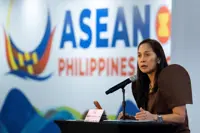
SINGAPORE: The Philippines is in talks with Saudi Arabia, Russia and the United States to store oil in the fuel-import-dependent nation, its energy secretary said on Wednesday (Oct 28), in a bid to hedge against fuel price spikes driven by the Iran war.
The nation, which imports nearly all its energy needs, also plans to increase diesel and gas-fired power output to make up for an estimated 60% decline in hydropower and 20% fall in solar output in the first half of 2027 due to the El Nino weather phenomenon, Secretary Sharon Garin told Reuters.
The Philippines is also in talks with Russia, the United States, Japan, Kuwait, the United Arab Emirates and Australia on oil storage, Garin said, as it looks to build stockpiles after the US-Israeli strikes on Iran in February disrupted supplies.
"If El Nino finishes in April, that's the time that summer starts for us. So this would be a prolonged pressure for us, which started with the oil crisis in the Middle East," Garin said on the sidelines of the Singapore International Energy Week conference.
Opec kingpin Saudi Arabia, which is exploring locations to store its oil following attacks on its ports and oil facilities, announced this week an initial agreement to store Saudi crude in Singapore's rock caverns starting 2027.
The Philippines plans to build its first government-owned storage tank next year at Bataan to hold strategic oil reserves, Garin said, adding that the government has been working with Tokyo to build regional oil stockpiles, which would complement its national reserve.
Fuel inventories in the Philippines are currently at 55 days, up from a 15-day minimum requirement, Garin said. The government has one million barrels of oil stocks in private facilities, she added.
"We start with one million (barrels) and scale it up over the years with the objective of reaching 60 days," she said, adding that the volume will be split evenly between crude and fuels.
The country's average daily demand for petroleum products was about 78 million litres, or about 490,600 barrels, as of May, government data showed.
The country of 114 million also plans to install two gigawatts of new coal-fired power plants over the next five years to ensure reliable, round-the-clock power to complement eight gigawatts of additional renewables capacity it plans to add by 2028.
Garin said the government was keen on using clean power sources, but also faced rising power demand and geographical limitations.
"Our country needs to progress. And for you to be progressive, you have to have steady, secure energy. And sacrificing that just to transition, that would not help our country," Garin said.
"We're an archipelago, we cannot just have 5,000 megawatts of solar in a small island." - Reuters