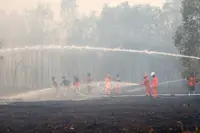
JAKARTA: Orangutan populations are at a higher risk of extinction amid soaring forest loss and raging wildfires across key habitats in Sumatra and Kalimantan, as the world struggles to keep up with the global target of halting biodiversity loss by 2030.
In a joint report published on Oct 24, environmental groups Mighty Earth and Satya Bumi issued a “red code” warning for the Tapanuli orangutan, often considered world’s rarest great ape, which is facing a higher extinction risk.
The species is endemic to the fragmented forests of the Batang Toru ecosystem in South Tapanuli regency, North Sumatra.
But the ape faced another danger when at least 58 individuals inside the ecosystem were killed by the cyclone-induced floods and landslides in the region in 2025, leaving only an estimated 658 Tapanuli orangutans remaining in the wild. In their report, the environmental groups noted the disaster had damaged more than 8,300 hectares of forest in the western Batang Toru ecosystem, the largest of the three forest blocks inhabited by the orangutans.
Enforcing a moratorium on industrial expansion, smallholder agriculture and small-scale logging, which are among the main drivers of rainforest destruction in orangutan habitat, remains vital, according to Phil Aikman, South-East Asia campaign director of Mighty Earth.
Limiting the business may pave the way for a recovery plan for the species, which includes restoration of the fragmented rainforest canopy across the ecosystem.
“There is now far too little Tapanuli orangutan habitat left to allow any further rainforest loss,” Aikman told The Jakarta Post on Sunday.
Weeks after the 2025 disaster, President Prabowo Subianto suspended business permits for 28 companies for alleged environmental breaches that worsened the impact of the disaster.
Among suspended businesses were the Martabe gold mine of PT Agincourt Resources, a subsidiary of global conglomerate Jardine Matheson, that sits on the western edge of the orangutan habitat.
Meanwhile, the Batang Toru hydropower plant, developed by Chinese-backed power producer PT North Sumatra Hydro Energy (NSHE), is one of the government’s national strategic projects (PSN) to reinforce Sumatra’s electricity system.
Both the mine and the power plant intersect with the geographical range of the Tapanuli orangutan in Batang Toru. Earlier this year, the government allowed the two companies to resume their operations after they were claimed to meet environmental compliance and paid for the subsequent fines.
The gold mine is developing a new pit northward, while the power plant is fast tracking the operations of its 510-megawatt (MW) facility.
Concerns over orangutan populations have come as Indonesia battles with raging wildfires in recent months that have also threatened critically endangered Bornean orangutans.
As of early October, at least 290 animals had been rescued from multiple scenes across the country, including 96 Bornean orangutans that were relocated from burning peatland in four Kalimantan provinces.
The International Union for Conservation of Nature (IUCN) has also flagged a warning about the orangutans, as fires affected 52 per cent of the total Bornean orangutan population, including those situated in national parks.
The piling pressure on wildlife in Indonesia has also renewed scrutiny over the world’s goal of halting biodiversity loss by 2030, as hundreds of national parties and international groups gather in Yerevan, Armenia for the United Nations biodiversity talks (COP17) to accelerate the global goal of conserving 30 per cent of land and ocean in the next four years.
The target was first established four years ago under the “30 by 30” framework, which includes slowing down species extinction and mobilising a US$200-billion nature fund by 2030.
But a recent assessment by the UN found the world is largely off track to reach the 23-goal framework, despite around 60 per cent of the 196 signatories to the Convention on Biological Diversity (CBD) already establishing national biodiversity strategies and action plans.
Indonesia ratified the CBD in 1994 and has since developed national biodiversity strategy and action plans. But the country remains behind in several important areas of conservation and environmental policies, with Indonesia ranking 168 out of 177 countries assessed by Yale University.
Addressing the summit on Oct 16, UN Secretary-General António Guterres urged leaders to deliver more action, speed and will to “make peace with nature”, as he highlighted: “There is no time to waste.” - The Jakarta Post/ANN