BEIJING: While China’s iconic silk embroidery is world-renowned for its exquisite detail and painterly effects, an even more meticulous traditional technique surpasses it.
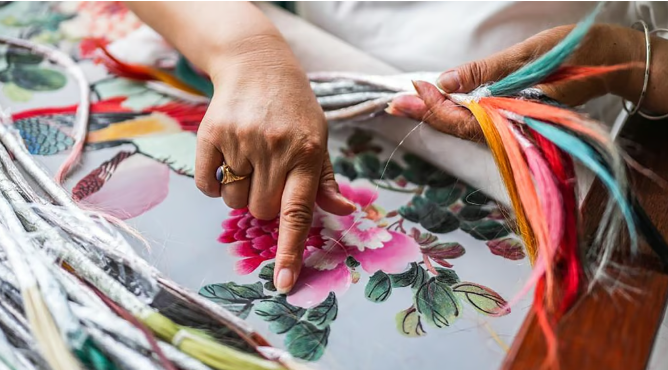
Originating in Dongtai, located in eastern China’s Jiangsu province, during the Tang dynasty (618–907), hair embroidery relies on the incredibly fragile medium of human hair. With a rich history spanning over 1,000 years, a single intricate piece can take skilled artisans anywhere from several months to multiple years to complete.
It is said that young women in Dongtai first used their own hair to weave images of Buddha as a demonstration of their piety.
In China, there is a traditional saying: “Our bodies – to every hair and bit of skin – are received from our parents, and we must not presume to injure or wound them.” Thus, embroidering with hair is also a profound expression of dedication.
The skill declined during the Ming and Qing dynasties (1368–1912). In the 1960s and 70s, some Su embroidery professionals and artists were sent to Dongtai during the Cultural Revolution, which led to the rediscovery and revival of this ancient hair embroidery technique.
Hair embroidery requires the hair of young, healthy women no shorter than 30 centimetres. The hair undergoes a series of treatments, including degreasing, softening, colour-fixing, and preserving, to maintain its best quality over time.
While silk embroidery can utilise machines, hair embroidery must be executed by hand due to the ultra-fine quality of the material and the intricate details required.
A hair embroidery artist employs multiple stitching techniques, such as stemming, swirling, and wrapping, to achieve a vivid and natural combination of shades and densities.
One piece of hair embroidery art, especially larger works, is often a collaborative effort and could take months to years to complete.
One of the most famous examples, Prosperous Suzhou, is an over 12.4-metre-long and 36-centimetre-wide piece crafted based on a 1759 painting, featuring 12,000 figures, 400 boats, and 500 shop signs. It took artist Zhou Yinghua and more than 10 embroidery artists three years to accomplish in 2009.
The hair material is particularly effective in depicting human and animal features in a work.
Traditionally, only black hair was used in hair embroidery, leading to its alternative name, moxiu, or ink embroidery.
Due to the limited shades of hair available, the themes of hair embroidery tended to focus on portraits with minimalist backgrounds.
As dyeing techniques advanced in modern times, hair can now be dyed in various colours, allowing for the representation of themes such as flowers and birds, as well as natural and urban landscapes.
Some artists also split the hair further into finer strands or combine hair with silk and gold threads to achieve expressionistic effects.
In 2021, Dongtai hair embroidery was recognised as a national intangible cultural heritage. - South China Morning Post