
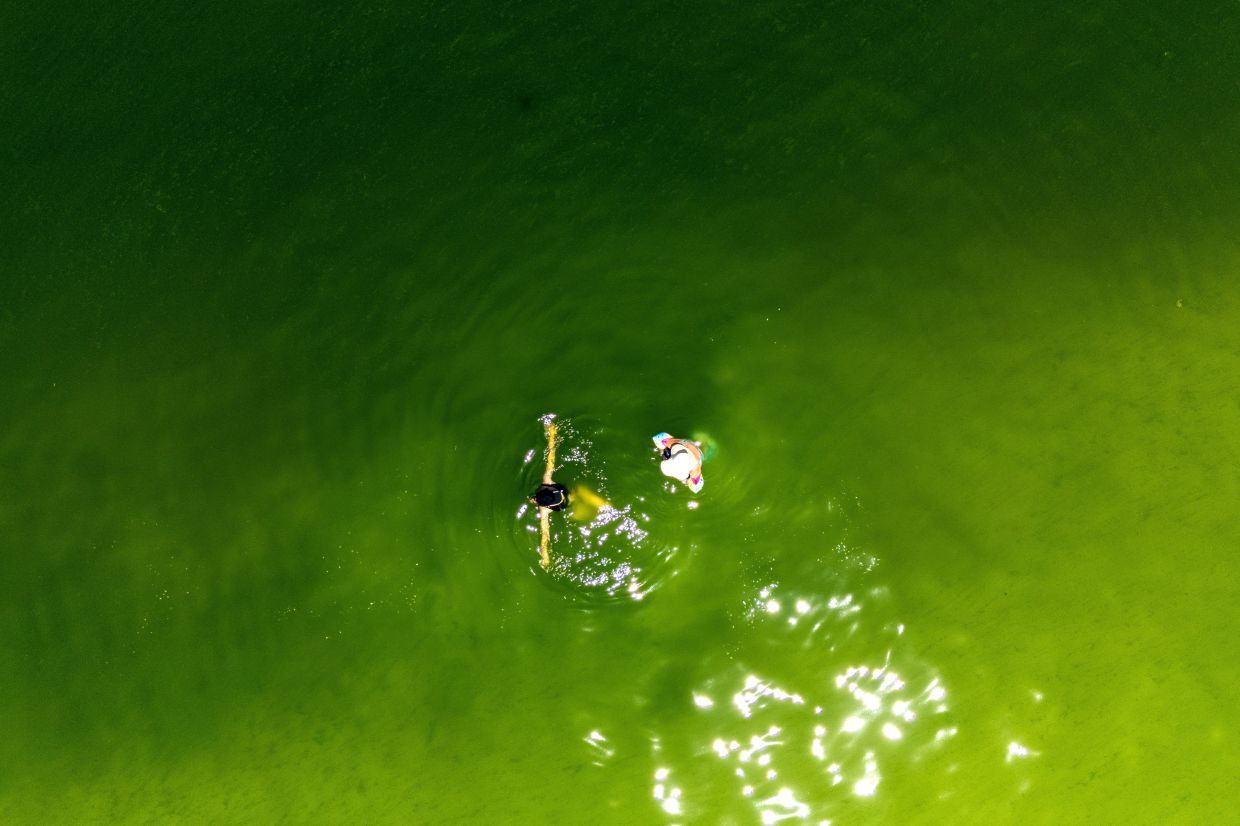
KO LAN, Thailand: The sea off Thailand's popular tourist island of Ko Lan turned a bright, pungent green this week as heavy rains and floods helped spark a plankton bloom that kept some swimmers on shore.
Dense patches of green could be seen stretching along parts of the coast, with jet skis floating in discoloured waters around the island in the northern part of the Gulf of Thailand, while other stretches of the shoreline were unaffected.
"What we're actually seeing with the naked eye is a colour that comes from a type of plankton called Noctiluca," said Arvut Munhapon, a senior researcher and head of marine environmental research at the Marine Science Research Division, Institute of Marine Science, Burapha University.
His team of four was on the ground collecting water samples, measuring water quality, and bringing samples back to the lab to identify species and build a database that would help form a clearer picture of the situation.
Plankton blooms are a natural, recurring phenomenon, but have worsened around the world as climate change has warmed seas, the researchers said. Fertiliser runoff and nutrient-rich wastewater also wash into the sea and feed rapid plankton growth, they said.
Blooms typically last two to three days. When they end, mass plankton die-off consumes oxygen and sometimes creates hypoxic conditions, or an "aquatic dead zone", with oxygen levels too low to support marine life, according to Anukul Buranapratheprat, deputy director of the Institute of Marine Science, Burapha University.
"We're looking at the endpoint, which is hypoxia... and hypoxia in the inner Gulf of Thailand, based on my own research, has genuinely gotten more severe," Anukul said. His biggest concern was a wide hypoxic zone that had formed this year, too low in oxygen to support bottom-dwelling marine life.
This year's monsoons and El Nino may be intensifying both the bloom and this year's hypoxic conditions, since warmer water holds less dissolved oxygen, but Anukul said more research was needed to confirm the connection.
Significant flooding has hit Thailand in recent weeks, including in central provinces and Bangkok, adding to the volume of freshwater reaching the Gulf.
Food vendors along the beach said customer numbers had thinned since the green water appeared, with some visitors moving to unaffected areas of the island. The discolouration was enough to keep others out of the sea altogether.
"I felt that it was unusually green compared to normal seawater, so I didn't dare go in. I was afraid I'd break out in a rash,” Latipeya Thantibhapat, said a 29-year-old tourist from Chiang Mai. - Reuters.