




Former Ecuadorian president Lenin Moreno and a former Chinese ambassador to Quito asked the country’s highest court on Thursday to spare them the five-year sentences handed down last week over a US$76 million bribery scheme.
Moreno was convicted of bribery by a three-judge panel of the National Court of Justice over contracts for Ecuador’s largest hydroelectric project secured by a Chinese state contractor.
The judges found unanimously that he had used his position as vice-president, held from 2007 to 2013 before he won the presidency in 2017, to help secure financing for the Coca Codo Sinclair plant, built by Sinohydro, a unit of Chinese state group PowerChina.
But the former president has not been detained and remains in Ecuador, and if the conviction is upheld, he would serve his term at home rather than in prison, because he is paraplegic.
The judges will take up his request on September 7 and, if it is granted, his prison term would be suspended and replaced with conditions such as periodic reporting.
“I have not received a single cent from Sinohydro, so please do not come and tell me that I am an accused man,” Moreno told reporters after the ruling was read out.
He has said the case was motivated by a desire for revenge by Rafael Correa, the president who made him his running mate and then turned on him after Moreno moved rightward and let investigators pursue his allies. Correa was convicted in absentia in 2020 and lives in Belgium.
The plant at the centre of the case is the costliest ever built in Ecuador, in the Amazon basin 100 km (62 miles) east of Quito.
Sinohydro signed a US$1.9 billion contract in 2009 and China’s Export-Import Bank lent about US$1.68 billion the next year, on condition that a Chinese company do the work.
The deal predated Xi Jinping’s Belt and Road Initiative by four years, but was later rebranded as part of the investment strategy and set the template for what the programme would look like in South America.
Coca Codo Sinclair has since become a case study in the risks of that model, never running at its full 1,500 megawatt capacity because of defects present from the outset, with a congressional report counting 17,499 cracks by 2022.
Ecuador still depends on the dam for about a quarter of its electricity, and its weak output added to the blackouts of up to 14 hours a day during the 2024 drought.
From ambassador to Sinohydro representative
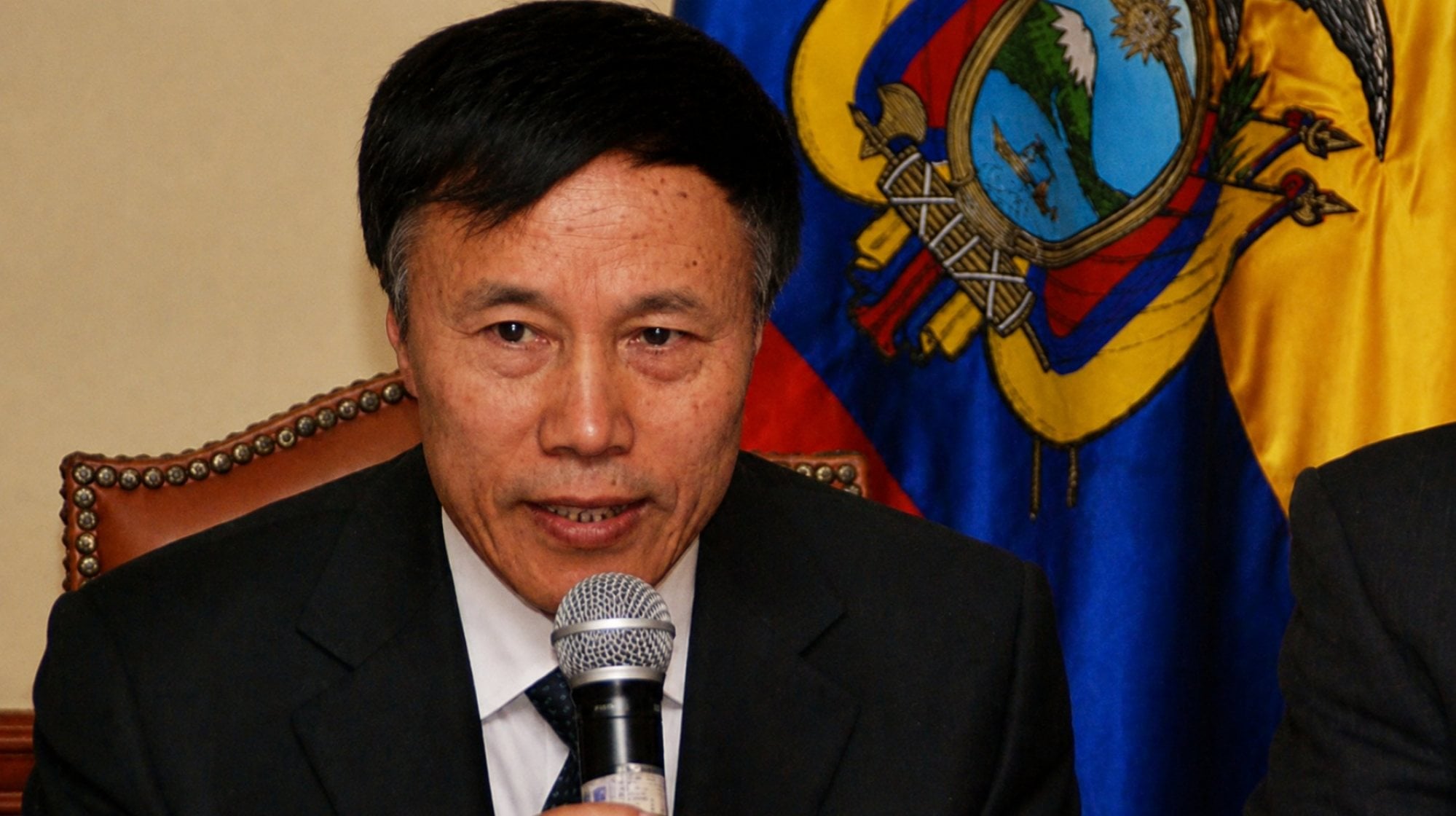
Cai Runguo was China’s ambassador in Quito from 2007 to 2011 and was honoured by Correa shortly after Sinohydro won the contract. Within months of leaving the embassy, he joined the company he had dealt with as a diplomat, becoming its legal representative in 2013.
Prosecutors said Cai met Moreno while both were in office, pushed the financing through and later helped arrange the payments.
He received five years, as did former Sinohydro representatives Yang Huiju and Song Dongsheng, along with Conto Patino, a friend of Moreno’s. Cai has not appeared publicly in Ecuador since around 2016.
Twenty of the 21 defendants were convicted, among them Moreno’s wife, daughter, two brothers and a sister-in-law, all of whom were sentenced as accomplices.
Those who had held public office, Moreno among them, were barred from public service for life, and reparations totalled more than US$163 million.
The payments ran from 2009 to 2018 and came to about 4 per cent of the contract, prosecutors said, most of it passing through a firm linked to Patino and accounts in Panama, disguised as consultancy fees.
The case grew out of a 2019 leak about an offshore firm registered in Belize by Moreno’s brother and tied by investigators to the payments.
The evidence against Moreno rested largely on a recording of a March 2010 interview, authenticated through forensic voice analysis, in which the judges found he admitted lobbying the Correa government for someone connected to Sinohydro.
Moreno argued that the contract was signed and executed under Correa, and that responsibility lay with Jorge Glas, who succeeded him as vice-president and ran the energy portfolio, now serving a corruption sentence of his own.
A narrow point in time
Article 630 of Ecuador’s criminal code allows judges to suspend a prison term of up to five years, but an anti-corruption reform in February 2021 added bribery to the offences excluded from that benefit.
Moreno’s lawyers argued that the earlier text, which barred suspension only for sexual and domestic violence offences, should govern because the bribery began in 2009, 12 years before the reform.
Cai’s lawyers made the same argument, telling the court he rejected the conviction and would appeal but was asking for suspension now because it was the only stage at which the law allowed it.
“Considering that the benefit whose application is sought was in force on the date of the events, I ask you to set a day and time for the hearing,” Moreno’s filing said.
Thirteen of the convicted made the same request and 12 will be heard, after the court threw out one as late.
The judges delivered their verdict orally and have yet to issue the written judgment, which starts the clock on appeals.
And the sentences fell on individuals rather than on Sinohydro, whose international arm was folded into PowerChina International in 2016.
The company has not commented on the verdict and the Chinese embassy in Quito did not immediately respond to a request for comment. Prosecutors said at least 10 requests for banking and corporate evidence sent to China since 2019 went unanswered. -- SOUTH CHINA MORNING POST


