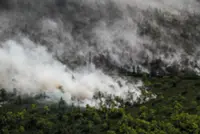
JAKARTA: Indonesia may be heading toward its worst wildfire season in years as fire activity surges ahead of peak burning months, fuelled by a prolonged dry spell expected to intensify under a strong El Niño.
Government data and independent analysis show that burned areas and fire hot spots have surpassed levels recorded during the same period in 2019, when Indonesia suffered one of its most destructive fire seasons in recent history.
According to the Forestry Ministry's Sipongi wildfire monitoring platform, around 107,000 hectares of land and forest, an area nearly twice the size of Jakarta, burned nationwide in the first half of the year.
The figure is 120 percent higher than during the same period in 2019. Independent forest monitoring platform Nusantara Atlas recorded 116,000 fire hot spots across the country since January, about 6,000 more than during the corresponding period in 2019.
More than 3,100 hot spots were detected between Aug 3 and Aug 4 alone, with the highest concentrations in East Nusa Tenggara, West Kalimantan, Riau and South Papua.
The warning signs are already evident in several regions.
In West Kalimantan, which has recorded the country's largest burned area this year, authorities have extended a haze emergency alert until Nov 15 after detecting more than 200 hot spots in a single day late last month.
The Meteorology, Climatology and Geophysics Agency (BMKG) has forecast a strong El Niño to persist through the first quarter of 2027.
Combined with a positive Indian Ocean Dipole, the climate pattern is expected to prolong drought conditions across much of Indonesia, increasing the risk of more widespread fires.
During the previous strong El Niño in 2019, around 1.64 million ha of land and forest were burned nationwide, according to Forestry Ministry data.
David Gaveau, founder of geospatial company The TreeMap, which operates Nusantara Atlas, said the fire activity so far this year was tracking closely with 2019.
“What we know is that the trend is similar to 2019 and that’s a sign that something is soaring,” Gaveu told The Jakarta Post on Tuesday, adding that if it were a low-fire year, the numbers would be much lower.
With Indonesia's peak burning months still expected in September and October, he warned that the number of hot spots and burned areas could rise sharply.
Human factors Forestry expert Bambang Hero of Bogor Agricultural University (IPB) agreed that Indonesia could be heading toward another severe wildfire season, with El Niño likely to keep fire risks elevated into next year.
However, he stressed that climate conditions alone do not ignite fires.
Most land and forest fires stem from human negligence or deliberate land clearing, while prolonged drought simply allows them to spread more rapidly.
His assessment is echoed by a recent analysis from the Indonesian Forum for the Environment (Walhi), which found that at least 74 per cent of hot spots detected across Kalimantan were located within industrial concessions.
Bambang also warned that many regional administrations were struggling to prevent and contain fires because of limited personnel and funding.
“Numerous regional administrations have failed to allocate dedicated budgets for wildfire control, treating fires as an annual occurrence rather than a policy priority.”
The challenge has been compounded by budget cuts introduced under President Prabowo Subianto 's austerity drive to fund his costly initiatives, which has reduced spending across ministries, agencies and regional administrations.
Forestry Ministry spokesperson Ristianto Pribadi acknowledged that tighter budgets had created challenges for various stakeholders but assured that wildfire mitigation remained a national priority.
The ministry has further imposed administrative sanctions on 14 companies found responsible for wildfires and issued warning letters to 13 others.
It has also required concession holders to strengthen firefighting brigades to improve prevention and response.
“Through these measures, the government hopes wildfire management can become faster, more effective and more accountable while continuing to prioritise prevention, law enforcement and collaboration with all stakeholders," Ristianto told the Post on Tuesday. - The Jakarta Post/ANN