
Hong Kong flag carrier Cathay Pacific Airways has further extended its suspension of all flights to and from the Middle East until the end of April amid the ongoing conflict in the region.
Observers said on Wednesday that war-driven drops in demand had made some routes commercially unviable, while noting the impact on travellers would be limited as regional carriers still maintained essential services.
Cathay Pacific said flights between Hong Kong and Dubai in the United Arab Emirates, and between the city and Riyadh in Saudi Arabia, would remain suspended until the end of next month.
All services between Hong Kong and the Middle East were first suspended on February 28 following the joint United States-Israeli attack on Iran.
The airline has extended the suspension multiple times, most recently adding another 17 days to keep services cancelled until the end of the month.
“We’re continuing to monitor the situation closely,” Cathay said. “Further changes to our flight schedule may be needed in the coming days, with the safety of our customers and people being our first priority.”
The airline said it had activated its ticket waiver policy for passengers booked to travel between Hong Kong and the two Gulf cities up to May 31, allowing them to rebook, reroute or obtain refunds without the usual administrative fees.
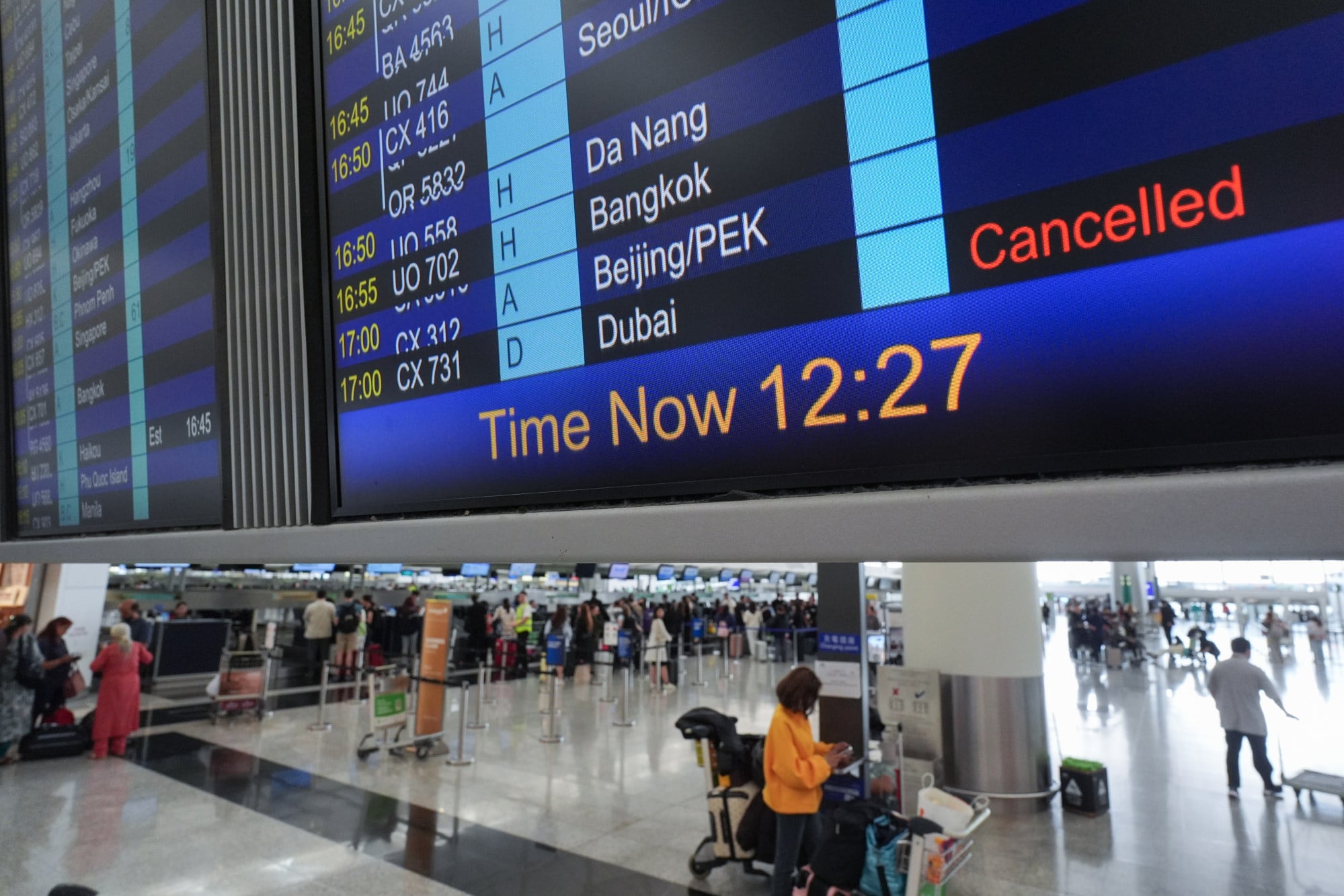
Cathay is among four carriers operating direct flights between Hong Kong and the Middle East.
Etihad Airways earlier said it had temporarily stopped services between Hong Kong and Abu Dhabi as part of a broader suspension affecting several destinations until April 1.
Both Emirates and Qatar Airways are offering limited services between Hong Kong and Dubai and Doha, respectively, according to the websites of the two carriers.
Emirates said that following the partial reopening of regional airspace, the airline had been operating a reduced flight schedule.
“We continue to monitor the situation and we will develop our operational schedule accordingly,” it said.
Qatar Airways said it would resume operations once the country’s civil aviation authority announced the full and safe reopening of Qatari airspace.
“Qatar Airways will operate a revised limited number of flights from March 18 to 28. These schedules have been enhanced to give more flexibility to passengers wishing to travel,” it said.
Terence Chong Tai-leung, an economics professor at the Chinese University of Hong Kong, said the impact of Cathay halting services between the city and the Middle East was limited, given the demand had dropped due to the war.
He also doubted that one airline halting flights would undermine the government’s ambition to explore Middle Eastern markets amid global geopolitical tensions.
“The war will eventually end one day, and we still have other carriers offering services between Hong Kong and the Middle East,” he said.
“Whether an airline operates certain routes is purely a business decision. Demand for travel to the Middle East has dropped since the outbreak of the war. Even if service continues, operating with low load factors will inevitably lead to financial losses.”
Chong’s remarks were echoed by independent aviation analyst Jason Li Hanming, who noted Mideast carriers operated most of the flights connecting the region to Hong Kong.
“When an airline determines whether or not to recover service to a specific destination, the key is definitely the safety and security of crew, passengers and cargo. For carriers in the Middle East, the risk is systemic. No matter where they are flying to ... they have no choice,” Li said.
He noted that Cathay and other Asia-Pacific carriers had the flexibility to pivot to “safer” destinations, adding airlines such as Air China and China Eastern had restricted their Middle East operations, either halting them or maintaining only essential flights.
“Actually the halted Cathay flights are only a small portion of all flights,” Li said. “More flights are restricted by the Middle East carriers.”
Business sector lawmaker Jonathan Stuart Lamport said he believed the impact of suspending direct flights to the Middle East would only be temporary.
He said the commerce sector understood airlines’ decision to suspend their flights to the region, adding that aviation safety should be the top priority.
A surge in regional hostilities, triggered by reciprocal strikes between US–Israeli forces and Iran, has severely disrupted Middle Eastern airspace, leading to a massive wave of flight cancellations affecting millions of travellers.
As of Tuesday, more than 52,000 of the 98,000 scheduled flights in the Middle East had been cancelled since the outbreak of the war, affecting over 6 million passengers, according to aviation data specialist Cirium.
Separately, Cathay Group announced its traffic figures for last month, saying its flagship carrier and budget arm HK Express carried more than 3.2 million passengers in February, a 24 per cent increase year on year.
“Turning to March, the global geopolitical environment is volatile, causing unexpected shifts in passenger and cargo traffic flows, as well as a significant increase in the price of jet fuel,” the group said.
The group said it has increased the number of flights to London and provided additional capacity to Zurich in the coming month to cater for a surge in demand for Europe as customers prioritised alternative travel routes due to airspace closures in the Middle East.
-- SOUTH CHINA MORNING POST