




Animal activists have urged Hong Kong authorities to review their culling strategy for wild boars and to introduce measures such as animal bridges to reduce human-wildlife conflict in urban areas following the recent deaths of eight wild pigs and a buffalo.
They warned that as urban expansion, particularly the Northern Metropolis project, continued to erode wildlife habitats through the clearing of large tracts of land, inadequate city planning would exacerbate the problem, endangering more animals.
On Tuesday, authorities euthanised eight wild boars – two adults and six juveniles – after they wandered into a residential area near Chuk Yuen North Estate in Wong Tai Sin.
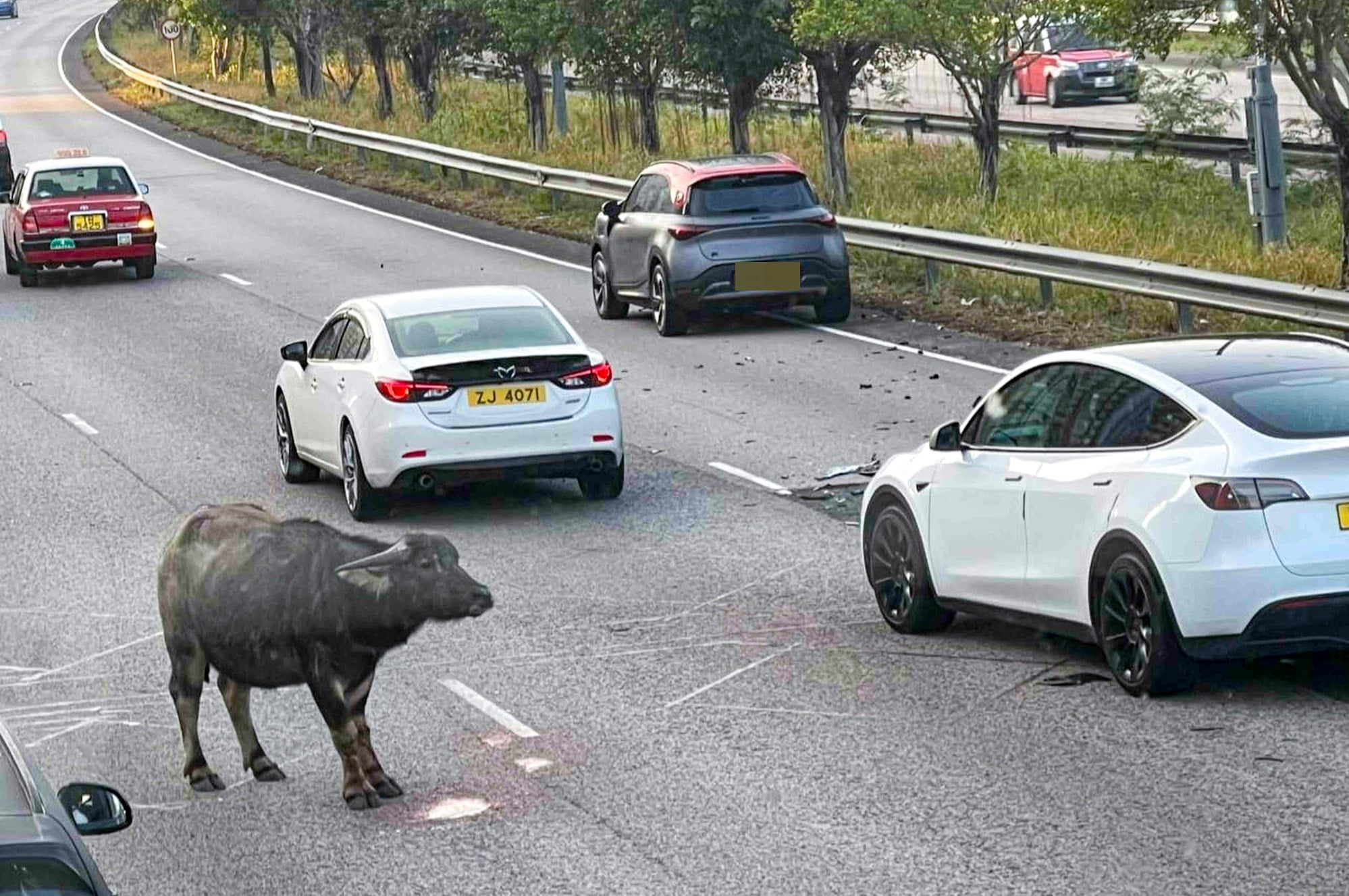
The next day, a buffalo was struck by a car on a highway in Yuen Long, disrupting traffic for hours, before it was euthanised due to severe injuries.
The boar cull reignited debate over the government’s 2021 policy shift to euthanasia, replacing the “capture, contracept and relocate” approach.
The accident involving the buffalo also highlighted the lack of safe crossings for wildlife on busy roads in rural areas.
The Hong Kong Wild Boar Concern Group condemned the culling as “brutal”.
“At that time, the wild boars posed no threat. Elderly people were chatting nearby, everyone was minding their own business, with no threat to residents’ lives or property,” the group’s Roni Wong Ho-yin said.
“The Agriculture, Fisheries and Conservation Department [AFCD] staff first threw bread on the ground to lure them, targeted the piglets first, then rounded up the adults. I think exploiting the animals’ trust to capture and humanely dispatch them is despicable and brutal behaviour.”
Wong argued that the sedated boars could have been returned to the hills instead of being killed. He also warned that continued culling could push the population towards extinction.
“Since the policy started, roughly 80 to 90 per cent of Hong Kong’s wild boars have been culled,” he said. “The AFCD has never explained its ultimate target.”
Under the policy of capturing and killing wild boars that posed potential danger or caused injuries, the number of wild pigs fell from about 1,830 in 2022 to around 900 in 2024.
Kent Luk Ka-chit, the founder of Paws Guardian Rescue Shelter, which cares for injured wild boars alongside stray cats and dogs, echoed Wong’s criticism.
He described boars being tied by the neck or mouth or maimed by traps, some losing limbs.
“As long as they’re injured and we have the capability, even if they are wild, from a humane standpoint, we should rescue them,” he said.
His group recently highlighted three cases of stray dogs hit by cars on social media, urging drivers to slow down, use headlights and watch roadsides, especially in hilly areas at night.
Both Wong and Luk voiced concern about habitat loss from the Northern Metropolis development near the border with mainland China.
Luk cited cleared land in Kwu Tung, Hung Shui Kiu and Yuen Long, saying many sites had been levelled, leaving half-collapsed homes and stranded strays.
He contrasted Hong Kong’s approach with others in the region. “Nearby Taiwan and Japan have comprehensive wildlife protection laws, giving animals status in society,” he said. “Direct or indirect harm carries legal responsibility.”
Brian Wong Shiu-hung of the Liber Research Community, which studied Hong Kong’s wild boars in 2024, noted the sharp decline after 2021.
“The population has clearly dropped a lot, similar to the 1950s and ’60s when post-war urban expansion led to mass culling, nearly wiping them out – then protection was needed again. It’s a cycle,” he said.
“The ‘kill order’ has run for five years. The strategy needs review because with numbers below 1,000, continuing to kill on sight deviates from scientific population control.”
Wong acknowledged that development would bring inevitable conflict but urged coexistence, including studying boar habits, setting boundaries and creating buffer zones where possible.
He said city planners should consider wild animals as stakeholders and provide living space, such as the animal bridges over highways in Singapore and Malaysia, with vegetation and fencing to prevent road entry, and monitoring systems to alert vehicles.
Killing the animals could backfire, Wong said: “Aggressive culling could make them warier or more violent towards humans. A less drastic approach – guiding them back to non-urban areas – could establish boundaries for peaceful coexistence, teaching them where they belong and where humans do.”
An AFCD spokesman defended the current approach, stating the capture and dispatch programme had proven to be the only population control measure capable of effectively reducing wild pig conflicts.
“While the overall wild pig nuisance situation in Hong Kong has gradually improved in recent years, the department continues to receive more than 1,000 related public reports annually,” he said. “For this reason, it remains necessary to sustain these measures.”



