
THE cost of higher education involves far more than tuition fees.
For Malaysian families planning their child's next step after SPM, understanding the full cost of a qualification, including living expenses, learning materials and other hidden costs, is essential.
Education and financial experts say parents should compare not only course fees, but also the value of a programme, potential career outcomes and whether the investment aligns with their child's goals and family finances.
How do education pathways differ?
Every education pathway comes with its own costs, timelines, learning experiences and long-term returns.
The different pathways:
- Diploma: Builds industry knowledge and practical skills.
- Foundation/Pre-University: Provides academic foundations for degree studies.
- Degree: Offers deeper specialisation and wider career opportunities.
According to Loh Sue May,director and co-founder of education consultation portal EduAdvisor, families should consider the total cost of reaching the final qualification.
“For example, a foundation typically takes one year and is usually followed by a three to four-year degree.
“They should therefore consider the combined cost of both the foundation and the degree,” she explains.
How much do pre-university programmes cost?
Costs vary widely according to the institution, subject stream and course.
- Foundation programmes can range from RM0 (for universities that waive fees for students who continue their degree at the same institution), to more than RM35,000.
- Diploma programmes start from around RM17,000.
- Degree programmes start around RM25,000.
- Professional courses such as medicine, dentistry and pharmacy can cost considerably more.

The cheapest pathway is not necessarily the most suitable one.
Loh says families preparing to send their children for higher education should consider the full education journey, including:
- Possible fee increases
- Funding options
- Living expenses
- The time taken before entering the workforce
Beyond costs, families should also consider the student's strengths, interests and future goals.
For students weighing several universities, Loh suggests listing and rating what matters most, including affordability, location, reputation, campus life and facilities.
A simple comparison can help families look beyond the headline tuition fee and assess which option offers the best overall fit.
What are the hidden costs in pre-university tuition fees?
Tuition fees are usually the first number parents consider, but they are rarely the only expense.
The total cost of studying can include:
- Accommodation and living expenses
- Food and daily expenses
- Transport
- Learning materials and equipment
- Other course-related or unexpected expenses
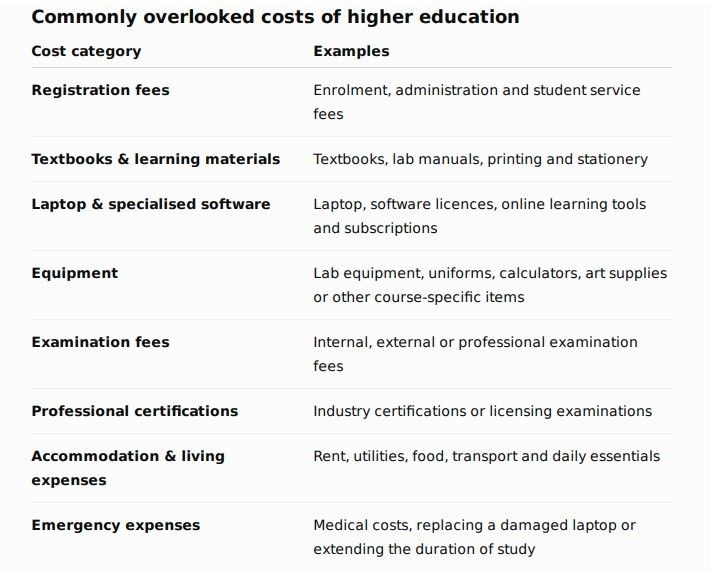
Financial risk strategist and Blueprint Planning International Sdn Bhd director Rajendaran Vairavan says many families often make the same mistake.
“Parents often underestimate the total cost of the education journey. They may plan for tuition fees, but overlook other expenses that come along the way,” he explains.
He advises preparing for the unexpected and recommends splitting education costs into four categories: Living expenses, one-off costs, tuition and academic fees as well as emergency and contingency funds.
“The goal is not to predict every expense perfectly. It is about being prepared enough so that unexpected costs do not create unnecessary financial stress,” says Rajendaran.
What better education means
A lower fee does not always mean a better choice, and a higher one doesn't guarantee better quality.
According to Loh, factors that influence the long-term value of a qualification include:
- Accreditation
- Teaching quality
- Industry partnerships
- Internships and practical learning opportunities
- Graduate outcomes
Programmes with specialised facilities, industry-standard equipment or extensive practical training may cost more because of the resources involved, but a higher price alone does not guarantee stronger career outcomes.
“Ultimately, there should be a focus on value rather than price alone. Cost is what a family pays today.
“Value is what that education can contribute to a person's future over the next few decades," says Rajendaran.
What are the ways to pay for higher education?
Families have several ways to manage costs, including scholarships, financial aid and education loans.
Both experts encourage researching these options early and understanding the financial commitments and repayment obligations involved.