
The world in which we live in today is changing rapidly.
Climate risks and nature loss are colliding with geopolitical uncertainties, energy transition dynamics and technological disruptions, resulting in a complex investment landscape.
As these forces directly impact markets, asset valuations and capital allocation, integrating ESG considerations into core operations and investment decision-making has become essential for long-term value creation.
This is the imperative guiding the ongoing sustainability journey of Permodalan Nasional Berhad (PNB), which is one of Malaysia’s largest asset managers with close to RM370bil in assets.
While upholding its fiduciary responsibility of an institutional investor in enhancing the economic wealth of the bumiputra community and all Malaysians, it introduced PNB’s sustainability framework and 10 ESG commitments in 2022.
Four years on, it has made measurable progress in translating these commitments into actions, and launched the next evolution: the PNB Sustainability Framework 2026.
At the centre of this approach is a clear directive: “Investing Responsibly, Empowering Generations”. This principle drives PNB’s effort to create sustainable long-term value through responsible investment, active stewardship, organisational sustainability and nation-building initiatives.
“At PNB, sustainability is ultimately about future-proofing value,” said PNB president and group chief executive Datuk Rizal Rickman Ramli.
“We operate in a world where climate change, resource constraints, technological disruption and shifting societal expectations are reshaping the way businesses grow and compete. As a long-term investor, we see these trends not only as risks to manage, but as opportunities to position ourselves and our investee companies for long-term success.”
What PNB has delivered
Since launching its sustainability framework in 2022, PNB has worked to translate its original 10 ESG commitments into actions across its operations, investments and stewardship activities.
One of the important milestones happened in 2025, when PNB attained its Net Zero Enterprise target for Scope 1 and Scope 2 emissions, while continuing to advance portfolio decarbonisation and responsible stewardship practices.
This reflects the effectiveness of PNB’s “Reduce, Replace, Offset” strategy, which prioritises emission reduction and operational efficiency. Replacement measures support transition to lower-emission operations, while offsets are considered for residual, hard-to-abate emissions.
As a long-term investor, the larger challenge is in the portfolio it holds. PNB has continued to build its exposure to green and transition assets, with RM8.1bil invested as at 2025, against an enhanced target of RM15bil by 2030.
The investments span listed equities, fixed income, private market and real estate.
These green investments allow PNB to tap into opportunities emerging from energy transition and climate change, helping PNB capture sustainable, long-term returns while staying disciplined on the risk-return expectations it holds its portfolio to.
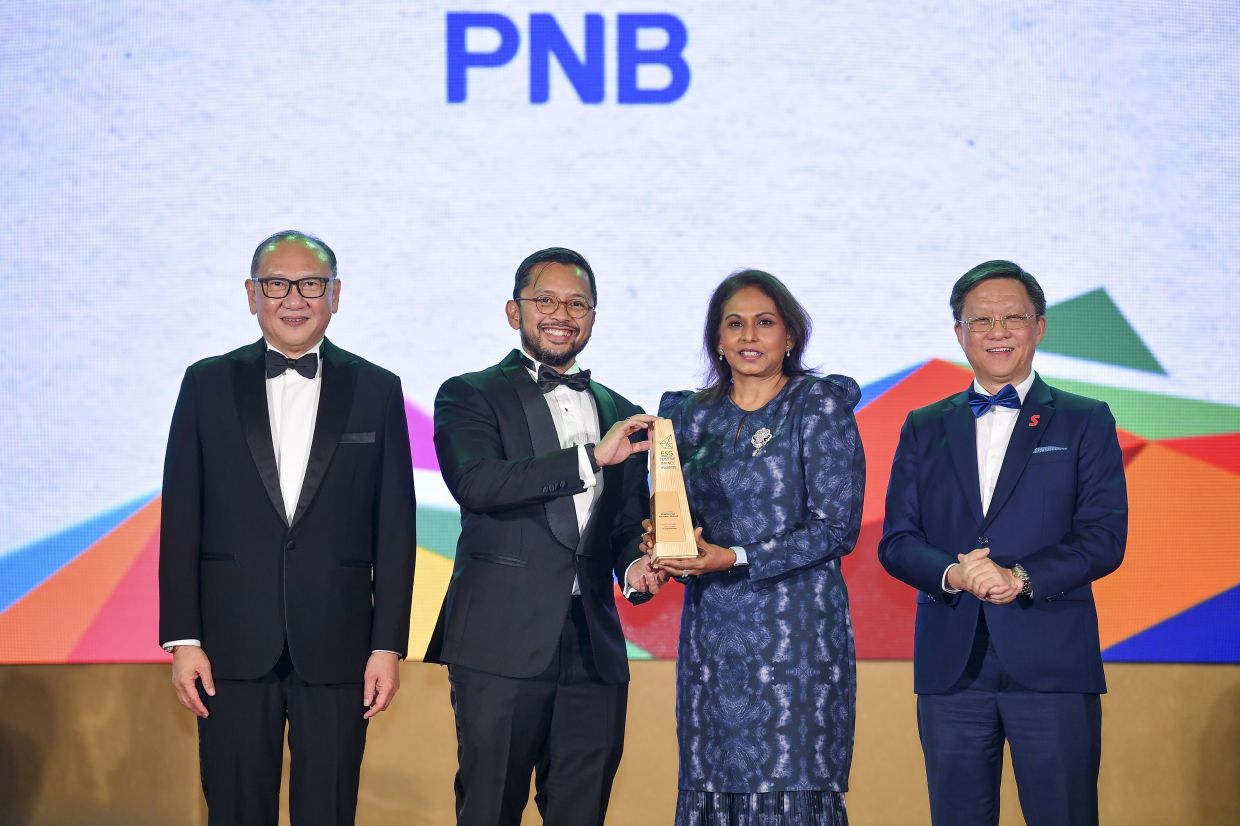
PNB’s progress has attracted international recognition. In the 2026 Global SWF Governance, Sustainability and Resilience (GSR) Scoreboard, PNB was ranked the highest Malaysian institution and joint fourth globally, rising from 17th globally in 2025.
Its overall GSR score was 88%, including a perfect 100% for sustainability.
These achievements are external validation of PNB’s sustained efforts, particularly in governance, transparency, sustainability integration, engagement with investee companies as well as climate, labour and biodiversity commitments.
Sustainability progress also extends beyond climate actions. Labour practices, fair compensation and broader social outcomes are becoming more material to investors and stakeholders.
Through active stewardship, PNB has strengthened engagement with investee companies on issues that can influence long-term business resilience and social outcomes.
An example is the GEAR-uP initiative, through which PNB encourages its strategic companies to formally commit to a living wage pledge anchored on the RM3,100 GEAR-uP benchmark.
This reflects a broader understanding that sustainable value creation encompasses workforce wellbeing, inclusive growth and nation building.
PNB Sustainability Framework 2026
Building on the 10 ESG commitments introduced in 2022, the PNB Sustainability Framework 2026 marks the next phase of PNB’s sustainability journey.
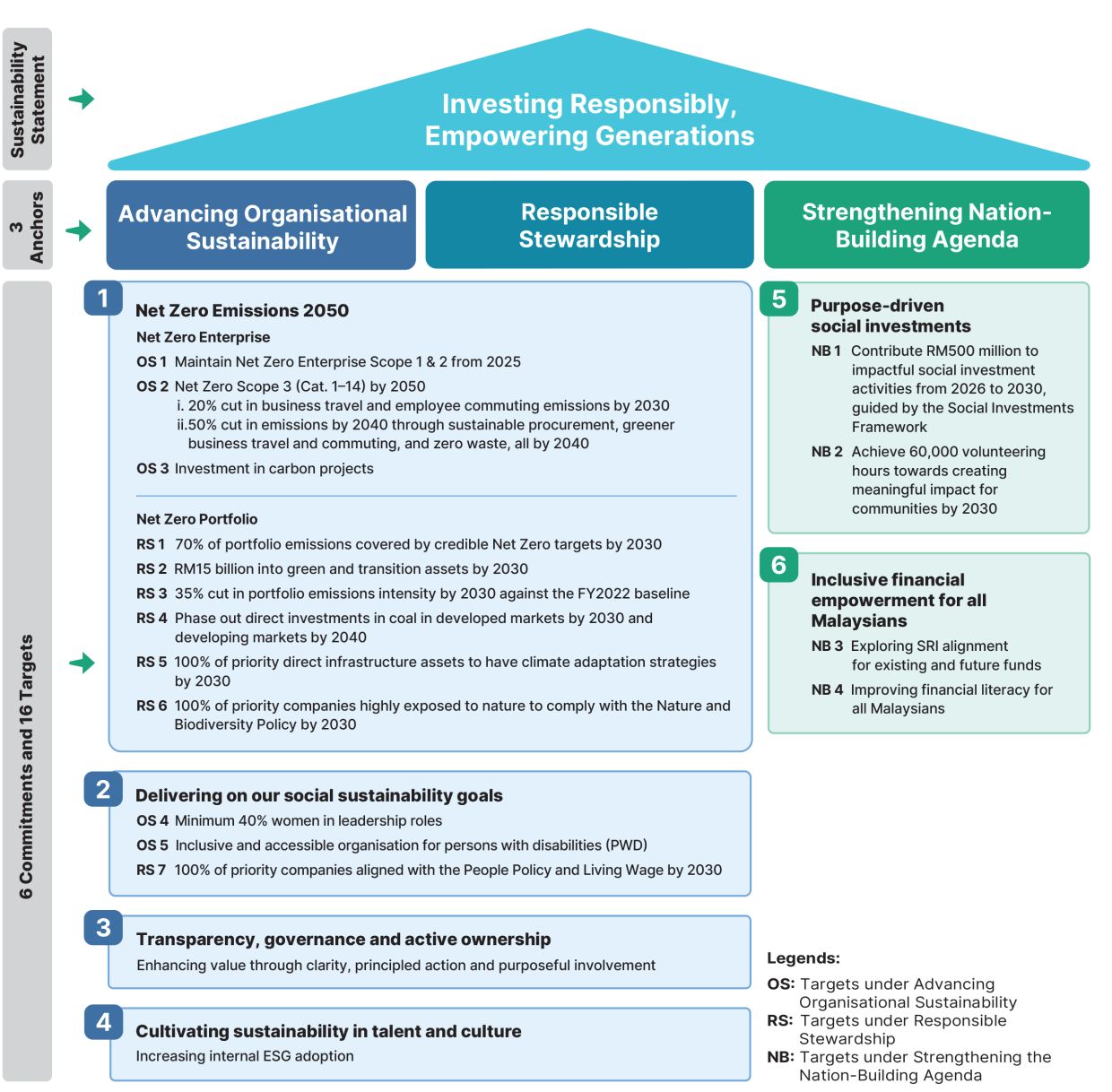
It brings PNB’s sustainability priorities under three strategic anchors – Advancing Organisational Sustainability, Responsible Stewardship and Strengthen Nation Building Agenda – supported by six commitments and 16 measurable targets, alongside relevant policies and guidelines.
Guided by the sustainability statement “Investing Responsibly, Empowering Generations”, this new framework strengthens the integration of ESG considerations across PNB’s investments, stewardship, operations, people and nation-building activities, while supporting the creation of sustainable long-term value for unitholders and broader Malaysian society.
Advancing organisational sustainability
The sustainability journey must begin at home.
PNB is working towards a more sustainable organisation by embedding environmental and social considerations into its operations, from the energy it consumes to the way employees travel, procure goods and manage waste.
Its ambition is to maintain Net Zero Enterprise Scope 1 and 2 emissions from 2025 onwards, while progressing towards net zero Scope 3 emissions across all relevant categories applicable to PNB by 2050.
This is a transition that requires changes in everyday behaviour as much as long-term strategies. By 2030, PNB aims to reduce emissions from business travel and employee commuting by 20%, progressing towards a 50% reduction by 2040.
Sustainable procurement, greener mobility and business travel, along a zero-waste ambition, will form part of this transformation.
PNB will also invest in carbon projects as it works towards its longer-term climate goals.
Recognising that a sustainable workplace must be one where different perspectives are valued and everyone has the opportunity to contribute, PNB aims to maintain at least 40% women in leadership roles, while working towards creating a workplace that is inclusive and accessible to persons with disabilities.
PNB will also strive to cultivate sustainability in talent and culture, equipping employees to make sustainable choices and understanding how their individual roles contribute to a larger purpose.
Responsible stewardship
As a long-term investor, PNB’s great opportunity to influence the transition to a more sustainable economy lies beyond its own operations.
Every investment carries consequences, and responsible stewardship is therefore about looking beyond immediate returns to understand long-term risks, opportunities and impact associated with the capital.
By 2030, PNB aims for 70% of portfolio emissions to be covered by credible net zero targets, while directing RM15bil into green and transition assets. It is also targeting a 35% reduction in portfolio emissions intensity against its FY2022 baseline.
While there will be new investment opportunities, the transition will inevitably require difficult choices. As part of its climate commitments, PNB will phase out direct investments in coal in developed markets by 2030 and developing markets by 2040.
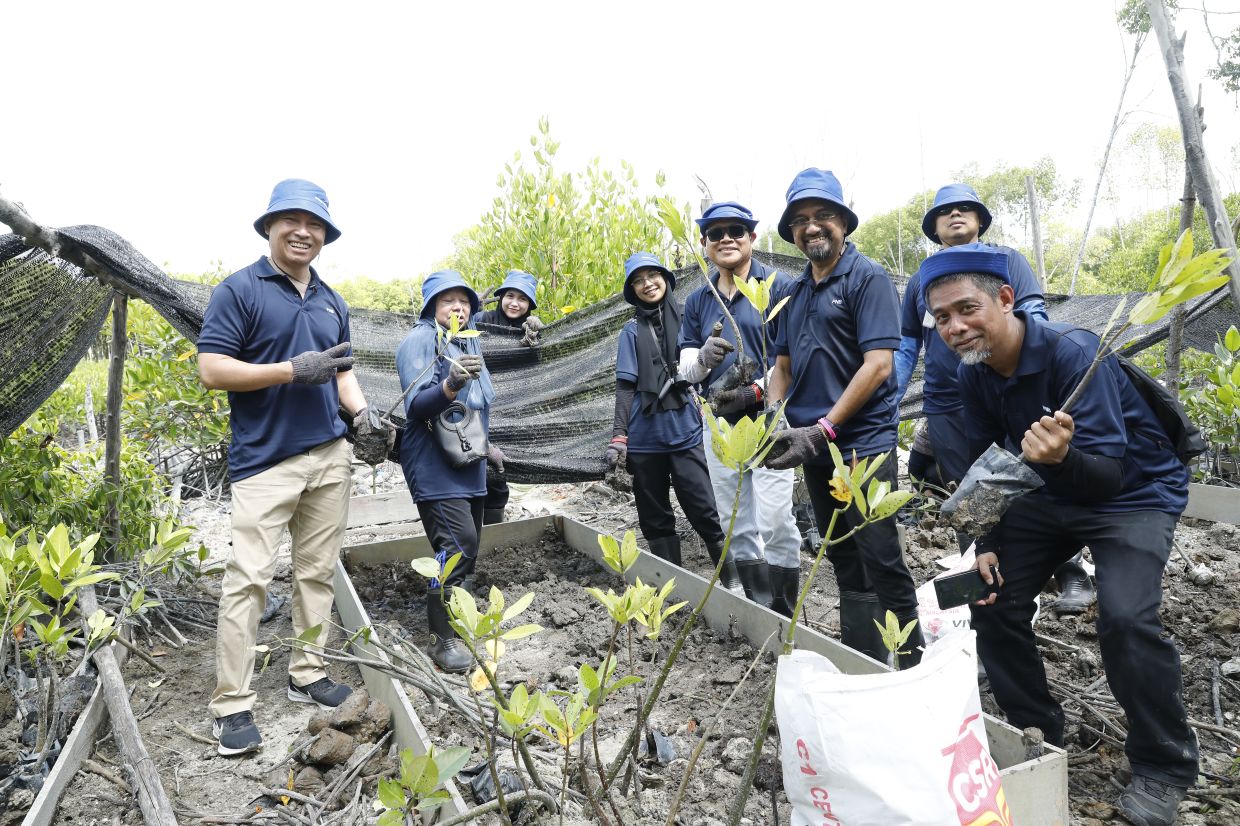
While the climate conversation expands, resilience, nature and biodiversity will become increasingly important to the long-term health of economies and investments.
By 2030, PNB aims for all priority direct infrastructure assets to have climate adaptation strategies, while priority companies highly exposed to nature will be expected to comply with its Nature and Biodiversity Policy.
People remain at the heart of this stewardship. To create value to employees, communities and other stakeholders, PNB will work towards having 100% of priority companies aligned with its People Policy and Living Wage by 2030.
Strengthening the nation building agenda
Through the third anchor Strengthening the Nation Building Agenda, PNB is taking a more purpose-driven approach to investment.
Between 2026 and 2030, it aims to contribute RM500mil to impactful social investment activities, guided by its Social Investments Framework.
Impact is not measured in ringgit alone. By 2030, it aims to achieve 60,000 volunteering hours, turning skills and action into tangible support for communities.
Meanwhile, financial empowerment is key for a nation to prosper, and people have to be armed with the knowledge and confidence to make informed financial decisions.
PNB will therefore explore sustainable and responsible investment alignment for existing and future funds, while continuing efforts to elevate financial literacy among Malaysians.
‘Investing Responsibly, Empowering Generations’
Through its sustainability statement “Investing Responsibly, Empowering Generations”, PNB is reinforcing its ambitions in responsible investment and its broader role in the society.
Its nationwide Sustainable & Responsible Investment (SRI) survey, running from Aug 10 to Dec 31, is an example of this approach. The survey seeks to understand the awareness, preferences and expectations of unitholders and retail investors around sustainable investing. It is intended to establish a baseline sustainability awareness and expectations dataset to guide PNB’s future ESG-aligned product design, investor education and SRI communication strategies.
This complements PNB’s support for the Financial Education network’s National Strategy for Financial Literacy 2026-2030 and Strategic Pillar 5 in particular, which focuses on strengthening financial education initiatives to increase adoption of digital and responsible investment products.
As financial literacy and sustainable investing become part of the same nation-building conversation, PNB is helping Malaysians understand that responsible investing and informed financial decisions is an important part of empowering future generations.
Moving forward
In the World Economic Forum’s Global Risks Report 2026, extreme weather events, biodiversity loss and ecosystem collapse, as well as critical change to Earth systems are among the top three long-term global risks.
Five out of 10 risk categories were dominated by environmental risks in a 10-year period.
These developments reinforce the understanding of sustainability as an essential component of risk management and long-term resilience.
As one of Malaysia’s largest asset managers with close to RM370bil in assets, PNB is operating in an environment increasingly shaped by climate risks, geopolitical uncertainty, energy transition dynamics and technological disruption.
“Our approach therefore goes beyond delivering financial returns,” Rizal said. “It is about building resilient businesses, supporting a more inclusive society and contributing to a stronger, more sustainable Malaysia.”
“Because long-term prosperity can only be achieved when economic growth, environmental responsibility and social progress move forward together,” he added.
PNB is the supporting partner of Asia ESG Summit 2026.