ALONG the nation’s coastline, a quiet superhero is at work: mangroves.
While often overlooked as just another part of nature, mangroves play a significant role in carbon sequestration and mitigating global warming.
Yet, despite their crucial role in absorbing and locking away carbon, protecting coastlines and supporting marine life, mangroves are vanishing.
According to the International Union for Conservation of Nature’s first global assessment for Red List Ecosystems, an estimated 50% of the world’s mangroves are at risk of collapsing by 2050, classed as either vulnerable, endangered or critically endangered.
Malaysia is no exception, as coastal development, land-use change and the growing impacts of climate change including sea-level rise and coastal erosion continue to put pressure on mangrove ecosystems.
In response, PETRONAS launched the Blue Carbon Collective (BCC) last year to not only protect but also better understand these ecosystems.
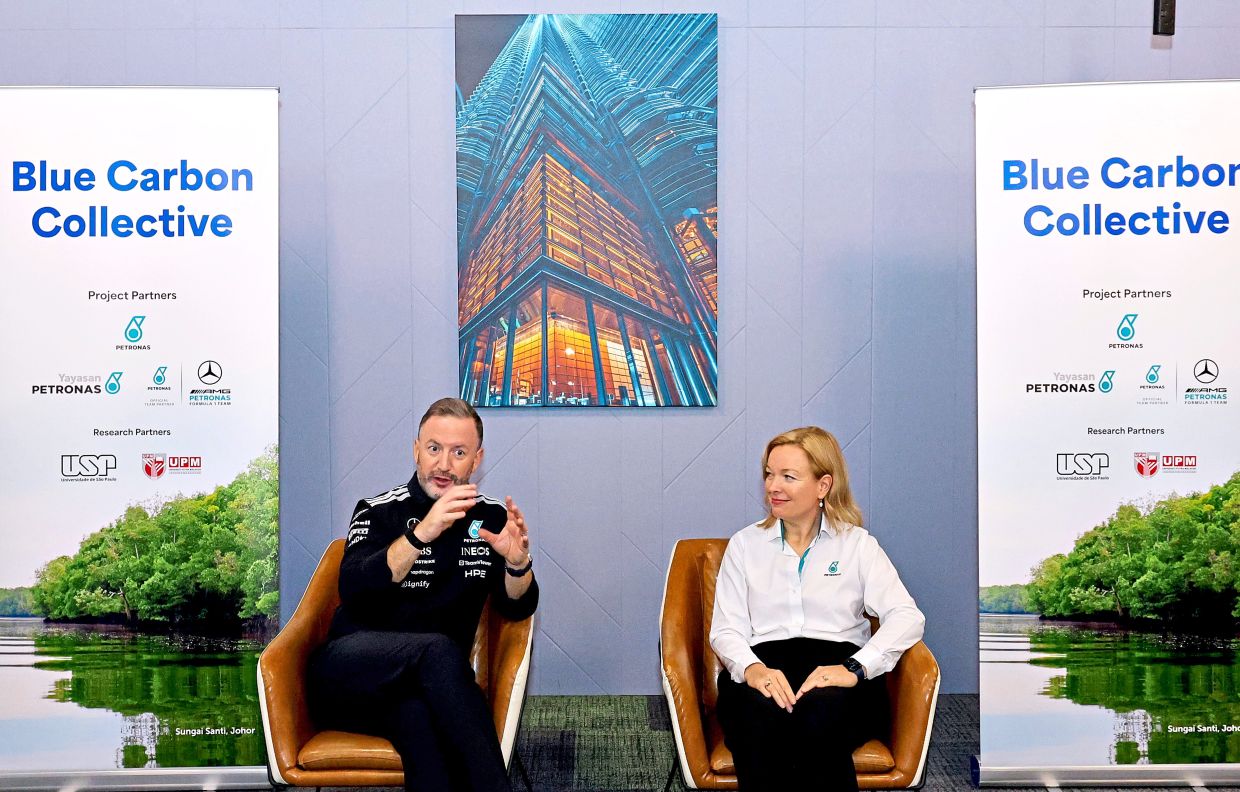
“Nature loss is real in the world, and here in Malaysia as well. BCC was launched because mangroves are vital blue carbon ecosystems that absorb and store carbon, protect coastlines from storms and erosion, and provide habitats for marine life,” said PETRONAS vice president and group chief sustainability officer Charlotte Wolff-Bye.
Developed as a South–South research initiative between Malaysia and Brazil, with the Mercedes-AMG PETRONAS Formula One (F1) Team supporting the research in Malaysia, the collaboration aims to advance research and knowledge exchange on how mangrove ecosystems absorb and store carbon.
Why mangroves matter
Blue carbon is the carbon captured and stored by marine and coastal ecosystems, notably mangroves, seagrass meadows and tidal marshes.
Blue carbon ecosystems, such as mangroves, have the potential to sequester and store more carbon dioxide than tropical forests, which is why they are crucial to the environment.
Wolff-Bye said that BCC forms part of the organisation’s commitment under the “Thriving with Nature” framework that shapes its broader strategy and net-zero carbon emissions objectives.
“This initiative is very important to us, because you can’t address climate change on its own – you have to address it as a whole and the biodiversity that it entails,” she said.
“Mangroves are true ‘superheroes’: they absorb carbon, shield coastlines from storms and large waves, and provide breeding grounds and habitats for fish, crabs, birds and other wildlife.”
That conviction also reflects PETRONAS’ broader Thriving with Nature ambition, which recognises that protecting and rehabilitating ecosystems cannot be achieved by any organisation acting alone.
Rather than working in isolation, BCC brings together partners whose capabilities and expertise complement one another.
“You can’t do it on your own – you have to partner and complement each other’s knowledge, know-how and resources,” she said.
Two continents, one shared challenge
At the heart of PETRONAS’ approach is a research partnership that spans two tropical nations – Malaysia and Brazil.
Together, the two nations are home to roughly 14% of the world’s mangroves, making them natural counterparts for studying how these ecosystems behave and how much carbon they can hold.
To explore this further, PETRONAS brought together Universiti Putra Malaysia (UPM) and the University of São Paulo, two institutions with expertise in mangrove research.
UPM conducts fieldwork in Johor’s Sungai Santi Forest Reserve using methodologies established in Brazil, while the broader research examines how land-use changes affect mangrove ecosystems, how carbon is stabilised and how soil quality is assessed.
“We wanted to conduct comparative studies on mangroves and their blue carbon sequestration capacity across these two mangrove ecosystems,” said Wolff-Bye.
“The partnership is strong, and the research is already delivering promising results.”
Science alone, however, will not keep mangroves standing.
Working alongside the universities in this initiative is Yayasan PETRONAS, which has experience working with local communities across the country and brings this perspective to the on-the-ground rehabilitation of these ecosystems.
BCC includes the foundation’s One Million Trees initiative, which will see 100,000 mangrove trees planted in the Sungai Santi Forest Reserve in Johor to rehabilitate degraded areas.
The foundation has already planted over 60,000 trees and the survival rate is around 86%.
PETRONAS group strategic relations and communications vice president Norafizal Mat Saad highlighted the local communities’ active role in the initiative.
“BCC reflects PETRONAS’ belief that lasting outcomes are best achieved through collaboration. Local communities are our partners in conservation, enabling us to combine local knowledge with scientific expertise to strengthen conservation results and support effective ecosystem management.
“This creates opportunities for two-way knowledge-sharing, increased awareness of environmental challenges and a deeper appreciation of the importance of protecting these ecosystems,” said Norafizal, who is also a member of the Yayasan PETRONAS Board of Trustees.
Beyond the research sites, BCC is also helping to bring these important conversations closer to the public.
Through a six-month exhibition at Petrosains, The Discovery Centre, visitors can explore the role of mangroves in climate resilience, learn about blue carbon and discover the collaborative research and rehabilitation efforts taking place under the initiative.
Racing meets rehabilitation
The final piece of the collective is one few would expect to find beside a mangrove forest – an F1 team.
“What’s so great about the Mercedes-AMG PETRONAS F1 team is that we have been partners with PETRONAS for a long time, and we share many objectives on and off the track, which include addressing climate change and nature loss,” said Wolff-Bye.
For the F1 team, that sentiment runs both ways. Mercedes-AMG PETRONAS F1 deputy team principal Bradley Lord explained that the longstanding partnership reflects the sport’s natural evolution into promoting more sustainable technologies to address climate impact.
“Sustainability is not a project or topic that can be addressed in isolation. As a team, we are very conscious that we need to be responsible for our impact on the world,” he said.
“Part of that holistic view is also understanding how the world around us is changing, and what we can do to help address and understand some of those changes, and build greater resilience, particularly in the environments in which we race.”
He also noted the positive impact that sustainable technologies can have on F1, pointing to the introduction of new-generation hybrid power units this year and the advancements in sustainable fuels, particularly PETRONAS’ Advanced Sustainable Fuel (ASF).
“The hybrid power units that we race are roughly a 50-50 split between electric and combustion power.
“We’ve demonstrated as a sport that more sustainable racing cars can also provide exciting racing. So, it’s not a trade-off between ‘sustainable’ and ‘fun’ – you can combine the two.”
That same spirit of experimentation and innovation now extends to the mangroves. Having described F1 as the “fastest laboratory in the world”, the Mercedes-AMG PETRONAS F1 team sees BCC as its natural complement.
“What’s lovely about this project is that we’ve created a ‘living laboratory’ in Johor that is advancing cutting-edge research and understanding about these habitats,” said Lord.
“There is a really nice parallel between how we develop technology on track, and then this living laboratory that is at the heart of the research as well.”
Beyond shared values, the team brings something research alone cannot – reach.
With a global fanbase and a calendar that includes several of the world’s most important mangrove regions, F1 is well placed to carry the BCC’s story far beyond its two partner countries.
“A number of the world’s most important mangrove areas are also destinations on the F1 calendar, so it’s a brilliant fit for our global footprint,” said Lord.
“What we can bring is the visibility of the F1 team, and the platform that creates new ways of talking about the project and raising awareness of it to build further interest.”
The hope is that the work will not remain confined to Malaysia and Brazil, but be adopted in other regions too.
That ambition is ultimately what sets the BCC apart. Its partners want it to serve as a model for cross-continent collaboration and show that positive change is possible when science, industry and communities pull in the same direction.
For the mangroves of Malaysia, and those much further afield, that cannot come soon enough.