




GLOBAL supply chains face mounting pressure from shifting geopolitical forces and escalating tariff tensions — placing Asean at a crucial inflection point.
Within this evolving landscape, Malaysia is strategically positioning itself through the National Semiconductor Strategy (NSS) to contribute meaningfully to regional integration and innovation.
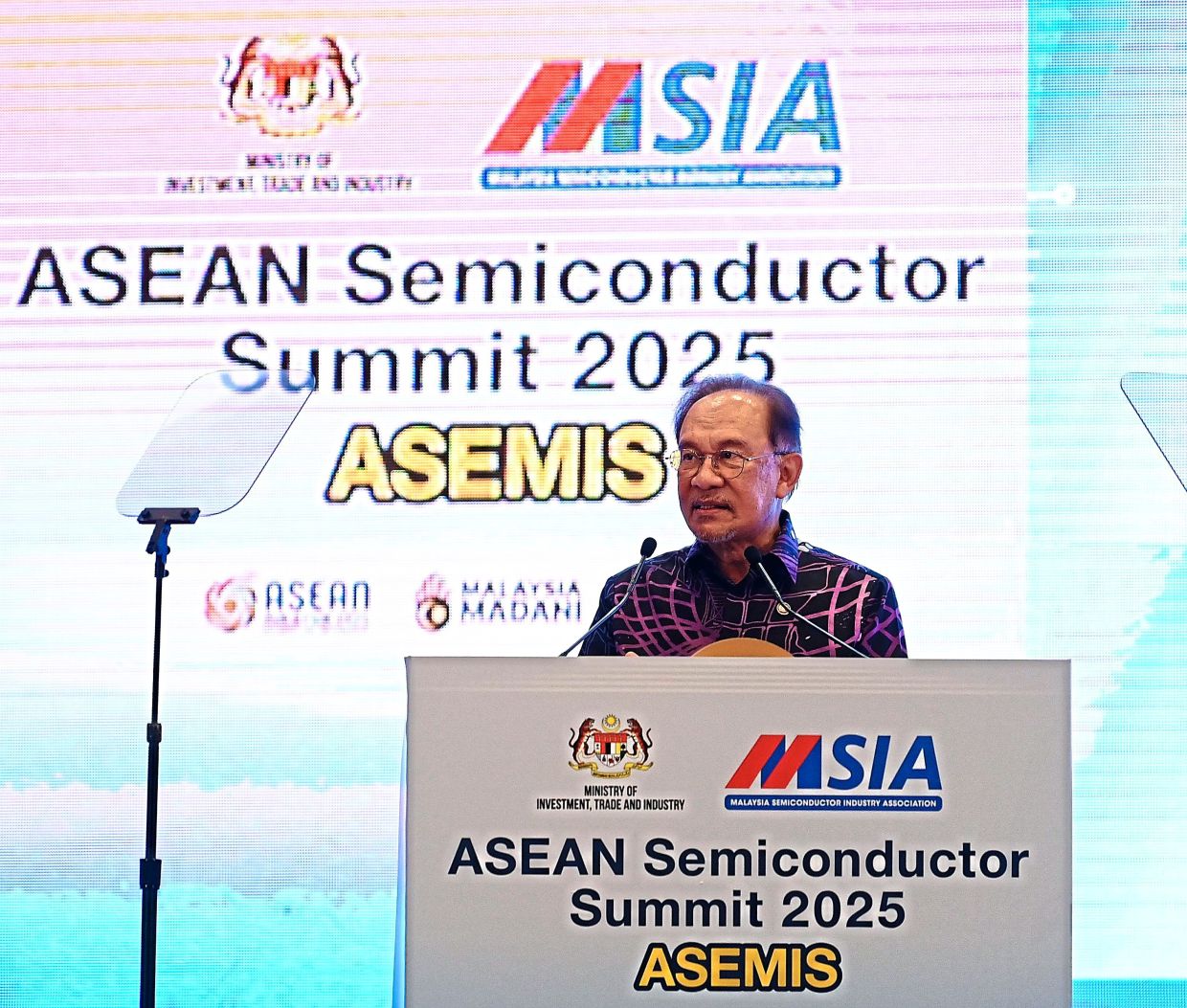
At the Asean Semiconductor Summit (ASEMIS) 2025, about 500 policymakers, analysts, economists, sovereign fund representatives and industry leaders gathered to discuss how Asean can respond to global trade shifts and build a united, resilient and competitive semiconductor ecosystem.
Held on July 24 at One World Hotel, Petaling Jaya, the summit — themed “Shaping the future of Asean’s semiconductor industry” — focused on strengthening Asean’s role as a global hub for semiconductor manufacturing, innovation and technological security.
Strategic ambition
Prime Minister Datuk Seri Anwar Ibrahim, in his keynote address, reaffirmed Malaysia’s ambition to move beyond its traditional role as an assembly and testing hub.
“Our journey in the semiconductor sector began over 50 years ago, with Intel opening its first overseas production in Penang. Today, we are an indispensable node in the global semiconductor supply chain. But the NSS is not about staying where we are – it’s about moving forward, capturing more value through research and development, integrated circuit (IC) design and advanced manufacturing.”
Anwar emphasised a mindset shift from “Made in Malaysia” to “Made by Malaysia” products, highlighting the need for deeper regional collaboration and greater self-reliance through the development of homegrown champions.
“We had a series of discussions with our Asean partners on how to utilise this experience and work together to benefit our region.” He explained that the immediate focus is to deliver the “10+100” target. “This means building 10 Malaysian semiconductor and supply chain companies with revenues between RM1bil and RM4.7bil and nurturing at least 100 more to approach the RM1bil mark. These companies will not only export Malaysian products to the world but also bring our knowledge, value creation and talent into Asean – and together with Asean – to the global markets. They will be our flag-bearers abroad, rooted at home.”
This vision is already supported by tangible progress under the NSS: RM63bil in investments, 13 local companies emerging as potential national champions and initiatives to train 60,000 engineers by 2030.
National asset
Investment, Trade and Industry Minister Tengku Datuk Seri Zafrul Abdul Aziz shared how the NSS has quickly become the backbone of Malaysia’s economic transformation. In 2024 alone, semiconductors contributed RM313bil in exports – more than 20% of the nation’s total. Despite global volatility, semiconductor exports grew by 15.7% in the first half of 2025, outpacing overall export performance.
“By harmonising policies, fostering talent mobility and attracting strategic investments, we can enhance Asean’s competitiveness via a robust and truly integrated regional semiconductor ecosystem supply chain that benefits all our peoples.
“We must continue to act decisively to capture this once-in-a-generation opportunity to secure long-term economic resilience and technological leadership.” He described the semiconductor industry as a strategic national asset and a cornerstone of Malaysia’s ambition to lead in innovation, trade and shared prosperity.
He further highlighted the cascading economic benefits of the electrical and electronic (E&E) industry, which supports over 1.5 million jobs directly and indirectly, generated more than RM4.9 trillion in economic output last year, and drives growth across Penang, Selangor, Kedah, Negeri Sembilan, Perak and Sarawak – lifting nearly 1,000 small and medium enterprises.
Malaysia Semiconductor Industry Association (MSIA) president Datuk Seri Wong Siew Hai, in his welcome address, shared that the inaugural summit – hosted during Malaysia’s Asean chairmanship – is aimed at defining the bloc’s collective ambition in the global semiconductor and E&E value chain.
“We must rise from being the factory of the world to becoming the brain of the value chain.
“We must think big, act boldly, and collaborate deeply. Asean can become not just a part of the trillion-dollar future - but an architect of it.”
Collective challenge
The panel discussion, “Navigating Geopolitical Headwinds: Government strategies to strengthen Asean’s semiconductor supply chain,” moderated by former Deputy International Trade and Industry Minister and Malaysian Investment Development Authority (MIDA) board member Prof Dr Ong Kian Ming, highlighted both the complexities and opportunities surrounding regional coordination. As the United States (US) reimposes tariffs under a new administration, Asean nations find themselves balancing national interests with the need for collective resilience.
Panellist Maria Monica Wihardja, visiting fellow and coordinator of the Media, Technology and Society Programme at the ISEAS–Yusof Ishak Institute, pointed to Asean’s structural challenge – diverse economies with differing stakes in US trade relations.
“This is a coordination issue. In an ideal world, Asean would have its own approach to counter the US reciprocal tariffs. But it’s difficult to imagine, as member countries come from different starting points and have varying stakes in their negotiations with the US.”
Fellow panellist and Economic Research Institute for Asean and East Asia (ERIA) president Tetsuya Watanabe cited the Asean Framework for Integrated Semiconductor Supply Chain (AFISS) and the Asean Geoeconomics Task Force as concrete steps in the right direction.
“Asean’s response in establishing the task force is remarkable. Asean member states are committed to collectively promoting regional integration, using this crisis as an opportunity to strengthen resilience and move toward a single market in the long term future. The AFISS offers a good policy framework to complement one another in advancing Asean’s vision as a regional hub for semiconductor manufacturing.”
Regional catalyst
As co-chair of the Asean Geoeconomics Task Force, Deputy Investment, Trade and Industry Minister Liew Chin Tong emphasised Malaysia’s leadership in shaping policy alignments that serve the region.
“We must reframe how we think about wages, foreign direct investment and regional integration. It’s time for us to build Asean multinationals that can drive innovation and industrialisation.” As a panellist, Liew also stressed the need for horizontal integration – linking the semiconductor industry across sectors like automotive, defence, medical technology and data infrastructure.
With the right strategy, both Malaysia and Asean can shift from being production sites to becoming growth markets in their own right.
In his opening remarks at ASEMIS 2025, Liew noted that Malaysia has long been an integral part of the global semiconductor ecosystem and is home to over 5,000 companies in the E&E sector, including seven of the world’s top 10 semiconductor companies.
Panellist Norjamin Gallardo-Delos Reyes, commercial counsellor at the Philippine Trade and Investment Center, reminded participants that each Asean economy brings unique strengths to the table. “Each Asean economy brings its own strengths, whether it be advanced packaging, design, or emerging tech capabilities. Let us make sure that we complement and integrate – and ensure that no one is left behind.”
Fellow panellist Narit Therdsteerasukdi, secretary-general of Thailand’s Board of Investment, highlighted how cross-sector synergies – between the bio-circular and green industry, electric vehicles and key components, semiconductors and advanced electronics, digital industry and international business centres – are driving Thailand’s transformation.
“Semiconductors are key to supplying many industries, including electric vehicles, medical devices, electronic devices and even survival appliances.”
He also cited Thailand’s goal of training at least 80,000 talents for the semiconductor sector. This includes collaborations with seven leading companies, 15 local universities and the establishment of three national semiconductor training centres in partnership with foreign universities.“Collaboration between Asean members for talent development is very important.”
Talent and technology
Talent development is central to Malaysia’s NSS. Both Anwar and Tengku Zafrul emphasised the urgency of closing the global engineering talent gap.
More than 13,000 high-skilled workers have been trained under initiatives led by Collaborative Research in Engineering, Science and Technology (CREST) and Talent Corporation Malaysia Bhd (TalentCorp).
In addition, the Investment, Trade and Industry Ministry (Miti) has also implemented programmes to strengthen the semiconductor value chain.
Tengku Zafrul highlighted that the involvement of global multinational companies (MNCs) is creating important stepping stones to anchor Malaysia as a competitive semiconductor R&D hub and co-development partner for MNCs.
Tengku Zafrul also congratulated the MSIA, Singapore Semiconductor Industry Association (SSIA), Semiconductor and Electronics Industries in the Philippines Foundation Inc (SEIPI), Thai Semiconductor Industry Trade Association (THSIA) and Vietnam Electronic Industries Association (VEIA) on signing a Memorandum of Understanding during the summit. This, he said, is a significant step towards fostering a more integrated and robust Asean semiconductor ecosystem.
There was also an exchange of MoUs between CREST and Human Resource Development Corporation (HRD Corp) – an essential talent partnership under the NSS. The initiative forms part of a broader national effort to contribute towards the goal of upskilling 60,000 engineers by 2030.


