



The global consensus reached at COP28 on the urgent need to transition away from fossil fuels to cleaner energy systems has sparked interest among governments and businesses in present, emerging, and advanced sources of clean energy to reach the Paris Agreement target.
The call for an acceleration of the deployment of clean energy, including nuclear power, as part of the COP28 negotiated outcome/First Global Stocktake, was a testament to the increasing recognition that nuclear has a key role to play in clean energy transitions.
This marks the first time nuclear energy has been formally specified as one of the solutions to climate change in a COP agreement, with World Nuclear Association Director General Sama Bilbao y León remarking that "This marks a 180° turn-around in the treatment of nuclear energy in the COP process, from the lone technology excluded from the Kyoto Protocol mechanisms to COP28's inclusion among a range of zero and low-emissions technologies."
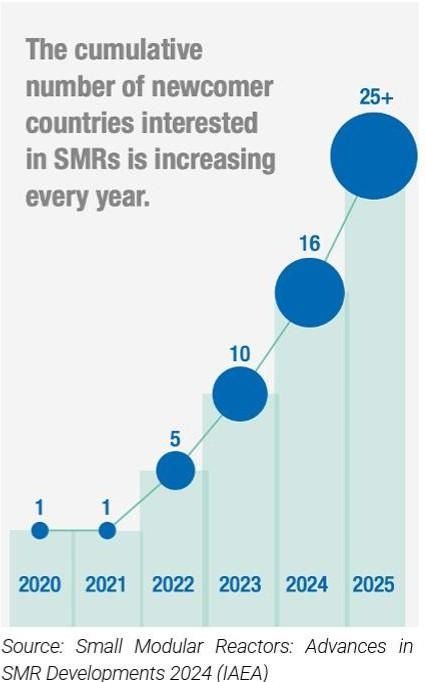
Emerging and advanced technologies, including small modular reactors (SMRs), are presently and widely promoted as key solutions to assist in decarbonising energy systems to reach net-zero whilst also meeting rapidly growing electricity demand, and are garnering increasing interest from governments (Fig 1), utilities, and tech giants.
The International Atomic Energy Agency has reported that as of 2024, governments from 25 countries are exploring SMRs.
Fig 1: The cumulative number of newcomer countries interested in SMRs is increasing every year
Nuclear Energy is Central to Southeast Asia's energy conversation
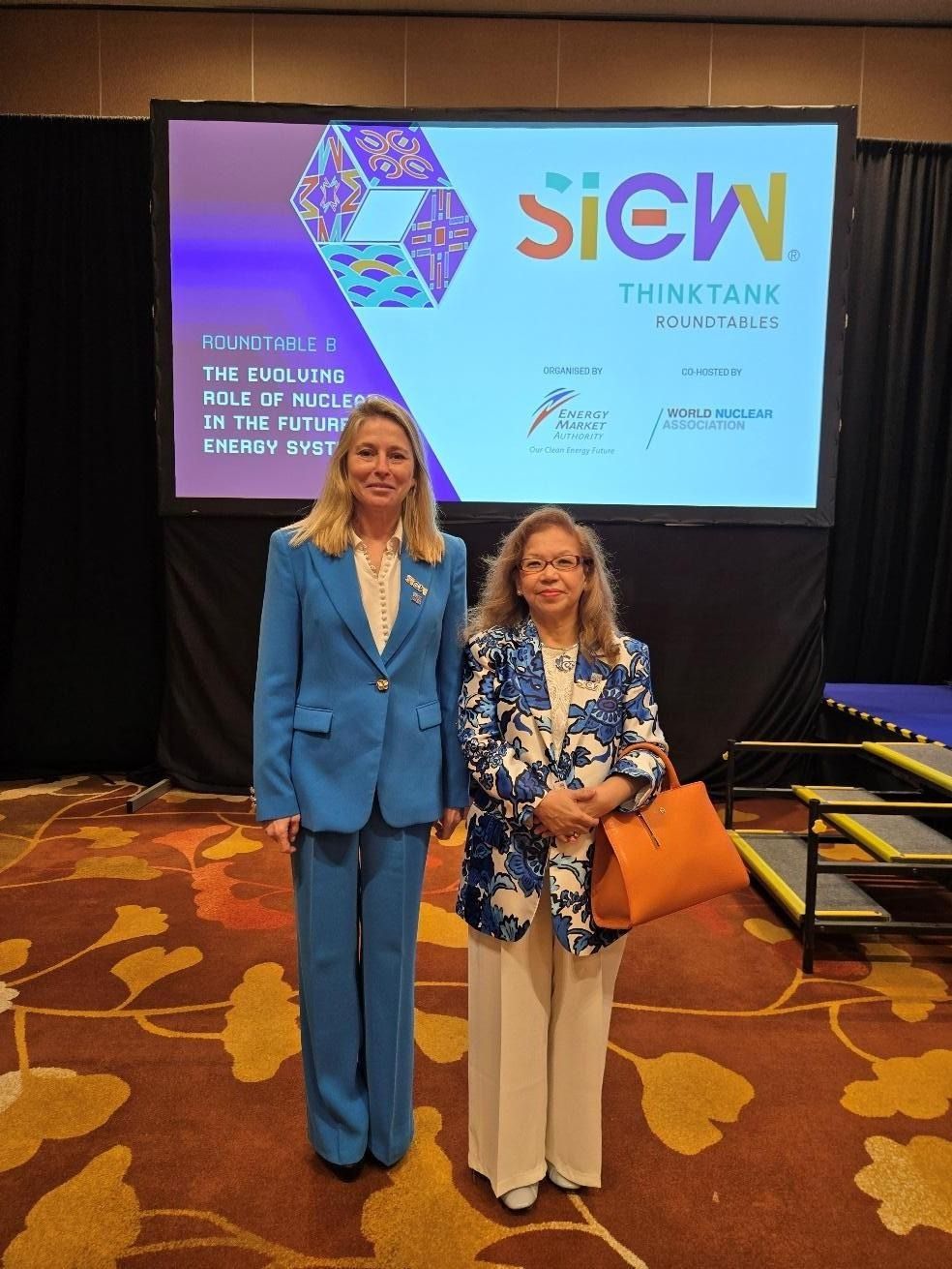
At the Singapore International Energy Week 2025 (SIEW2025), WNA Director General Dr. Sama Bilbao y León stated that nuclear energy is now central to Southeast Asia's energy conversation, with many ASEAN countries viewing it as an essential component for providing 24/7, affordable, and clean electricity. She further noted that Asia is projected to account for 30% of the global nuclear share by 2030, with growing interest in small modular reactors (SMRs) to meet power needs and decarbonise heavy industry (Fig 2).
Fig 2: Ms Sheriffah had the honour and pleasure of meeting the World Nuclear Association (WNA) Director General Sama Bilbao y León at SIEW2025, who was also the moderator of the RoundTable Think Tank on Nuclear Power, of which Sheriffah was one of the panellists.
SMR Developers and Vendors are making efforts to improve the safety, economic efficiency, and modularity of their products
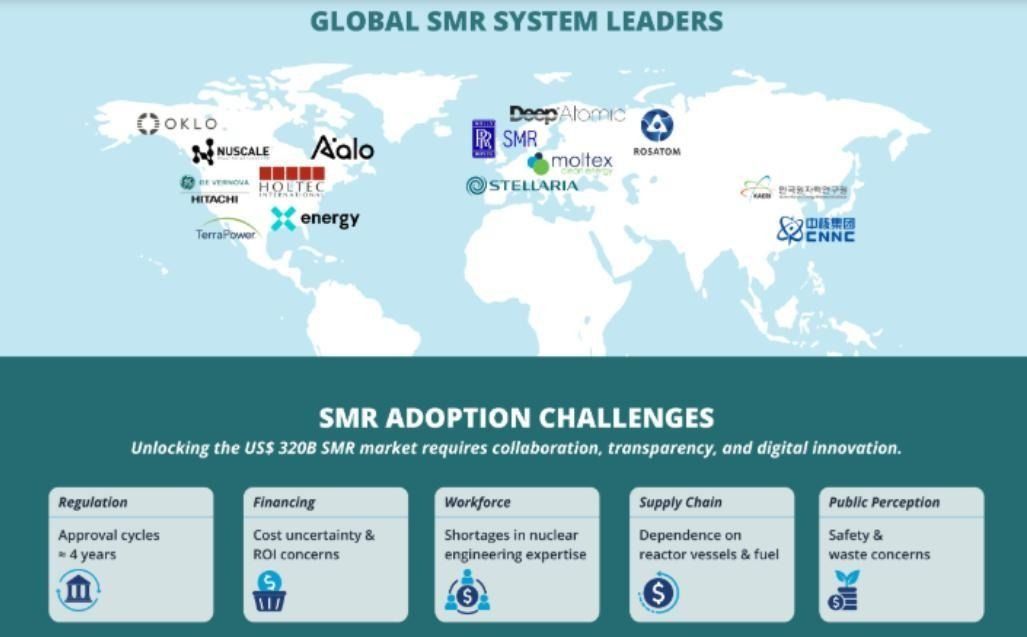
ABI reported that many SMR vendors are making efforts to improve the safety, economic efficiency, and modularity of their products, with several vendors, including GE Vernova Hitachi Energy, NuScale, Rolls-Royce, Holtec, Oklo, and X-energy investing billions of dollars into constructing SMRs across North America and Europe over the next decade. (Fig 3)
Fig 3: Global SMR System Leaders
ABI Research
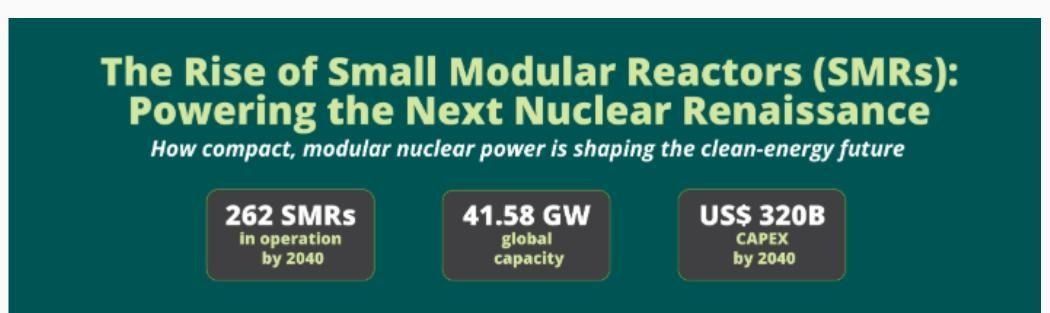
According to ABI Research, the cumulative Capital Expenditure (CAPEX) on SMR construction is projected to exceed US$320bil between 2025 and 2040. (Fig 4)
Fig 4: The Rise of Small Modular Reactors (SMRs)
Source: ABI
Growing Consensus
There is a growing consensus and support for SMRs as a viable option for meeting net-zero emissions, with intense interest , enthusiasm and investment from government, utilities and technology companies.
Relying on nuclear energy, including SMRs, is one strategy for Big Tech companies to avoid reneging on their net-zero carbon goals as they simultaneously scale up power-hungry AI. In March 2024,
Utility Dive estimated that the U.S. had nearly 4 gigawatts (GW) of publicly announced SMR projects, as well as nearly 3 GW of projects in early development.
Skepticism is abound too regarding SMRs ability to deliver on its promise
Whilst there is growing interest and enthusiasm regarding SMRs as a potential clean energy source, there is also increasing scepticism regarding SMRs' ability to deliver on their promise.
Projected Attributes of SMRS and Cause for Caution
Proponents and advocates of SMRs have claimed that, vis-à-vis conventional larger nuclear reactors, SMRs are faster to build, cheaper (cost-effective), require less capital investment, have a smaller footprint, and are safer; significant attributes and compelling factors for interest and investment.
However, with only 2 recently commercially operating SMRs worldwide, one in Russia and the other in China, several groups have argued that these claims are speculative at best. Recent experiences with SMRs that were aborted or abandoned, as well as current operating SMRs that have experienced delayed construction schedules resulting in escalated costs, suggest otherwise.
Additionally, many of the challenges facing conventional nuclear power, including lengthy licensing processes, high upfront costs, constrained fuel supply chains, and unresolved waste management, remain just as relevant for SMRs.
Aborted and Abandoned SMR Projects
Energy Intelligence reported on 17 November 2023 that the collapse of the US Department of Energy’s (DOE) flagship small modular reactor (SMR) project – Babcock & Wilcox "mPower" design, which received the agency’s first SMR funding in 2012 and was regarded as the industry leader in SMRs, but collapsed in 2017 – and NuScale Power’s SMR project in the Idaho Carbon Free Power Project (CFPP) with the Utah Associated Municipal Power Systems (UAMPS), funded in 2013 but terminated in November, should serve as a cautionary tale to SMR developers everywhere.
In the latter case, NuScale and its primary customer, Utah Associated Municipal Power Systems (UAMPS), a nonprofit electricity wholesaler with 50 utility members across seven Western states, couldn’t generate enough interest among the utilities to keep the project going, in light of the target price of power from the proposed 462-megawatt plant, consisting of six 77 MW reactor modules, which stood at $58 per megawatt hour; but then rose to $89/MWh, a 53% increase
Current Commercially Operating SMRs-Russia’s FNPP , China’s HTGR and Argentina’s CAREM 25
- Their Construction period and Cost
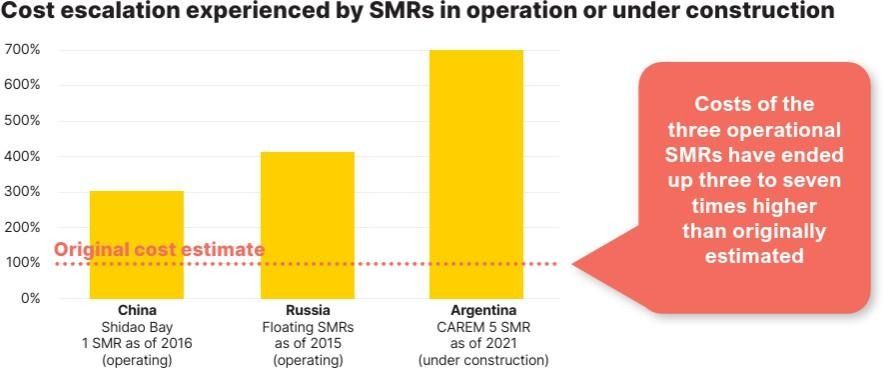
The Institute for Energy Economics and Financial Analysis (IEEFA) has reported that there are currently three operating SMRs worldwide – two in Russia and one in China – with a fourth under construction in Argentina. Costs for all four have been three to seven times higher than originally expected.
Additionally the IEEFA had dovetailed that
Russia’s Floating Nuclear Power Plant (FNPP)
The World Nuclear Industry Status Report 2021 (WNISR 2021) highlighted the case of the twin “floating” reactors Akademik Lomonosov, small 30-MW reactors intended to demonstrate a precursor to a new generation of Small Modular Reactors (SMRs), smaller, cheaper, and faster to build. However, construction took about four times as long as originally projected. A little before construction of the ship began in 2007, Rosatom announced that the plant would begin operating in October 2010, but it finally began operating in December 2019.
Power Magazine on 1 July 2015 reported that the costs for the Akademik Lomonosov, Russia’s flagship floating nuclear power plant, have reportedly mushroomed to 37 billion rubles ($700 million), an increase of more than 300% from the original 2006 estimate of nine billion rubles ($170 million) (Fig 5).
WNISR 2021 reported that, in terms of cost, the “nuclear barge” has become more expensive, rising from an initial estimate of around 6 billion rubles (US$2007232 million) to at least 37 billion rubles as of 2015 (US$2015740 million), or close to US$25,000 per installed kilowatt, almost twice as costly as the most expensive Generation III reactors.
China’s demonstration twin-reactor high-temperature gas-cooled reactor (HTGR)
The World Nuclear Industry Status Report 2021 noted that the other operating SMR – loosely defined – is China’s demonstration twin-reactor high-temperature gas-cooled reactor (HTGR). The World Nuclear Association states that the cost of the demonstration HTGR was $6,000 per kilowatt, three times higher than early cost estimates and two to three times higher than the cost of China’s larger Hualong reactors per kilowatt (Fig 5).
Additionally, NucNet reported in 2020 that China dropped plans to manufacture 20 HTGRs after levelised cost estimates rose to levels higher than those of conventional large reactors.
Argentina’s CAREM 25 SMR
Geopolitical Monitor reported on 1 July 2025 that the Argentine-designed CAREM-25 (Central Argentina de Elementos Modulares -25) 32Mwe SMR, which began construction in 2014 with completion aimed for 2017, was meant to herald an Argentine nuclear renaissance and increase Argentina’s nuclear power generation. By 2023, it had reached only 85% completion, and in early 2024, 470 engineers were laid off due to Milei’s 54% budget cuts to nuclear projects.
NucNet highlighted that CAREM-25, estimated at approximately $63 million USD (originally expressed in ARS) in 2014, is now targeted for first criticality around 2028, with the total projected cost rising to $446 million USD, over 600% from the initial estimates.
Fig 5 Cost escalation experienced by SMRs in operation or under construction
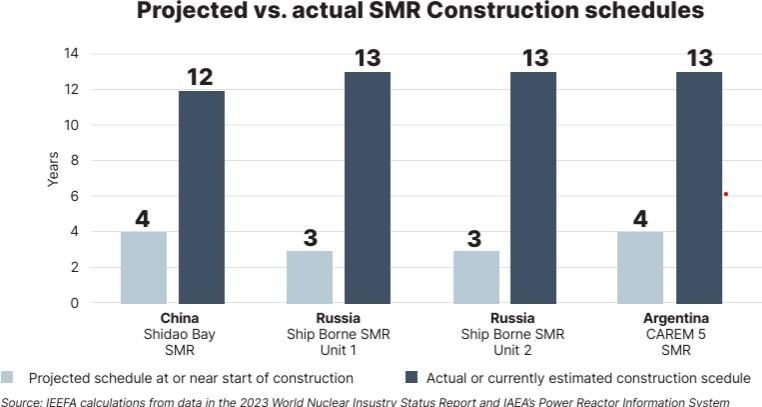
In terms of construction period, the Institute for Energy Economics and Financial Analysis (IEEFA) noted that, based on results in Russia, China and Argentina, long construction delays have been the norm, not the exception. Not one of these SMRs has come close to meeting its projected three- to four-year construction schedule, instead taking (or estimated to take) 12-13 years (Fig 6). The construction schedule is the time it takes from the first concrete pour, which in turn can take place only after years of planning, contracting and pre-construction works.
Fig 6: Projected vs actual SMR Construction schedules
The Path to Commercial viability is still riddled with uncertainty
According to the OECD Nuclear Energy Agency, however, the attractive features of SMRs rely on a business case that requires the development of a global SMR market to become economically viable.
Large-scale deployment of SMRs faces several technical, economic, regulatory and supply chain challenges and will require considerable government efforts and efficient international collaborative frameworks to be realised in the next decade.
Additionally, as the IAEA has reported, there are 80 SMRs, with many designs still under development, and many envisage that SMRs are highly unlikely to achieve manufacturing economies of scale due to the sheer number of competing technologies.
Furthermore, Geopolitical Intelligence Services AG (GIS) has underscored that most SMR designs are unproven at scale, and the full economic, regulatory and operational implications will only become clear after broader deployment.
Recommendations to the Government of Malaysia
Given the track record of abandoned SMR projects and the expanded construction schedules that have led to cost escalation for currently operating SMRs, it is imperative that the Government of Malaysia and the private energy sector recognise both the advantages and disadvantages of SMRs before committing to final plans for selection and investment.
A thorough review and comparison of the proven safety and financial track record of SMRs, alongside other key parameters, versus conventional larger nuclear power plants should be conducted to enable the Malaysian Government to decide on the preferred nuclear power reactor design and capacity as the best and safest investment choice for Malaysia and the Rakyat (Malaysians).
