IN diplomacy, terms of endearment could matter more than geopolitical grid lines. When leaders use language that conveys warmth and respect, they build trust and foster amity, paving the way to steer the stormy waters of geopolitical discord. This makes for easier and more productive dialogue and collaboration.
And this was precisely what unfolded during the encounter between Prime Minister Datuk Seri Anwar Ibrahim and US President Donald Trump on Sunday.
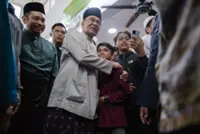
If there is anything predictable about Trump, it is his sheer unpredictability. It could have gone the other way, but his arrival at KLIA was instead marked by a spontaneous overflow of flourish when he gamely joined the welcoming dancers and waved, magnanimously, the flags of both nations (pic).
And in an extraordinary display of camaraderie, he invited Anwar to ride with him in The Beast, all the way to KLCC.
For Anwar, the visit crowned nearly a year of persistent engagement with the White House. Even before Malaysia formally assumed the Asean chairmanship, the government understood that the success of its year at the helm would depend, in part, on how deftly it could engage the new occupant of the White House.
Getting on board with the US is always a complicated matter for any Malaysian leader. This became even more so since the genocidal war in Gaza began in October 2023.
Under Trump, there is no illusion that America’s fundamental stance on Israel would change. Yet, there is at least a sense that his transactional, deal-making instincts make him less ideologically captive to that relationship; and that has proven to be an unexpected source of advantage.
That same unconventional instinct has been applied to South-East Asia. When Thailand and Cambodia exchanged fire across their disputed border earlier this year, Trump and Anwar played complementary roles.
Anwar offered Malaysia and Asean as a neutral venue for talks; Trump offered trade deals – with the implied threat of none if the guns did not fall silent, although that was not quite a “guns or butter” binary.
Nevertheless, despite detractors (mostly anti-Trump Western media) panning the deal, the signing of the “KL Peace Accord” underscores a formal step towards restoring peace between the two Asean member states.
For Malaysia, hosting Trump was not merely a matter of protocol but of positioning – a test of whether a South-East Asian country could steer both America’s regional role and a president wary of multilateralism towards constructive ends.
Anwar’s preparations and handling of the visit, at once courteous and disciplined, helped make it look effortless.
Beyond the peace accords, Trump’s visit yielded tangible results for Malaysia. Despite its asymmetrical nature, the Malaysia–US Agreement on Reciprocal Trade (ART) offers tangible advantages for Malaysian consumers, businesses and institutions. The new trade deal and partnership on critical minerals will give Malaysia a stronger position within the evolving architecture of US-anchored supply chains, reinforcing our commitments to international standards in steel, telecommunications security and logistics. Malaysia’s acceptance of US FDA approvals ensures faster availability of innovative medicines and devices without duplicative testing.
Trump has now attended an Asean summit within the first year of his second term. The challenge will be to keep Asean on his diplomatic calendar.
By the end of the day, it was clear that Trump’s visit had gone better than almost anyone had expected. There was praise – for Malaysia’s leadership, for Asean’s unity, and for Anwar personally, whom Trump described as “a great historic figure” for his role in brokering the Thai-Cambodian peace.
PROF DATUK DR MOHD FAIZ ABDULLAH
Chairman
Institute of Strategic and International Studies, Malaysia
(Read the full article at thestar.com.my)
Already a subscriber? Log in
Get 20% OFF The Star Digital Access
Cancel anytime. Ad-free. Unlimited access with perks.