AS the authorities investigate the recent stabbing incident at a school in Banting, we as a society must confront an uncomfortable truth: our schools are simply not equipped to rescue vulnerable youth before they reach breaking point.
Today’s classrooms do not exist in a vacuum. They mirror broader societal fractures, reflecting modern crises like severe bullying, broken homes, mental health struggles, cyber risks and child neglect.
When children carry these heavy emotional burdens into school, the trauma inevitably manifests as behavioural volatility or flashpoints of aggression. Yet, our institutional reflex remains stubbornly punitive.
We look at a troubled child and see a disciplinary problem to be corrected with suspension, detention or public shaming.
In doing so, we treat the outward symptom while completely ignoring the underlying disease.
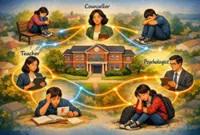
Teachers remain the bedrock of our education system, but it is both unfair and unrealistic to expect them to moonlight as mental health practitioners, family interventionists or child protection experts. They are already drowning in administrative duties and curriculum demands.
Similarly, while school counsellors play a vital role, they are frequently overwhelmed by staggering student-to-counsellor ratios.
When a system relies solely on strict rules and overburdened staff, vulnerable students inevitably slip through the cracks. This is where professional social workers become indispensable.
Professional social workers are trained to look beneath the surface. They operate on a fundamental understanding that a student’s actions are heavily dictated by their ecosystem, family dynamics, peer influences and socioeconomic realities.
A student displaying sudden aggression may be reacting to domestic abuse or severe emotional distress at home. A student with chronic absenteeism might be trapped in a cycle of poverty or acting as an underage caregiver.
Addressing the behaviour without treating the underlying trauma achieves nothing.
Social workers do not just react to a crisis; they prevent it. They are uniquely equipped to conduct psychosocial assessments, implement early intervention programmes, perform home visits and bridge the gap between vulnerable families and community resources.
Global precedents show us the way. In the United States, school social workers have been embedded for decades to spearhead crisis response.
In the United Kingdom, a rigorous child safeguarding model seamlessly connects schools with social care professionals.
Singapore uses a tightly knit ecosystem where schools, healthcare providers and community agencies share collective responsibility for student welfare.
These models highlight a universal truth: safeguarding children requires a multi-disciplinary coalition. It takes a village, but that village must be backed by professional expertise.
Introducing professional social workers to Malaysian schools is not about replacing our dedicated teachers or counsellors; it is about reinforcing them.
True school safety cannot be built on higher fences, stricter rules or harsher punishments alone.
Lasting security is cultivated through early risk identification, meaningful relationships, active family engagement and accessible professional care.
If we are genuinely committed to protecting the next generation, professional school social workers must be recognised as an essential pillar of a modern, compassionate and resilient education system.
THANASELAN PUNICHELVANA
Kuala Lumpur
Already a subscriber? Log in
Get 20% OFF The Star Digital Access
Cancel anytime. Ad-free. Unlimited access with perks.