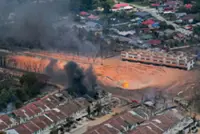
THE investigation by the Occupational Safety and Health Department into the April 1 Putra Heights, Subang Jaya, fire revealed that ground instability led to the gas pipeline explosion and inferno.
The weak soil condition at the location of the explosion caused a cyclic movement of the pipe that generated stress and metal degradation, resulting in a leak of liquefied natural gas (LNG) which exploded.
According to my research, the LNG pipeline was built in 1984. The Putra Heights pipeline is a section of the main LNG pipeline estimated at about 420km that starts in Terengganu. Emergency shut off valves are fitted at every 20km of the pipeline. Each section of the pipeline between two emergency valves contains an estimated 13 million litres of LNG.
From what I understand, transportation of LNG is a high-risk, complex process. The gas goes through a series of compressions for liquefaction and is sent to the pipeline under pressure. I believe the pressure of LNG in a pipeline typically ranges from approximately 6,800kPa to 8,200kPa (kilopascals). This high pressure is necessary to maintain the liquid state of LNG during transport.
Pipelines are normally buried underground to avoid damage while the gas is being transported.
If the pipeline was built to the American Society of Mechanical Engineers (ASME) codes and standards, there are requirements that the pipeline must be carried by concrete supports anchored to concrete foundations. This would greatly prevent movement of the pipeline.
Concrete supports are designed to withstand the weight of the pipeline, the contained LNG, and any external loads, including thermal expansion and contraction, and potential seismic events.
A pipeline cannot last forever. ASME does not explicitly define a specific lifespan for an LNG pipeline. However, pipelines in the United States are typically designed to ASME codes and standards with an intended 50-year service life.
The actual operational lifespan can be affected by various factors such as material selection, construction quality, operating conditions, and maintenance practices. The life span could be reduced to 30 years when taking these factors into account.
Two phases of actions have been charted for the LNG line, one of which is to restore gas supply in the Putra Heights section. The other phase is to repair the pipeline in the area in 2026. However, as a safety measure, there is also a need to identify metal degradations due to cyclic loadings likely to occur in other sections of the total pipeline. This would be a colossal task to undertake.
WONG SOO KAN
Petaling Jaya
Already a subscriber? Log in
Get 20% OFF The Star Digital Access
Cancel anytime. Ad-free. Unlimited access with perks.