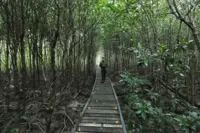
MANGROVE forests have been protecting Malaysia’s coastal areas from monsoons, sheltering young marine life and burying huge amounts of carbon underground for centuries.
According to the Natural Resources and Environment Sustainability Ministry, mangrove forests currently span about 586,548ha of the country with Sabah holding 57%, Sarawak 23% and Peninsular Malaysia 20%.
There has been a notable decline from the 629,038ha recorded in 2017 due to both natural and human-induced factors.
Human-induced factors include land-use conversion for port extensions, commercial aquaculture activities and even housing estates.
This loss is not just an environmental issue; it also directly impacts the coastal communities who depend on mangrove forests for their livelihoods.
Estuaries serve as nurseries for nearly 70% of commercial fish and shellfish species in the region. As tree cover disappears, fish stocks drop.
Furthermore, these wetlands deliver essential natural services like filtering and improving the quality of groundwater for local communities.
While roughly 549,818ha are located inside Permanent Reserved Forests (PRFs) or state parks, the remaining mangrove forests are vulnerable to human exploitation.
Under the State List (Ninth Schedule of the Federal Constitution), individual states control land ownership, alienation, local land revenue and development rules. This complicates Malaysia’s targets under the National Policy on Biological Diversity and its Paris Agreement climate goals.
Balancing coastal land use means looking at real economic trade-offs. Ports and aquaculture ponds bring in direct foreign investment, create jobs and generate export revenue.
On the other hand, intact mangrove forests absorb wave impact for free. Once they are destroyed, local councils will end up spending millions building concrete breakwaters that require constant maintenance.
Under Section 34A of the Environmental Quality Act 1974, Environmental Impact Assessments (EIAs) are required for developments affecting coastal forests. But conventional EIAs usually assess projects one by one and rarely account for the cumulative loss across an entire coastline.
Highlighting this gap, marine researchers such as Affendi Yang Amri from Universiti Malaya’s Institute of Ocean and Earth Sciences have pointed out that evaluating environmental impacts on a project-by-project basis misses the bigger picture.
A five-hectare project might be small, but when there are multiple projects on adjacent sites, the impact will be more significant.
Conserving our mangrove forests entails finding solutions to address states’ need for revenue as well as physical restoration of the degraded areas.
First, Integrated Coastal Zone Management (ICZM) rules must be woven directly into State Structure Plans. Enforcing a strict “No net loss” policy would require developers to fund 1:1 mangrove restoration in degraded areas whenever state land is approved for conversion.
Second, shoreline protection requires smarter engineering. Installing permeable geotextile breakwaters will dampen heavy wave energy while letting sediments settle. This creates a stable bed for young trees to take root, directly supporting the National Coastal Tree Planting Programme, which has already replanted over 3,800ha with nine million saplings.
Local stewardship is equally critical. Environmental researchers, including Dr A. Aldrie Amir, founder and coordinator of MyMangrove (Malaysian Mangrove Research Alliance and Network), emphasise that planting saplings is only the starting point. Long-term survival depends on coastal communities having a direct stake in managing the forests.
Finally, federal funding must support state preservation efforts. Through Ecological Fiscal Transfers and Blue Carbon markets, the Federal Government can compensate state authorities for gazetting remaining mangroves on state land into PRFs.
By tightening spatial planning, funding state-level conservation and protecting connected coastal ecosystems, Malaysia can meet its economic goals while keeping its natural defences intact.
ADAM NUQMAN HAZIM NOORMAN
SMK Taman Selasih
Kulim
Already a subscriber? Log in
Get 20% OFF The Star Digital Access
Cancel anytime. Ad-free. Unlimited access with perks.