IT is heartening to note that the 2025 Global Peace Index ranks Malaysia as the 13th most peaceful country globally and second in South-East Asia after Singapore. This index, produced by the (International) Institute for Economics and Peace, measures peacefulness across three main domains:
> The level of societal safety and security;
> The extent of ongoing domestic and international conflict; and
> The degree of militarisation.
The relevance of these indicators may, of course, be criticised by some observers.
Nevertheless, let us seize this moment to count our blessings and note that there is much in the Malaysian constitutional, political, social, cultural and economic set-up that permits and encourages people of dazzling diversity to live together in peace, harmony and dignity.
The Constitution: Our Consti-tution of 1957 and 1963 walked the middle path of moderation and compromise. It sought to reconcile the seemingly irreconcilable; the old and the new; the indigenous and the imported.
Indigenous features: The prominent indigenous features of our Constitution are the following:
> The unique system of multiple Malay monarchs united by a Conference of Rulers: Articles 32-38;
> An exalted position for Islam as the religion of the Federation: Article 3;
> Affirmative action provisions to uplift the position of the Malays and the natives of Sabah and Sarawak: Article 153;
> Malay reserve lands: Article 89;
> Acceptance of legal pluralism and multiple systems of law – civil law, Syariah law and native law of Sabah and Sarawak;
> Malay language as the nation’s official language: Article 152; and
> Weightage for rural areas in the drawing up of electoral boundaries: Thirteenth Schedule, Part I, section 2(c).
Safeguards for minorities: Con-comitant with the above Malay-Muslim features, there are many glittering provisions suitable for our diverse, multiracial, multi-religious and multi-lingual society.
> At the stroke of midnight on Aug 31, 1957, citizenship was granted to nearly 1.3 million non-Malays. This was a remarkable act of accommodation for the age: Articles 14-22.
> Though Islam is the religion of the Federation, Malaysia is not a theocratic state. Under Article 4(1), the Federal Constitution is the supreme law of the land.
> Article 3(1) on Islam as the religion of the Federation must be read with Article 3(4) that “Nothing in this Article derogates from any other provision of this Constitution”.
> Syariah law and Syariah courts apply only to Muslims: Schedule 9, List II, section 1.
> Under Article 11, all religious communities are allowed to profess and practise their faiths in peace and harmony. No person can be required to pay a religious tax for a faith other than his own. Every religious group has the right to manage its own affairs and to establish institutions for religious or charitable purposes.
> The electoral process grants rights to all citizens irrespective of race or religion: Articles 47 and 119.
> With some exceptions, fundamental liberties are available to all: Articles 5-13.
> At the federal level, membership of the judiciary, Cabinet, Parliament, public services and special commissions under the Constitution are open to all citizens.
> Article 136 mandates that there should be impartial treatment of all federal employees.
> Under Article 12, there are rights for all in respect of primary and secondary education.
> Under Article 152, though Malay is the national language for all official purposes, there is protection for the formal study in all schools of other languages. There is a right to use other languages for unofficial purposes. Federal and state governments are empowered to preserve and sustain languages of other communities,
> Though Article 89 reserves some lands for Malays, it also provides that no non-Malay land shall be appropriated for Malay reserves. Note the recent Ipoh case of Daniel Ong and Connie Ong (2025).
> Article 153 on the special position of Malays is hedged in by five or six limitations. One is that along with His duty to protect the Malays and natives of Sabah and Sarawak, the King is enjoined to safeguard the legitimate interests of other communities.
> Due to their unique position, Sabah and Sarawak enjoy many special rights in the legislative, executive, judicial and financial fields: Articles 95B-95E, 112A-112, 161-161H and Schedules 9-10.
> Even during a state of emergency, rights relating to citizenship, religion and language are not subject to emergency power: Article 150(6A).
In addition to the above legal protections for multiculturalism, Malaysia has benefited from one of the world’s longest periods of inter-communal coalition at the federal level (roughly from 1955 to 2020).
In 1971, the government of Tun Abdul Razak framed the Rukun Negara to achieve and foster unity, preserve a democratic way of life, create a just society where prosperity is shared, and ensure a liberal approach to cultural traditions. Till lately, the country had successfully used the economy to unite the people. Economic opportunities gave to everyone a stake in the country.
Unifying role of Rulers: Our Rulers are custodians of the nation’s heritage and enduring symbols of unity. When tensions and conflicts occur, as is common everywhere, the Conference of Rulers often takes the lead to foster tolerance and mutual respect. Article 38(2) permits the Conference to deliberate on any matter that it thinks fit. It often issues communiques urging caution and moderation.
Additionally, individual Malay Rulers exercise their moral authority to urge mutual respect and a rejection of divisive rhetoric or extremist actions. For example, in 2017, the Sultan of Johor, Sultan Ibrahim, now our Yang di-Pertuan Agong, reprimanded a laundromat owner in Muar for implementing a “Muslims-only” policy.
His Majesty emphasised that Islam teaches tolerance and respect for all people and faiths, not segregation. He is also known for sending greetings to all Malaysians on their cultural and religious festivals.
A fortnight ago, Sultan Nazrin, Sultan of Perak, in a scintillating speech, urged his people to reject any actions that undermine national unity or disturb harmonious inter-ethnic relations. Sultan Nazrin criticised those who sensationalise issues of race, religion, state or region and warned that the meaning of independence will be reduced to rubble if the tongues of some citizens become more poisonous than a venom-tipped arrow, spreading toxins into the minds of the people.
He urged us to focus on strengthening the cooperation and understanding forged by past leaders. He reminded the people that the Constitution recognises diversity of races, religions, cultures and languages. He urged Malaysians to focus on shared challenges, eg poverty and development, rather than identity- based politics.
In past addresses, Sultan Nazrin advocated that our diversity is an asset, not a liability, despite its challenges.
Regression: However, it is sad to note that despite the above admirable structural and legal features, Malaysia has regressed from being a plural society par excellence (except for a few tragic days in 1969) to a society buffeted by the divisive problems of race, religion and region.
Politics has become polarised and identity-driven. Many who claim their party’s mantle descend instead into gutters politics, stirring shadows of fear and embers of hatred, while the true ailments of the land lie unattended and unheard.
We all have a role to play to reverse this slide. The advocacy for inclusivity and mutual respect must begin at home, in schools, universities, neighbourhoods, at the workplace and government departments. MPs, assemblymen, the judiciary, NGOs and the media must play their role. Though the path to victory may be dim, we are all called to walk it still.
Finally, a reminder to two bearers of power. First, to the media. Every day in innumerable ways, there is heroism and transcendence by so many citizens towards each other. Why not highlight their initiatives and acts of kindness instead of concentrating on what flows in our gutters?
Secondly, a reminder to all leaders. The late US civil rights leader Martin Luther King Jr is supposed to have said moral leaders of substance do not follow opinion polls. They mould opinion – not with guns or dollars or position, but with the power of their souls.
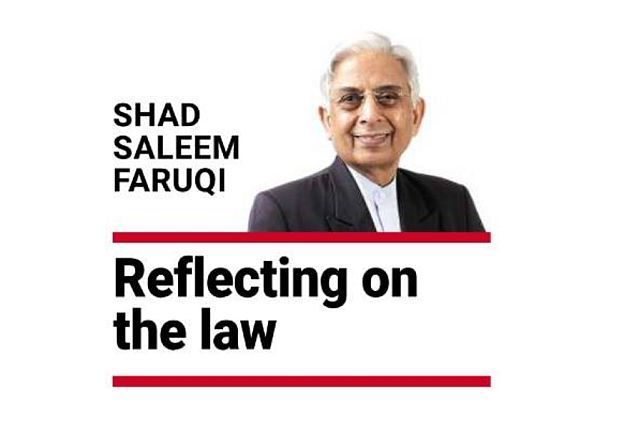
Emeritus Prof Datuk Dr Shad Saleem Faruqi is principal research Fellow at Universiti Malaya. The views expressed here are his own.
Already a subscriber? Log in
Get 20% OFF The Star Digital Access
Cancel anytime. Ad-free. Unlimited access with perks.