
Freshness awaits at Penang’s noon markets 


FRESH fish balls cannot be frozen.

You can hardly find them in the cold sections of supermarkets. Try freezing them and the magic is gone.

The delicate web of fish proteins, beaten and bound into a tight, elastic, microscopic network is torn apart by ice crystals on freezing.

The springy bite of fresh fish balls is due to muscle proteins in fish called actin and myosin being re-bonded into a tight gel after the fish meat is pounded into a paste and salt is added.

This is what gives the balls character – that momentary resistance when you bite before it yields and releases its light, briny sweetness.

Once frozen, water expands within those protein strands, rupturing the bonds.

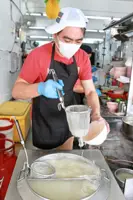
A wide variety of fresh fish balls at a stall in the Batu Lanchang market and (below) fresh tofu at the market, still warm to the touch. — ARNOLD LOH/The Star

What had been supple and bouncy becomes mushy.

One of the best places to buy real, fresh fish balls is Batu Lanchang market in George Town.

Two stalls there sell a range from round, square, grey, white to every kind of yong tau foo filling imaginable – red chillies and brinjal or bitter gourd slices stuffed with fish paste, sheets of bean curd skin ready to wrap and fry.

But here’s the thing – you can’t visit Batu Lanchang market early like other markets nationwide.

At 8am, not one stall is open. You have to go at noon.

Penang’s major markets in Batu Lanchang and Lebuh Cecil, both on the island, and Chai Leng Park on the mainland are not morning affairs. They open from midday to around 6pm, long after other wet market traders in the rest of the country have washed their floors and gone home.

This peculiarity exists because Penang is the first state to open a free industrial estate.

Bayan Lepas Industrial Estate, launched in 1972, was Malaysia’s first experiment in welcoming multinational corporations. It ran 24 hours a day in three shifts: 7am to 3pm, 3pm to 11pm, and 11pm to 7am.

When tens of thousands of workers filled the factories, many just could not go to morning markets on account of their duty rosters and there was not a single supermarket in existence then.

So traders adapted with wet markets that open shop at noon.

That rhythm exists to this day and honestly, the abovementioned markets are must-visit places for tourists.

They each have hawker food courts run by local councils and since Penang’s by-laws bar foreign workers from doing the cooking in these courts, you can be sure your char kuey teow, koay teow th’ng, Penang white laksa and the whole shebang are prepared by locals.

For domestic tourists, take note. If you drive to Penang, bring a large ice box. On your last day, after your final hawker food fix, stop by one of these afternoon markets before heading home.

You’ll be amazed by the freshness that awaits – bags of plump mantis prawn flesh, live crabs and clams, crisp preserved jellyfish, and tofu still warm to the touch – all the makings of a feast you would never expect to find.

Get 20% OFF The Star Digital Access

Monthly Plan

RM 13.90/month

RM 11.12/month

Billed as RM 11.12 for the 1st month, RM 13.90 thereafter.

Best Value

Annual Plan

RM 12.33/month

RM 9.87/month

Billed as RM 118.40 for the 1st year, RM 148 thereafter.

Follow us on our official WhatsApp channel for breaking news alerts and key updates!

Next In Columnists

Make Penang AI plan a bridge for majority
Giants fall, England survive – World Cup quarter-finals take shape
Who shapes global AI rules: Asean-China cooperation role
Why the Johor election is good for Malaysian democracy
Confessions of a durian season sinner
Looming threat to social security
More predictable than the World Cup
America at 250
Coexistence with wildlife key for public safety
Jitters all round in Johor

Others Also Read