A case of island mentality


PENANGITES can get defensive over negative comments about hawker food on the island.

The adverse reactions can even be a case study on the notion of “island mentality”.

This term is a colloquial rather than a scholastic concept, so the definition is quite broad.

Some philosophers and psychologists opine that “island mentality” gives rise to twin characteristics to communities affected by it.

On the one hand is a sort of positive exceptionalism: the belief that your community is generally better than others.

On the other hand is a negative provincialism leading to a disregard or even disdain for outsiders, external values, practices and ideas.

Insular communities anywhere that only keep to themselves and do not expose themselves to the outside world are said to also develop “island mentality”.

And now, back to Penangites and their hawker food.

During the recent state assembly meeting, Air Itam assemblyman Joseph Ng said hawkers operating in Penang Island City Council’s 31 public market food courts and 72 food courts elsewhere paid monthly rentals of just RM8 to RM250 a month.

Compare this to hawkers in privately-run food courts who pay thousands of ringgit a month in rent.

My buddy, a hawker, confirms that in highly popular private food courts, some hawkers pay as much as RM100 to RM300 a day for larger stalls with water and electricity included.

With such low rent charged at government-owned food courts, Ng questioned why hawker food there were priced the same as those operating in privately-run establishments.

He called on city councils to explore the idea of bringing down the price of hawker food at government-owned food courts.

Of course, Ng stirred up the proverbial hornet’s nest.

Many hawker associations retorted by relying on the rising prices of ingredients as a point of argument – never mind that rising costs is a national, even global, occurrence.

On social media, posts on the issue by news portals drew thousands of comments.

Some, including consumers, defended Penang hawkers too.

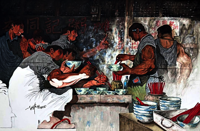
Penangites can be quick to defend against unfavourable comments about their hawker food. — CHAN BOON KAI/The Star

The same thing happened in a public Facebook group called “Curry mee lovers”, with a following of 19,000 members.

A member on June 3 shared a photo of a RM12 bowl of Penang curry mee and wrote a caption, “One of the less endearing qualities about most Penang hawker food is the stingy serving sizes.”

The post triggered a long string of comments that saw non-Penangites chiming in in agreement.

“Portions miserable”. “Cannot even tickle the corners of the tummy.” “In KL, you order one bowl and it’s enough for two persons.”

Then came the Penang commenters who, by and large, defended Penang hawker food portion sizes.

Aside from globally rising costs, some Penangites had rather unique arguments.

“Small serving sizes is traditional in Penang. That allows diners of hawker food to savour two or more varieties of their favourite food.”

“Penang style. We don’t eat like giants. Prefer small portions.”

“Unless you are a Penang lang, it is not easy to understand the nuances and uniqueness of Penang (What?)”.

“I could have written... if one is dissatisfied, not happy, one is more than welcome to stay away from Penang food. May God bless you.”

It did not matter that this “Curry mee lovers” group had members from around the world who shared pictures of the dish from different locations and with prices of the dish’s iterations.

Pictures of some of the portions clearly looked much more impressive than typical Penang hawker fare while just being a couple of ringgit more expensive.

Before 1985, or 39 years ago, the only access to Penang island was via old, slow ferries.

Large trailers were not allowed to roll onto those ferries; only small lorries.

For bulk cargo from the mainland, there were barges to ship it across the Penang channel.

So businesses ordering goods from the mainland always had to pay shipment surcharges.

A senior citizen on the island I once chatted with reminisced about a time in the late ’70s when he made an extension to his house.

Wanting to save money, he tried ordering bricks from the mainland and managed the shipping of the bricks to the island himself. After one shipment, he realised that paying for the bricks’ shipment ad hoc was an exercise in despair and so he relied on construction material suppliers on the island for subsequent orders.

That could be it. The lack of connectivity with the mainland in the old days could have been what caused Penangites to develop an “island mentality”.

But that is not the case anymore. We have two bridges and there might be an undersea tunnel or even yet another bridge, plus the possibility of rail connection in the future.

For Penang to push past its glass ceiling, it may be time to say goodbye to old thoughts and values and take a better look at the economic and socio-cultural practices of elsewhere, and then absorb them.

Get 20% OFF The Star Digital Access

Monthly Plan

RM 13.90/month

RM 11.12/month

Billed as RM 11.12 for the 1st month, RM 13.90 thereafter.

Best Value

Annual Plan

RM 12.33/month

RM 9.87/month

Billed as RM 118.40 for the 1st year, RM 148 thereafter.

Follow us on our official WhatsApp channel for breaking news alerts and key updates!
Penang , hawker , fare , Pinang Points , Arnold Loh

Next In Columnists

Make Penang AI plan a bridge for majority
Giants fall, England survive – World Cup quarter-finals take shape
Who shapes global AI rules: Asean-China cooperation role
Why the Johor election is good for Malaysian democracy
Confessions of a durian season sinner
Looming threat to social security
More predictable than the World Cup
America at 250
Coexistence with wildlife key for public safety
Jitters all round in Johor

Others Also Read