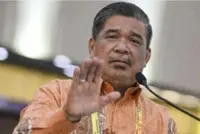
The more well-known youth-based parties in South-East Asia are Malaysia’s Muda, Thailand’s Move Forward Party (MFP) and the Indonesian Solidarity Party (PSI).
The PSI received a boost on Sept 23 when Kaesang Pangarep, the youngest son of Indonesian President Joko “Jokowi” Widodo, joined it, and two days later was named party president.
“I want my generation to be more involved in public administration. I believe that going into politics is one of the ways for the youth to save our future,” said the 28-year-old neophyte politician in his speech in Jakarta when accepting the ketum (ketua umum or chairman) post.
In his speech, Kaesang also referred to the MFP, which won the most seats in the Thai election on May 14. He said MFP’s victory has encouraged PSI to try for a Parliament seat in the Indonesian election next year.
The PSI chairman did not mention Muda, the other youth-based party talked about in the region.
Unlike the MFP, whose 43-year-old leader Pita Limjaroenrat almost became Thai prime minister, Muda did not achieve much in the 15th General Election (GE15) in November 2022. The party only won one seat out of 222 parliamentary constituencies via its 30-year-old president Syed Saddiq Syed Abdul Rahman, who retained Muar in Johor.
In the recent six state polls, Muda crashed and burned: The party lost in all 19 seats it contested.
In terms of electoral performance, PSI is more like Muda than MFP.
In the 2019 Indonesian elections, PSI fell short of the 4% popular vote threshold required to win a seat in Parliament. How-ever, it secured seats in local legislative councils, in cities like Jakarta and Medan.
When Muda quit the unity government on Sept 10 because the 47 corruption charges against Deputy Prime Minister Datuk Seri Dr Ahmad Zahid Hamidi were dropped, political pundits asked Syed Saddiq to “learn politics” from MFP and PSI.
Muda could learn that MFP is a data and social media-driven party. I met with its strategists in Bangkok in November last year, and they impressed me with their focus on bringing political change to Thailand.
Their approach was to stand independently and win as many seats as possible without any coalition partners. MFP also hit on the right sentiment: the youth-led reformist party rode on the anti-establishment mood in the country.

The MFP leaders struck me as “serious” in their political fight against an establishment that was being run by the military after the 2006 and 2014 coups. Pita and MFP boldly campaigned that they would break the military’s political influence and reform laws relating to the monarchy.
The Thai perception is that Pita is a political heavyweight. How do Malaysian voters perceive Syed Saddiq? Do they see him as prime minister material in the way Thais see Pita? Or do they see the Muar MP as a political lightweight?
The answer could perhaps be found in Syed Saddiq’s social media content. I’m told that for a successful social media political campaign, it should be 70% politics and 30% fun. It is perceived – perhaps unfairly – that Syed Saddiq’s content has too much fun.
The young man is undoubtedly famous on social media: he has 1.9 million followers on Insta-gram, 1.4 million on X (formerly known as Twitter), 1.1 million on TikTok, and 919,000 on Facebook. But does that popularity translate to votes for him and Muda?
It seems not – arguably because Syed Saddiq is seen as a “celebrity” politician. He has to decide what he wants to be. He’s popular, but can he be taken seriously?
Is he the next Jacinda Ardern, the young former New Zealand prime minister who wowed the world during the pandemic? Is he the next Emmanuel Macron, the French President who also has celebrity-level popularity but who has managed to stick through two difficult terms? Or maybe that other celebrity politician, Justin Trudeau, who is now into his third term as Canadian Prime Minister?
I’m told that former Umno star Khairy Jamaluddin, who is currently partyless, has a better chance as he knows how to mix politics with fun -- he’s a DJ and podcaster who discusses heavy subjects while also being a savvy social media influencer.
What can Muda learn from PSI?
The thing I’ve learned about Indonesian politics is that it’s about political manoeuvring versus popularity.
PSI, unlike MFP, won’t go it alone in the 2024 Indonesian polls. It is part of a coalition led by presidential contender Prabowo Subianto. The coalition is made up of big parties like Prabowo’s Gerindra (currently holding 78 seats out of 575 house representatives), Golkar (85), the Democratic Party (54) and PAN (National Mandate Party, 44), as well as some smaller parties.
PSI managed to manoeuvre itself into a big-tent coalition, whereas Muda has quit the ruling coalition. In GE15, Muda, although it was not part of the Pakatan Harapan coalition – which consists of PKR, DAP, Amanah and Upko – had an electoral agreement with it. Muda was given several seats to contest, including Muar.
Now that Muda is out of the coalition and has not made any other political alliances, such as with Opposition bloc Perikatan Nasional (comprising Bersatu, PAS, Gerakan and SAPP), can it survive on its own? It had gone solo in the six state polls and lost its deposit in all seats.
Muda is also seen as a one-man show. The only recognisable nationwide leader the party has is the president. Perhaps Syed Saddiq should create some mini-mes.
PSI has a very impressive social media campaign. Its content is slick albeit elitist as it is aimed at young, urban middle-class voters but not working-class youth.
But perhaps Kaesang can bridge that gap and make PSI more widely popular with the masses. He has an Everyman way of speaking. “That is exactly how Jokowi speaks. The masses can relate to Jokowi,” an Indonesian political analyst told me.
Having the son of the current president in its ranks might be a game-changer for PSI. And that’s what Muda needs too, a game- changer to move forward.
Already a subscriber? Log in
Get 20% OFF The Star Digital Access
Cancel anytime. Ad-free. Unlimited access with perks.