




THE SUN has been particularly active in recent days, releasing powerful bursts of energy into space.
Scientists monitoring solar activity have issued warnings about a severe solar radiation storm heading towards our planet.
But is Earth really experiencing the largest solar storm in two decades today?
Verdict:

TRUE
Earth will be experiencing the largest solar radiation storm in over 20 years today, according to the National Weather Service's Space Weather Prediction Center.
The severe solar radiation storm reached S4 level on the agency's severity scale, exceeding the intensity of the October 2003 "Halloween" space weather storms. A severe geomagnetic storm watch was issued for Tuesday (Jan 20) due to Earth's arrival of a coronal mass ejection that blasted from the sun on Jan 18.
Whilst solar storms might sound alarming, they're actually quite common occurrences. The sun goes through an 11-year cycle of activity, and we're currently in a particularly active phase that began in 2024 and is expected to continue through 2026.
What makes today's event special is its intensity, not that it's happening at all.
The last time such severe conditions were observed was during the Halloween solar storms of October 2003. That event generated the largest solar flare ever recorded by the GOES system and caused a one-hour power outage in Sweden, whilst 12 transformers in South Africa were disabled and had to be replaced.
During the 2003 storms, satellites, GPS and radio communications experienced problems or outages, whilst astronauts aboard the International Space Station had to take cover from high radiation levels. The majority of low Earth orbiting satellites were temporarily lost, requiring several days of around-the-clock work to re-establish their positions.
But the Halloween storms also provided a spectacular treat. Auroras were observed at unusually low latitudes, as far south as Texas, Florida, California and Mediterranean countries in Europe.
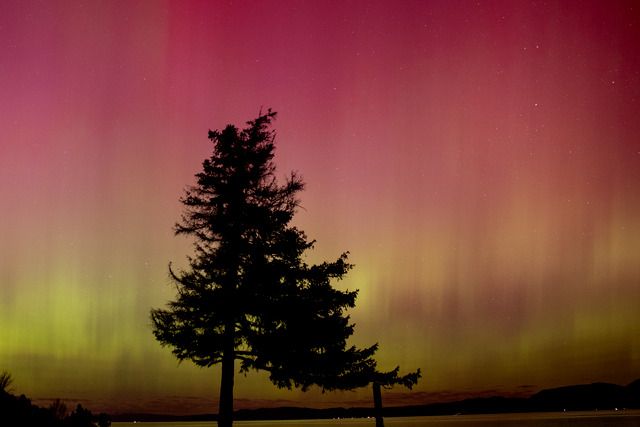
The current storm is expected to create similarly dazzling displays. Forecasters predict the northern lights could be visible in more than 20 US states, potentially reaching as far south as Alabama and northern California if geomagnetic activity intensifies to G4 levels.
For those in Malaysia, unfortunately the auroras will most likely not be visible here.
Auroras typically occur near the poles and require very strong geomagnetic storms to push them down to mid-latitudes.
Malaysia is far too close to the equator to witness auroral displays even during the strongest storms.
However, Malaysia may still feel some effects from the solar storm. GPS and satellite navigation systems can experience disruptions around the magnetic equator, particularly after sunset, due to a phenomenon called ionospheric scintillation.
This natural occurrence causes GPS signals to fluctuate and can lead to positioning errors. During major solar storms, these effects can be enhanced, potentially causing temporary inaccuracies in navigation apps, mapping services and GPS-guided systems.
Whilst today's storm is significant, it pales in comparison to the most powerful solar event ever recorded: the Carrington Event of September 1859.
Named after British astronomer Richard Carrington who observed the solar flare that preceded it, this geomagnetic storm was twice as large as any other in the past 500 years.
Auroras were seen as far south as the Caribbean, Panama, Venezuela and Honolulu in the northern hemisphere, whilst the southern lights were visible as far north as Santiago, Chile.
Telegraph systems worldwide failed, with reports of sparks showering from machines, operators receiving electric shocks and papers set ablaze.
The sky was so bright that birds began to sing, thinking it was morning, and people read newspapers by the light of the auroras.
Had the Carrington Event occurred today, experts estimate it could cause between US$1 trillion (RM4.47 trillion) and US$2 trillion (RM8.94 trillion) in damage and widespread disruptions to power grids, satellite communications and GPS systems.
The current storm poses increased radiation exposure risks for astronauts and flights on polar routes, enhanced risks to satellites and potential loss of high-frequency communications in polar regions.
Airlines, NASA and the Federal Aviation Administration have been notified to prepare for the storm's effects.
Despite the potential for disruptions, space weather officials stress this is a natural phenomenon we can prepare for, not a crisis.
Modern technology is far better equipped to handle solar storms than in 2003, though the interconnected nature of today's satellite systems means vigilance remains important.
References:
1. https://www.swpc.noaa.gov/
2. https://www.spaceweather.gov/
3. https://www.washingtonpost.
4. https://www.history.com/
5. https://www.swpc.noaa.gov/
6. https://www.gpsworld.com/how-


