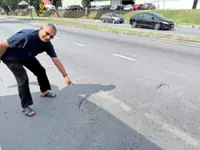
PETALING JAYA: Potholes. They’re a subject serious enough to be mentioned in Budget 2027, with the government allocating RM40mil to enable district engineers to speed up repairs on these and other road issues.
Under its Customers’ Charter, Public Works Department (JKR) director-general Datuk Ibrahim Esa said temporary repairs must be carried out within 24 hours, followed by permanent repairs within 72 hours.
“Each defect presents a potential safety hazard. Road users should receive a timely response regardless of the road traffic volume or location.”
He said JKR’s priority is not merely to adopt the latest technology, explaining that new proposals from industry players and maintenance concessionaires are subject to compliance with the department’s specifications.
ALSO READ : Potholes need more than just patch work, says expert
“In addition to the conventional use of hot mix asphalt, cold mix asphalt is also used for pothole repairs. The selection of material technology is not based solely on technical performance.”
Ibrahim said the choice of material depends on its suitability within the existing maintenance contract, cost, productivity, and implementation requirements.
“This ensures the adopted method is practical, effective, durable, and provides value for money to the government.”
However, he also acknowledged the many challenges on the ground.
While the allocation in annual budgets would lead to prioritising the fixing of urgent potholes, Ibrahim said the solutions must ensure reliable performance under local traffic, weather, and road conditions.
ALSO READ : Brotherhood fills its nights in service to others
“Temporary repairs address the immediate hazard, while permanent repairs provide a more durable restoration of the affected pavement.”
Where potholes recur, he said, JKR would assess the underlying cause and consider further engineering measures to reduce recurrence.
Among the key challenges for JKR are carrying out repairs during wet weather and managing repairs on roads that remain in use.
Ibrahim pointed out another difficulty: maintaining ageing roads with deeper structural deterioration.
“The challenge is to determine when patching is sufficient and when more extensive pavement rehabilitation is required.
“We also have to achieve lasting repairs on roads which have to withstand frequent heavy vehicle use. Selecting a suitable treatment requires consideration of both the surface defect and the strength of the underlying pavement.
“Where recurring damage involves poor drainage, leaking pipes, or utility excavations, a lasting solution may require coordinated action beyond the immediate patching work.”
Ibrahim said the current allocation is sufficient for routine pothole repairs on federal roads under the Federal Road Maintenance Contract.
“While patching addresses localised surface defects, damage that extends into the underlying pavement structure or repeatedly occurs at the same location, may require a more comprehensive engineering solution.
“In such cases, a separate budget allocation will be sought to undertake the necessary pavement rehabilitation works.”