
PUTRAJAYA: Road accident cases must go through court- annexed mediation before a trial date is fixed, with stricter operational pre-conditions under a new directive of Chief Justice Tun Wan Ahmad Farid Wan Salleh.
The latest “Practice Direction” sighted by The Star, which is effective from Oct 1, will involve tighter procedural integration through the e-Court system.
Compared to 2022, the new directive will centre heavily on structural efficiency, digital readiness, and strict documentation mandates. With the new directive, the 2022 Practice Direction will cease to be effective.
The system applies to court- annexed mediation proceedings in the High Courts and subordinate courts nationwide from this month.
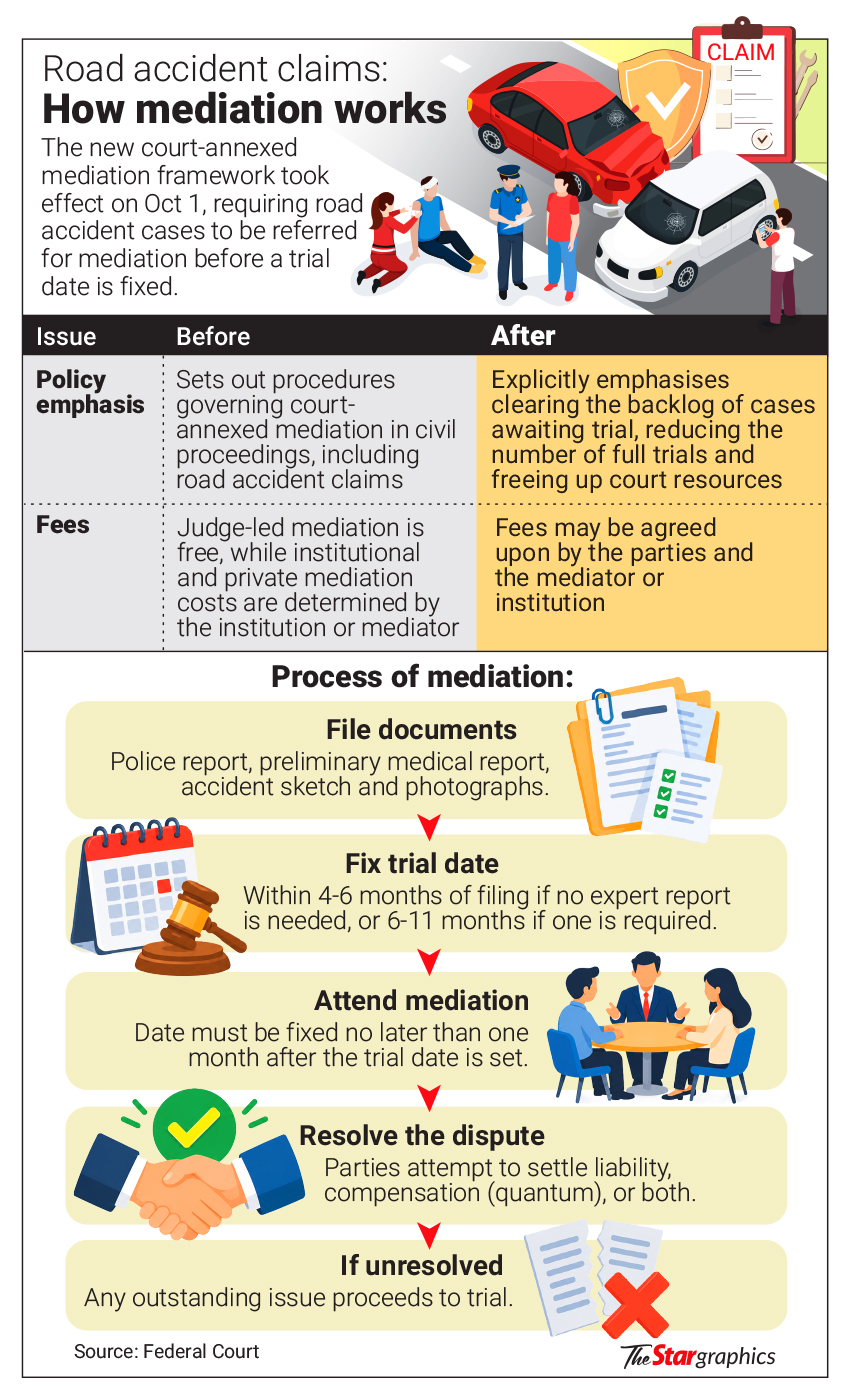
Under a court-annexed mediation, the parties involved are directed by the court to seek a settlement through mediation.
The move forms part of a new framework aimed at encouraging the settlement of civil disputes through mediation, with road accident cases given priority to help resolve disputes more quickly and clear the backlog of cases awaiting trial.
ALSO READ : Mediation speeds crash claims, but risks abound’
The mediation process is also expected to reduce the number of cases proceeding to full trial, freeing up court time and resources for more complex matters.
For road accident claims, the directive said that mediation would deal with issues of liability or the amount of compensation, or quantum, after basic documents, including preliminary medical reports, police reports, accident sketches and photographs, had been filed through the e-Court system.
Where both liability and quantum are resolved through mediation, the directive stated that the case would be considered successfully mediated.
If only one issue is resolved, judgment will be recorded on that issue while the unresolved matter proceeds to trial.
The directive also stated that trial dates for cases not requiring an expert report should be fixed within four to six months from the date of filing.
Trial dates should be fixed within six to 11 months for cases requiring an expert report.
For road accident cases where an expert report has yet to be obtained, parties must first attend mediation to resolve liability.
Mediation on quantum will only be conducted after the expert report is obtained, with the report to be filed within three months after pleadings are closed.
The new framework also allows mediation in other civil cases where a judge believes the dispute can be resolved through mediation and the parties agree, or where the parties themselves apply for mediation.
Mediation may be conducted at various stages, including during case management, interlocutory applications, before or during a full trial, after trial but before a decision is made, and during an appeal.
Parties may opt for judge-led mediation, mediation through listed institutions or mediation by a private mediator agreed upon by the parties.
Judge-led mediation is free, while institutional and private mediation may involve fees agreed upon by the parties and the mediator or institution.
The directive also formally provides for mediation through video conferencing, with parties required to ensure suitable technology, log in at least 30 minutes before proceedings and refrain from recording the session.
A mediation may be postponed if a technical problem lasts more than 15 minutes.
Parties who fail to attend mediation without giving a reason may also be referred to the trial judge for an order on costs arising from the absence.