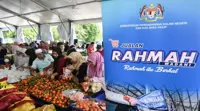
PETALING JAYA: The move to expand Jualan Rahmah Madani and Jualan Agro Madani programmes may provide immediate relief to households struggling with food costs, but economists are divided over their long-term effectiveness.
Under Budget 2027, Prime Minister Datuk Seri Anwar Ibrahim announced that the allocation for both programmes would be increased from RM630mil to RM750mil, with a target of 35,000 sales events nationwide.
Of these, 30,000 Jualan Rahmah Madani events will be held across all state constituencies, focusing on rural communities, low-cost housing areas and urban People’s Housing Projects (PPR).
Another 5,000 Jualan Agro Madani events will offer fresh produce, including fish, chicken, vegetables and fruits, at up to 30% lower prices.
Centre for Market Education chief executive officer Dr Carmelo Ferlito questioned whether government intervention in retail markets was the appropriate approach to addressing food affordability.
“The state should not be a retailer. Rahmah sales, government-organised distribution and price controls treat prices as the problem.
“Prices are messengers: they tell us where supply is scarce,” he said.
Ferlito warned that selling goods below market prices could undermine small traders while obscuring market signals that encourage businesses to increase supply.
“When the state sells below market, it crowds out the small traders it claims to protect and hides the information entrepreneurs need to bring in more supply.”
However, economist Dr Barjoyai Bardai described the increased allocation as a practical short-term measure to ease household food expenditure, particularly among lower-income communities.
“Offering selected essential goods at discounts of up to 30% can provide immediate relief, particularly to low-income households, residents of PPR housing areas and rural communities.
“The inclusion of fresh produce is also welcome because food affordability is not simply about having enough calories; it is also about access to nutritious food,” he said.
Barjoyai cautioned against measuring the programmes’ success solely by the number of sales events organised.
He said the government should instead assess actual household savings, product availability, price differences compared with regular market prices and the number of households benefiting.
“These initiatives should complement, rather than replace, efforts to improve productivity, food supply chains and competition in the food market.”
Anwar also announced RM250mil to expand the distribution of essential goods to rural and remote areas, covering six new locations, including Kampung Terian in Sabah and Kampung Dato’ Godam in Sarawak.
Barjoyai said the initiative could help narrow price disparities caused by high transport costs, limited retail competition and irregular supplies in remote communities.
Federation of Malaysian Consumers Associations (Fomca) chief executive officer Dr Saravanan Thambirajah welcomed the expansion of both programmes.
“These programmes are important in helping households cope with rising expenditure on food, transportation, housing and other essential needs.”