
GEORGE TOWN: A fish purportedly caught in Pahang has the physical traits of a red-bellied piranha, but the Fisheries Department cannot confirm it from a short video alone.
Although the fish resembled the omnivorous red-bellied pacu, the Fisheries Research Institute could not confirm its identity because it was thrown away.
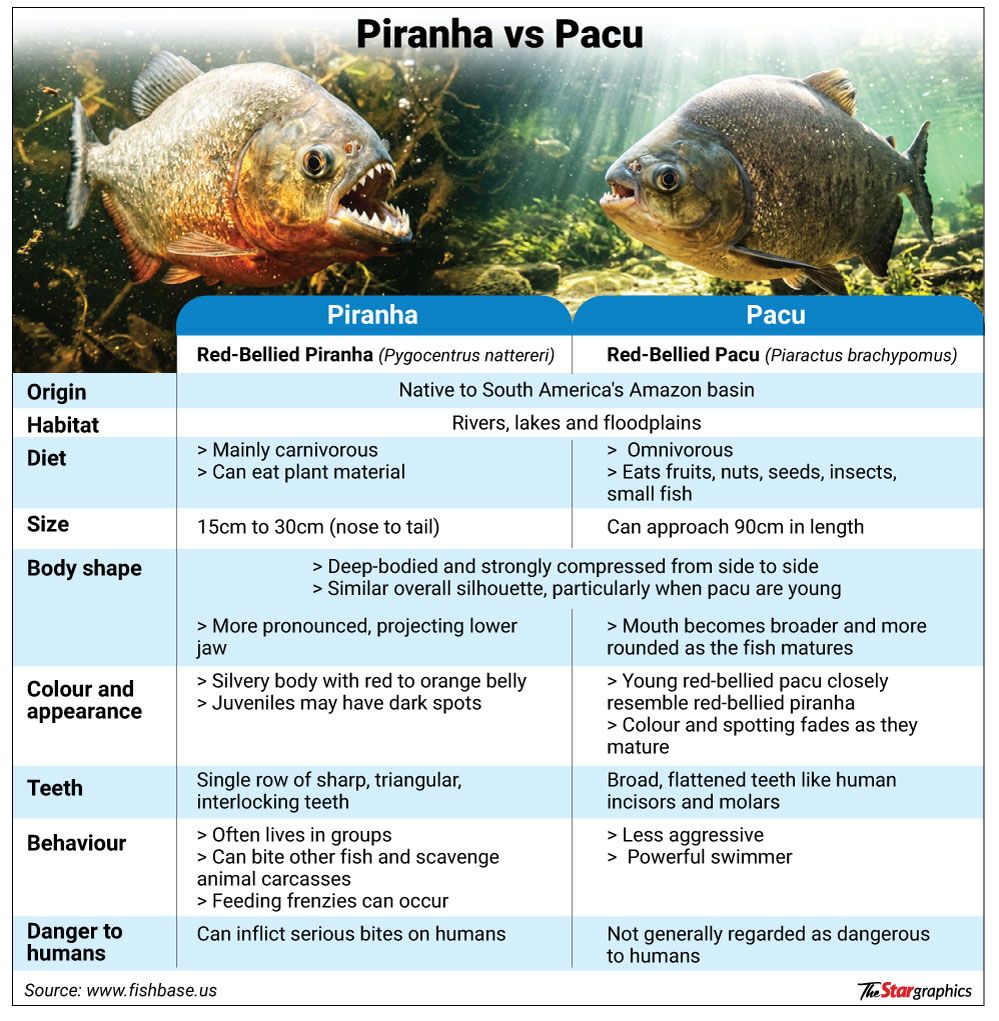
Department director-general Datuk Adnan Hussain said, based on the short video, the morphology of the fish caught in Pahang’s Klau dam was closer to that of the red-bellied piranha (Pygocentrus nattereri).
“But with only a video, we cannot confirm it.
“There are many other characteristics we need to identify, including its morphology, scales and teeth.
“Therefore, we cannot confirm whether it is actually a piranha or a pacu,” he said after opening the Marine Education Centre in Teluk Bahang, Penang.
The red-bellied pacu (Piaractus brachypomus) is an Amazon native like the piranha.
When young, the pacu mimics the appearance of the red-bellied piranha and will even blend in with a school of piranhas.
The pacu, however, is an omnivore with a preference that far outgrows the piranha, reaching almost 90cm or a bit larger than a lorry steering wheel.
Adnan urged fishermen in Klau Dam to preserve and surrender any suspected piranha or pacu caught.
He said the department will explore DNA and environmental DNA analysis with Aquaria KLCC, which has live piranha specimens and DNA references.
On Aug 26, a fish said to be a piranha was caught by a fisherman at the dam.
The fisherman took a short video of the fish and threw it on land.
Another video on social media claimed another fish resembling a red-bellied piranha was reportedly caught in Sungai Klau on Sept 19, but it was not handed to the authorities.
Adnan said that prohibited non-native fish continues to be offered for sale online.
He said the department will engage sellers to remind them that prohibited species require special approval from the authorities.
Even permitted foreign live fish brought into Malaysia must be accompanied by a health certificate to ensure they are free of diseases that could threaten the aquatic ecosystem, Adnan said.
“We will continue inspections at ornamental fish premises nationwide and take action where necessary to ensure our ecosystem remains protected from invasive fish species,” he added.