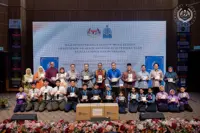
PUTRAJAYA: Chief Secretary to the Government Tan Sri Shamsul Azri Abu Bakar (pic) reminded civil servants, particularly those in ministries, to ensure spending is done in accordance with allocations approved under the national budget.
“In the civil service, we must spend according to what has been budgeted,” he told reporters after the closing ceremony of the 2026 Public Sector AI Seminar and the Public Sector AI Nexus Challenge 2026 awards presentation here yesterday.
He was responding to questions over the issue involving the Finance Ministry and the Rural and Regional Development Ministry concerning allocations for rural road projects.
On Wednesday, Treasury secretary-general Tan Sri Johan Mahmood Merican said there had been no restrictions on the Rural and Regional Development Ministry’s allocations for rural road projects and that the full allocation for the projects had been disbursed.
He said constraints in payments to contractors arose because almost all of the ministry’s allocation for the current year had already been spent.
The issue emerged following remarks by Deputy Prime Minister and Rural and Regional Development Minister Datuk Seri Dr Ahmad Zahid Hamidi over difficulties faced by contractors due to delayed payments for projects under his ministry.
Ahmad Zahid said the situation had affected contractors carrying out government projects and stressed the need to resolve the matter to prevent payment problems from persisting.
At the same event, Shamsul Azri also said the adoption of artificial intelligence (AI) in the public sector must translate into higher productivity and better service delivery, rather than merely increasing the use of the technology.
He said investment in technology did not automatically lead to productivity gains, as AI could only deliver results when supported by the right skills, quality data, sound governance and a willingness to change processes and working methods.
“The AI productivity paradox occurs when organisations invest in technology, but work processes remain lengthy, officers continue performing repetitive tasks and the public still faces long waiting times,” he said.
Shamsul Azri said AI adoption in the public sector should be measured by whether it makes services easier and faster for the public, saves time and reduces work processes, automates manual tasks and improves the quality of decision-making.
“If we cannot answer these questions, we must reassess whether the solution genuinely delivers value or is merely following a trend,” he said.
Shamsul Azri said AI, the Public Service Reform Agenda and bureaucratic reform must advance in tandem to improve work processes and support broader public service transformation.
“AI is not the end goal; it is merely a tool. Our real goals are higher productivity, excellent service delivery and the well-being of the people,” he said.
Meanwhile, Shamsul Azri said the Demerit Performance Evaluation (DEEP) for the public service’s top management was intended to improve leadership quality rather than punish officers who failed to meet prescribed performance standards.
“We have analysed the DEEP performance results for the second quarter of this year.
“As I have said before, DEEP is not intended to punish, but to improve leadership in the civil service, particularly among its top management,” he told reporters after the event, Bernama reported.
Media reports on Wednesday quoted Shamsul Azri as saying the Public Service Department had been asked to review the weightings used under DEEP to assess secretaries-general of ministries.
He said the move was aimed at ensuring the performance evaluation system for senior public service officials remained holistic, relevant and reflective of the changing challenges facing the administration.