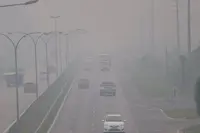
JOHOR BARU: The Fire and Rescue Department is actively monitoring 183 fire hotspots nationwide, particularly during the current dry spell.
Its director-general Datuk Seri Nor Hisham Mohammad said most of the hotspots were in Sarawak (30), followed by Penang (21), Perak and Pahang (20 each), and Johor (18).
“These are hotspots where fires have occurred at least five times over three consecutive years.
“The Malaysian Borneo region accounts for 45 locations, with the highest concentration in Sarawak, followed by eight in Sabah and seven in Labuan,” he said in an interview.
Nor Hisham said Malaysia was not immune to rapidly spreading fires, particularly in areas where dry forests, peatlands, plantations or bushland were close to settlements, industrial premises or critical infrastructure.
“Prolonged dry weather, low humidity and strong winds can cause fires to spread quickly and may require the temporary evacuation of nearby communities,” he said, adding that the level of risk varied according to vegetation, terrain, weather, access, water availability and proximity to populated areas.
Asked about contingency plans for these hotspots, Nor Hisham said they included mapping and risk-ranking recurrent fire locations, identifying access routes and nearby water sources, conducting patrols and periodic monitoring, and pre-positioning personnel and logistics in high-risk areas.
“We also mobilise personnel in phases and coordinate with landowners, local communities, police, local authorities, environmental agencies and other relevant departments,” he said, adding that aerial support or heavy machinery would be requested when terrain, fire size or access conditions required it.
“The priority is early detection and aggressive initial action before a small fire develops into a large and difficult-to-control incident,” he added.
On fires nationwide, Nor Hisham said departmental analysis showed that bush, forest, grassland and agricultural fires had risen to 18,432 in the first seven months of this year, exceeding the 9,941 cases recorded for the whole of 2025.
The figures were 16,294 in 2024 and 11,318 in 2023.
“Most of the fires this year involved bush and grassland, which accounted for 84.2% of all open fires nationwide,” he said, adding that most cases occurred in Kedah, Johor, Kelantan, Terengganu and Selangor.
He added that the department was also seeing recurring fires at known high-risk locations, with fires spreading more rapidly through dry vegetation under hot and windy conditions.
“Our operations are also increasingly affected by difficult access, limited nearby water sources, extensive fire areas and the need for additional pumps, water tankers, heavy machinery and logistical support,” he said.
Fires on peatlands were particularly challenging as they could continue burning beneath the surface and reignite even after visible flames had been extinguished, he added.
Asked how firefighters were coping with the additional workload and stress, Nor Hisham said personnel nationwide remained in good spirits and committed to carrying out their duties.
“To manage fatigue and maintain the welfare of personnel during prolonged operations, the department has been implementing planned personnel rotations, generally at intervals of three to five days,” he said.
He added that the department also emphasised adequate rest, meals and refreshments, clear operational briefings, safety supervision, medical monitoring, and access to welfare and psychosocial support.