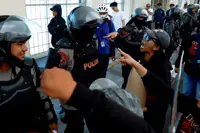
JAKARTA, Indonesia (AP): Thousands of students across Indonesia have staged days of demonstrations protesting the government’s response to toxic haze that has blanketed multiple cities and spread to other nations in Southeast Asia in recent weeks.
On Friday, more than 500 protesters gathered in front of the Central Kalimantan Governor’s Office in the provincial capital of Palangkaraya, demanding more action to address the haze. Protests earlier this week spread to more than half a dozen Indonesian cities, including on the island of Borneo, where many of the fires are actively burning.
Indonesia’s haze is primarily caused by forest and peatland fires, which are often started by slash-and-burn agricultural practices. While such fires are common during Indonesia’s dry season, which usually begins in April, this year’s are the worst on record.
The haze has spread to neighboring nations, triggering health concerns and igniting public backlash from Singapore, Malaysia and other members of the Association of Southeast Asian Nations.
For months, student and civil society groups have demanded stronger action on the haze. Some called for Indonesian President Prabowo Subianto to declare a national emergency and take more aggressive steps to prevent the agricultural practices that many blame for fueling the blazes.
In many cases, the student-led protests have merged with ongoing demonstrations over Indonesia’s struggling economy.
"In Indonesia, we’re so angry,” said Vincent Thomas, a student at Indonesia's Universitas Padjadjaran, who joined student protests in Bandung. "We want the officials responsible to be held accountable.”
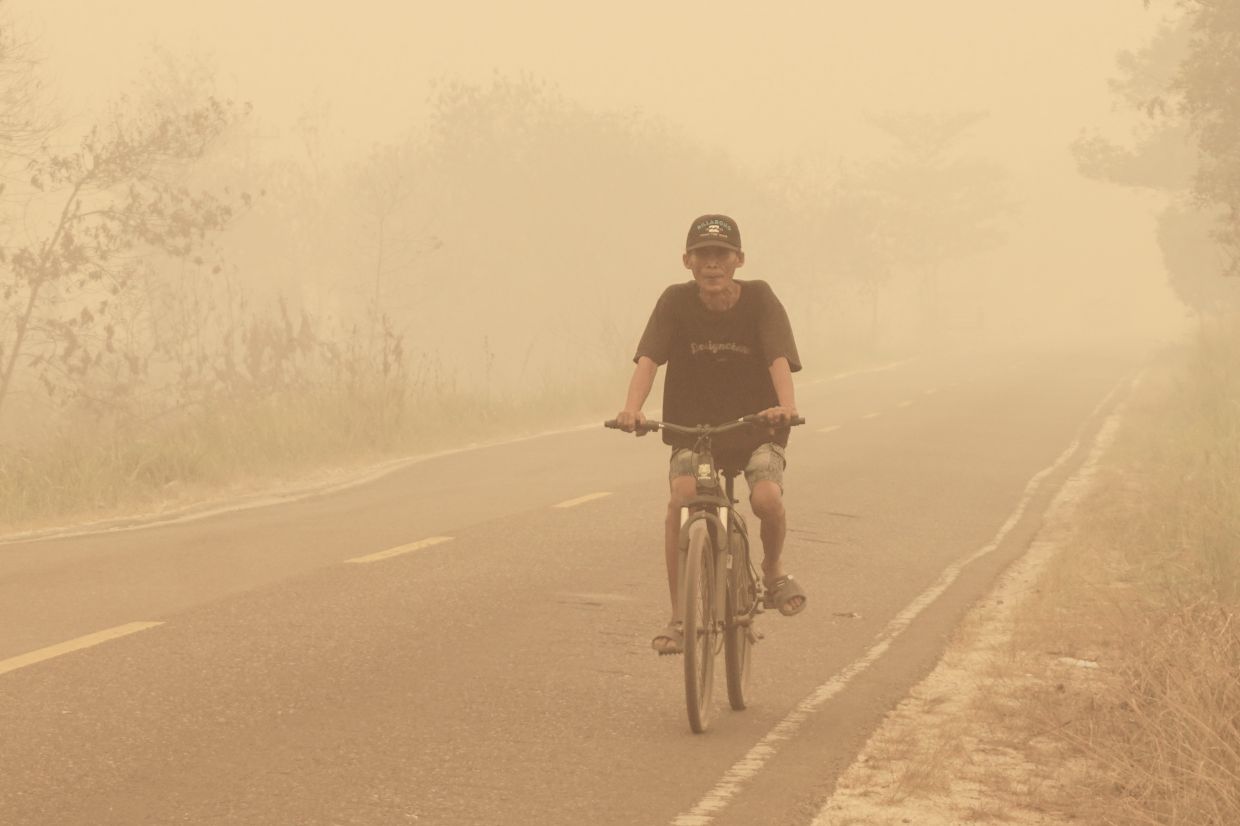
Many demonstrators on Friday wore thick masks to protect themselves from the air pollution blanketing the city of Palangkaraya, which was tinged orange by the haze.
Some held signs that read "haze emergency.”
"We want the government to openly declare a national disaster emergency,” said Thomas. "Not just regarding Kalimantan, but regarding forest fires across the entire country, in every part of Indonesia.”
More than 333,470 residents have suffered acute respiratory illnesses across the seven Indonesian provinces affected by the haze since mid-August, according to data from Indonesia's Ministry of Health.
Indonesia’s vast forests were a tinderbox because there was less rain than usual this wet season.
Experts blame this on record-breaking extreme heat, worsening climate change and an intensifying El Niño that may be the strongest in living memory.
"The current haze crisis is a real symptom, a real example of how climate change affects our day-to-day lives,” said Syahdiva Moezbar, with the Centre for Research on Energy and Clean Air in Jakarta.
Indonesia's fires have triggered clouds of toxic smoke across Southeast Asia.
Singapore and the Malaysian capital of Kuala Lumpur were ranked among the most polluted in the world this month by the global air quality monitoring platform IQAir, with many considering this the worst haze crisis to affect the region in over a decade.
Officials from Singapore are taking legal action against seven companies in Indonesia that the city-state blames for causing the fires that triggered the current haze crisis.
Grace Fu, Singapore’s Minister for Sustainability and the Environment, has warned that air quality in Singapore may deteriorate further.
"For me, the part that does worry me is just the difficulty in getting N95 masks and air purifiers,” said Qiyun Woo, a Singaporean environmentalist. "You just can’t help but worry about your own health, especially when you might not have an air purifier.”
The unhealthy levels of air pollution have closed schools in East Timor and been detected in the Philippines.
Haze is a regionwide issue in Southeast Asia.
Slash-and-burn agricultural practices are common across Cambodia, Laos, Myanmar, Thailand and Vietnam, with burning seasons typically running from January to April. But regional efforts to tackle the issue have lagged. -- AP