JOHOR BARU: An eerie quiet hung over the area around Sungai Kim Kim. All the nearby homes were empty. The residents had all been evacuated and moved elsewhere.
In their place were men in hazmat suits and masks, all serious and sombre.

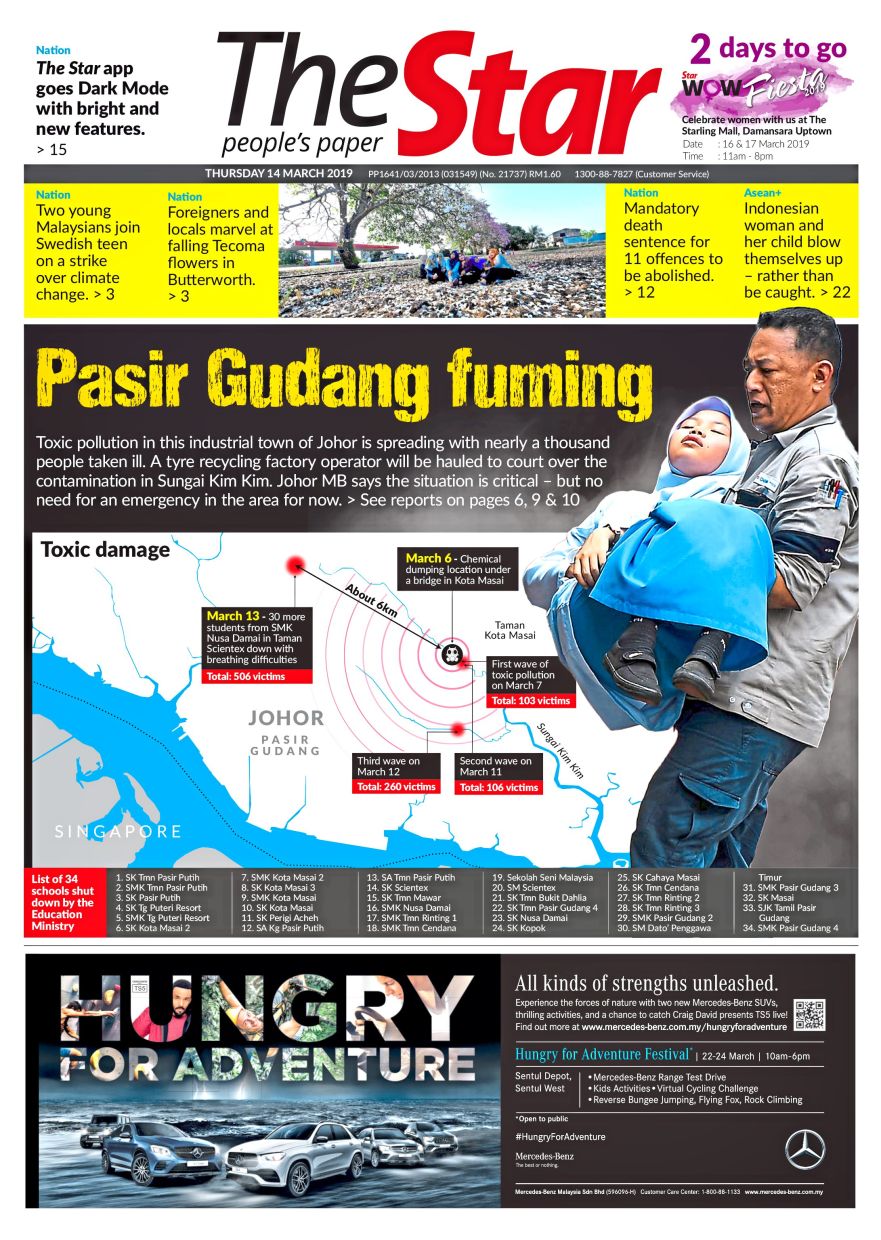
It all began when a lorry dumped oil waste and toxic chemicals into the river on March 6, 2019.
The waste released dangerous gases into the air, causing residents and schoolchildren to fall unconscious.
Nine days after the first wave of toxic fumes had hit, senior journalist Nelson Benjamin made his way to ground zero. By then, Pasir Gudang had already been hit by three waves of the pollution. The Star’s Johor bureau chief and senior editor was greeted by a strong, stinging chemical smell – despite the fact that he was wearing a full hazmat suit and gas mask.
The site, under a bridge in a secluded area near a soon-to-built light industrial area, had been cordoned off since the crisis began, but Benjamin and photographer Abdul Rahman Embong had managed to get exclusive access.
“It was a very secluded and poorly lit area. There were a few houses nearby, but no one was there,” Benjamin said.
“The odour was very strong and stinging. Even with the gas mask on, I could still smell the toxic waste. I was also feeling quite dizzy.
“In fact, one of the Department of Environment (DOE) personnel collecting samples at the site had to be evacuated as he felt lightheaded and had to seek immediate medical attention,” he said.
Benjamin said he also had to undergo a decontamination procedure and continued to have lingering migraine for days after. Abdul Rahman also experienced similar symptoms.
At that point, at least 1km of the river had been cleaned, with the waste put into giant white bags to be sent to a scheduled waste disposal facility in Negri Sembilan.
“The river was still very murky despite the clean-up operation. There were excavators digging up the soil, which was then placed into those huge bags,” he said.
“Officers from the Fire and Rescue Department, as well as the DOE, were also there to collect samples from the air and water,” he said, adding that the dry spell and low water level in the river at the time could have also contributed to a chain-reaction which resulted in toxic fumes.
The initial clean-up of Sungai Kim Kim began on March 7, the day the first wave of toxic pollution hit residents.
About 2.43 tonnes of chemical waste were collected on the first day alone.
The operation was halted the following day after authorities found that the toxic waste required specialised handling and experienced contractors were then appointed.
By the end of the operation on March 17, some 900 tonnes of contaminated soil and 1,500 tonnes of polluted water had been removed from a 1.5km stretch.
The scale of the crisis was something Benjamin had not expected when reports of pollution at Sungai Kim Kim first emerged on March 7.
Like many, he had thought it was just another case of river pollution.
“No one expected it to become this bad. After the first wave, I also didn’t think there would be another one. I thought we would have learnt from what happened the first time,” he said.
The first wave affected more than 100 people. But on March 11, students began falling ill again.
“I was shocked when a parent from a Tamil school far from the area alerted me that people were getting sick again in Pasir Gudang.
“We then found out that students from several other schools were also experiencing the same symptoms, and the chaos began again.
“The number of people affected continued to go up throughout the day, and you could hear ambulances going back and forth around Pasir Gudang,” he recalled.
The very next day, a third wave hit the area.
“More and more schools were ordered to close as students complained of breathing difficulties, dizziness and vomiting.
“Eventually, the Education Ministry ordered all 111 schools in Pasir Gudang to shut,” he said.
Even Johor Ruler Sultan Ibrahim Ibni Almarhum Sultan Iskandar, now the Yang di-Pertuan Agong, expressed anger over the illegal dumping and called for a full investigation and stern action.
His Majesty also made a personal contribution of RM1mil to assist rescue, treatment and prevention efforts, including helping the agencies involved obtain equipment needed for the operation.
As the crisis worsened, the Pasir Gudang Indoor Stadium became the main centre of activity, with government departments, health personnel and others involved in the crisis setting up their bases there.
The patients coming in all had the same complaints – incessant vomiting, nausea, light-headedness, and breathing difficulties.
For journalists, most of the action centred around the stadium, which was turned into a medical base and operations command centre.
“It was such a chaotic scene. There were so many things happening, We were constantly moving around and trying to keep up with the latest developments,” he recalled.
Benjamin said there was also concern over the safety of media personnel as they were spending long hours around Pasir Gudang.
“I contacted The Star’s Melaka bureau chief RSN Murali to see if he could help.
“Murali approached the then-Melaka health and anti-drugs committee chairman Low Chee Leong, who arranged for 1,500 face masks to be sent to media personnel covering the crisis here,” he said.
By then, the incident had drawn national and international attention as the number of victims continued to rise.
Then-prime minister Tun Dr Mahathir Mohamad and several other ministers also made impromptu visits to the hospitals where victims were being treated and to the command centre.
There was a sense of anger among the people, too. They felt the authorities were slow in reacting with then-mentri besar Datuk Osman Sapian being abroad when the incident happened.
“There were conspiracy theories too. Some claimed the authorities knew that this was a popular dumping ground but did little to stop it,” Benjamin recalled.
On March 19, the government declared the affected stretch of Sungai Kim Kim free of toxic pollution, although monitoring of the river and surrounding areas continued.
By then, more than 4,000 people, many of them children, had been affected by the pollution, with some hospitalised for days. Luckily there were no deaths.
On March 24, P Tech Resources Sdn Bhd directors Yap Yoke Liang and Singaporean Wang Jing Chao, together with lorry driver N. Maridass, were charged in court over the incident.
Maridass was charged with illegally disposing of chemicals into Sungai Kim Kim on March 7, while Yap and Wang were accused of conspiring with him.
On Nov 30, 2023, Maridass was fined RM100,000 after pleading guilty to illegally disposing of oil sludge, classified as scheduled waste, into Sungai Kim Kim.
P Tech Resources was convicted of eight offences and initially fined RM40,000 for each offence, totalling RM320,000.
In June 2024, the Johor Baru High Court increased the company’s fine to RM80,000 for each charge, bringing the total to RM640,000.
Today, Sungai Kim Kim is a far cry from the murky, foul-smelling river Benjamin encountered. The disaster changed the way authorities monitored industrial activities in Pasir Gudang.
The Johor DOE began using drones to monitor industrial areas, particularly secluded and difficult-to-access locations.
Last year, the Johor government allocated part of RM7mil for clean-up and rehabilitation works at Sungai Kim Kim, Sungai Skudai and Sungai Tebrau.
However, the Sungai Kim Kim incident remains a reminder of the environmental risks facing the heavily industrialised Pasir Gudang area.
“Many lives were disrupted by the crisis, and the government had to spend millions to clean up the mess.
“It should be a wake-up call for all of us to take environmental issues seriously. Pasir Gudang still remains a ticking timebomb for another environmental disaster,” Benjamin said.