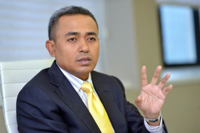
KUALA LUMPUR: Bank Negara Malaysia’s five warnings to Lembaga Tabung Haji’s on its financial issues since 2014 had gone unheeded, says Minister in the Prime Minister’s Department (Religious Affairs) Dr Zulkifli Hasan.
While briefing the Dewan Rakyat on the findings of the Royal Commission of Inquiry (RCI) on Tabung Haji, Zulkifli said it was unlikely that the responsible parties at the time were unaware of problems in the organisation.
He said Tabung Haji’s financial crisis did not begin last week but had already become critical more than a decade ago. However, the management at that time had left those issues unchecked.
“What happened was that Bank Negara, as the institution responsible for safeguarding the stability of the country’s financial system, raised concerns with Tabung Haji,” he said.
Despite not being the regulator of Tabung Haji, the central bank already had concerns that continuing to make high distributions would push the organisation’s already low reserves into negative.
“It was akin to an emergency savings fund being steadily depleted while spending continued at a high rate. Eventually, the reserves became negative, leaving Tabung Haji exposed to significant difficulties should depositors make large-scale withdrawals of their funds,” he said.
He said the underlying concern was that this could have severe implications on the country’s financial position and financial stability.
“Yet the warning letters issued by Bank Negara were not heeded, let alone given due attention or acted upon by the Tabung Haji management at the time,” he said.
“Tabung Haji’s financial position at the time had the potential to pose systemic risks to the stability of the country’s financial system,” he said.
He said the central bank’s warnings were further supported by the Auditor-General’s audit findings in 2017, which flagged the changes in the impairment policy—which was made twice within the same year in order to show higher profits for 2017.
Following that, the new Tabung Haji board in 2018 had appointed PricewaterhouseCoopers to reassess Tabung Haji’s financial position and performance in accordance with applicable and proper accounting standards.
The deficit between Tabung Haji’s assets and liabilities had widened to more than RM10bil in the fourth quarter of 2018, leaving only three months to find a solution.
“If its assets did not exceed its liabilities at the end of the year, Tabung Haji would not have been able to declare a profit distribution for 2018 and could have faced the risk of large-scale panic withdrawals, or a bank run,” it said.
"At the same time, efforts to secure standby financing as a precautionary measure in the event of large-scale panic withdrawals had failed.
"Had Tabung Haji collapsed at that time, the government would have been at risk of assuming liabilities of approximately RM74.5bil as all deposits held with Tabung Haji were fully guaranteed by the government.
“A panic withdrawal did in fact occur in 2019, involving net withdrawals of RM6bil within a short period following the announcement of a 1.25% hibah for 2018 in early 2019. Imagine if no hibah had been declared for 2018. How large might the panic withdrawals have been?” he said.
The RCI report was released to the public on July 29. The Dewan Rakyat is holding a one-day sitting to discuss the findings.