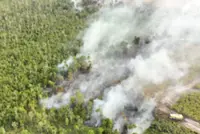
PETALING JAYA: The flames are often their biggest threat, but firefighters dealing with bush fires say the greatest danger is sometimes hidden beneath their feet.
“Peat fires are among the most challenging to deal with as the fire continues to burn beneath the surface. It would consume tree roots and underground peat layers even after the flames appear to have subsided,” said Rawang Zone 6 chief Mustakim Rimon.
“Ground that appears stable may still conceal burning embers, putting firefighters at risk of sinking into hollowed-out peat or being exposed to intense underground heat.
“One wrong step could cause a firefighter to sink or suffer serious injuries,” he said in an interview.
Mustakim, who has more than a decade of experience responding to forest and peat fires, said every operation begins with a risk assessment before firefighters identify the safest route into the affected area.
The team must then locate nearby water sources such as rivers, drains or former mining ponds before transporting pumps, hoses and firefighting equipment deep into the forest.
“For large-scale fires or areas that are difficult to access, aerial water bombing is deployed to slow the fire’s advance and buy time for ground crews to contain the blaze.”
One of the most harrowing moments of his career came when shifting winds engulfed his team in thick smoke during a reconnaissance mission.
“The smoke moved directly towards us. We had to retreat immediately and were almost overcome by the smoke,” he recalled.
Beyond unstable peat soil, Mustakim said firefighters also face the constant threat of falling trees weakened by burnt roots, thick smoke that affects breathing, extreme heat that can lead to dehydration and heatstroke, as well as venomous animals forced out of their habitats by the fire.
Bukit Sentosa Fire and Rescue station chief Senior Fire Supt Kamil Hamadan said the challenges begin long before firefighters even reach the flames.
Firefighters often have to trek between 1km and 3km through hilly terrain and dense undergrowth while carrying pumps, hoses, jet shooters, backpack water tanks and other firefighting equipment.
“In the forest, you never know what lies ahead. There could be steep slopes, hidden holes, fallen trees and very limited water sources. We have to carry everything ourselves,” he said.
Operations lasting several days also take a heavy physical toll, with crews rotating shifts to prevent exhaustion and heat-related illnesses. Temporary shelters are often built in the forest to provide shade while firefighters continue battling the blaze.
Kamil recalled one of his most demanding deployments while serving as Kuala Kubu Baru Fire and Rescue station chief in 2018 when his team responded to more than 10 bush fire calls across Hulu Selangor in a single day.
“Our fire engines were out almost the whole day. I was travelling from one location to another to coordinate operations and ensure the fires did not spread to nearby homes.
“It was one of the toughest days I’ve experienced because we had to make the best use of the manpower and equipment available.”
He said that responding to bushfires during the fasting month presents an even greater challenge.
“Fighting fires while fasting under extreme heat is physically demanding, but our firefighters remain committed to protecting lives, property and the environment.”
Kamil urged the public to refrain from open burning, warning that seemingly minor acts such as burning rubbish or clearing land with fire can quickly escalate into large-scale bush fires during prolonged dry weather.
“People may think it’s only a small fire, but under hot and dry conditions, it can spread rapidly and threaten nearby communities.
“The best way to prevent bush fires is to stop them before they start.”