
PETALING JAYA: Frequent Malaysian travellers have largely welcomed the government’s new 10-year passport, describing it as a more convenient and cost-effective alternative to the current five-year passport.
Data processing manager Atikah Razak, 33, who travels overseas three to five times a year, said the new system offers better long-term value.
“I think RM350 for 10 years is reasonable. It works out to RM35 per year, which is affordable considering a passport is an important travel document,” she said.
The change, she added, would minimise the hassle of renewals and help ease congestion at Immigration Department offices.
Tham Jo Yee, 30, also prefers the 10-year passport as it reduces the need for frequent renewals.
“Perhaps a 10-year passport makes more sense because many people tend to forget to renew their passports. Most of the time, they only check the expiry date when they are planning to travel,” she said.
The longer validity period, she said, could reduce last-minute problems caused by expired passports, especially for occasional travellers.
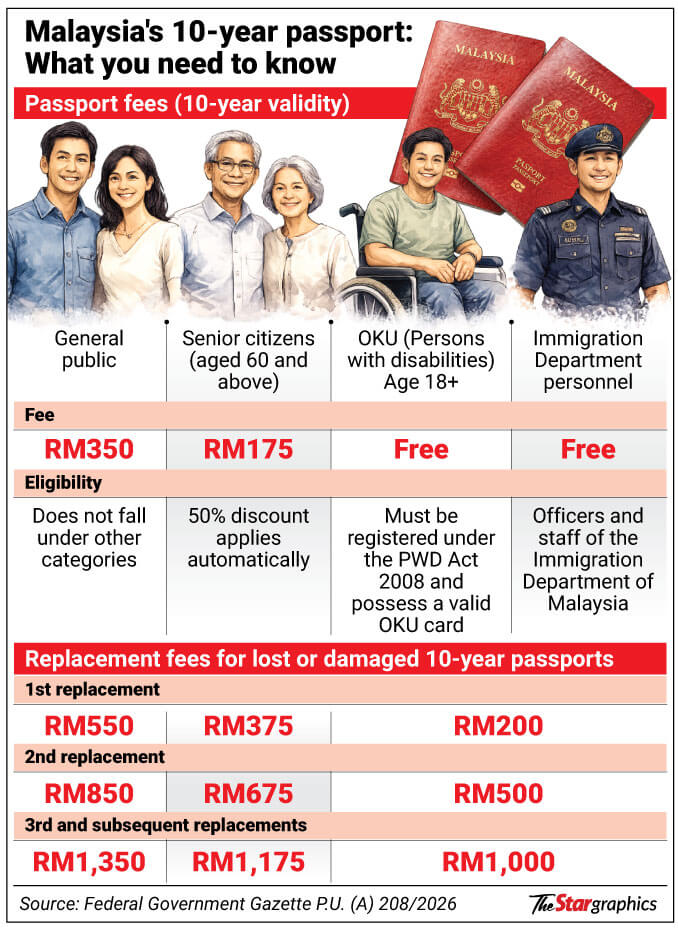
The Fees (Passports and Visas) (Amendment) Order 2026, which came into force on June 3, extends the validity of Malaysian passports to 10 years.
The gazette however did not state when the new 10-year Malaysian passport will be made available to the public.
Malaysians will be charged a fee of RM350 while senior citizens aged 60 and above will be charged RM175 for the 10-year passport.
Meanwhile, registered persons with disabilities aged 18 and above who hold an OKU card are entitled to a passport free of charge.
The gazette also states that Immigration Department officers and staff are entitled to 10-year passports at no charge.
Previously, Malaysian passports were issued with a five-year validity period at RM200 for adults and RM100 for senior citizens, while persons with disabilities were exempted from fees.
Dubai-based aviation engineer Rashidie Noridin, 34, described the RM350 fee as “cheap” when broken down annually.
“This new policy is better as it is in line with passport systems in several developed countries like the US, Singapore and the UK,” he said, adding that the 10-year expiry gives travellers more flexibility in planning their trips.
Banker Mohd Asri Bin Hishamuddin, 36, said the longer validity period improves efficiency for frequent travellers.
“It offers better value compared to renewing a five-year passport twice,” he said.
Mohd Asri added that passport validity often affects travel planning due to the minimum six-month validity requirement imposed by many countries.
Flight attendant Mahani Ishak, 27, said the 10-year option is particularly useful for those in the aviation industry, where valid travel documents are critical to operations.
She added that passport validity plays an important role in her job, as expired passports or insufficient remaining validity can directly affect flight assignments.
“If a passport has expired, it may lead to crew being offloaded from flights due to incomplete documentation.
“It helps reduce the need for frequent renewals, especially for those of us who are constantly travelling for work,” she said.
The amendment also introduces a fee structure for replacing lost or damaged 10-year passports.
For those aged 18 to 59, replacement fees are set at RM550 for the first replacement, RM850 for the second, and RM1,350 for the third and subsequent replacements.
Senior citizens will be charged RM375 for the first replacement, RM675 for the second, and RM1,175 for the third and subsequent replacements.
Eligible OKU cardholders and Immigration Department staff will be required to pay RM200 for a first replacement, RM500 for a second, and RM1,000 for a third and subsequent replacements.
Meanwhile, for the five-year passport, replacement fees range from RM400 to RM1,200 for those aged 13 to 59 years, and RM300 to RM1,100 for senior citizens depending on replacement frequency.
Registered persons with disabilities aged 18 and above who hold an OKU card are charged RM200, RM500 and RM1,000 for the first, second, and third and subsequent replacements, respectively.