
KUALA LUMPUR: Frozen inheritance assets has reached a staggering RM90bil, with experts attributing this to a lack of estate planning among Malaysians.
According to official statistics, the frozen assets include properties, shares, investments, and other capital belonging to deceased persons that cannot be distributed yet due to unresolved legal or administrative matters.

And if this does not pose a big enough headache, there is also the total in unclaimed money which stands at RM13bil.
ALSO READ: Planning ahead will save family the stress
The Accountant-General’s Department listed unclaimed money to include salaries, dormant bank accounts, insurance payouts, and deposits yet to be claimed by the rightful individuals; amounts range from several ringgit up to thousands of ringgit and more.
While frozen inheritance assets involve the estates of the deceased, unclaimed money can also entail living individuals.
Financial Planning Association of Malaysia general manager Alice Wong said many younger professionals and middle-income earners in the country still believe that estate planning is only necessary for the wealthy or elderly.
With such a mindset, many do not consider writing a will, she said.
“The reality is, if you have assets and dependants and a wish for how things should be handled after you are gone, a will is relevant,” she said in a recent interview.
Wong said cultural attitudes also play a role, as many families remain uncomfortable discussing death and inheritance matters.
She said many mistakenly believe that assets will automatically go to the “right people”.
“If you die without a will, your estate is distributed according to the Distribution Act for non-Muslims, which follows a fixed legal formula that may have nothing to do with what you actually want,” Wong pointed out.
She said another common misconception is that a will alone will allow families immediate access to assets.
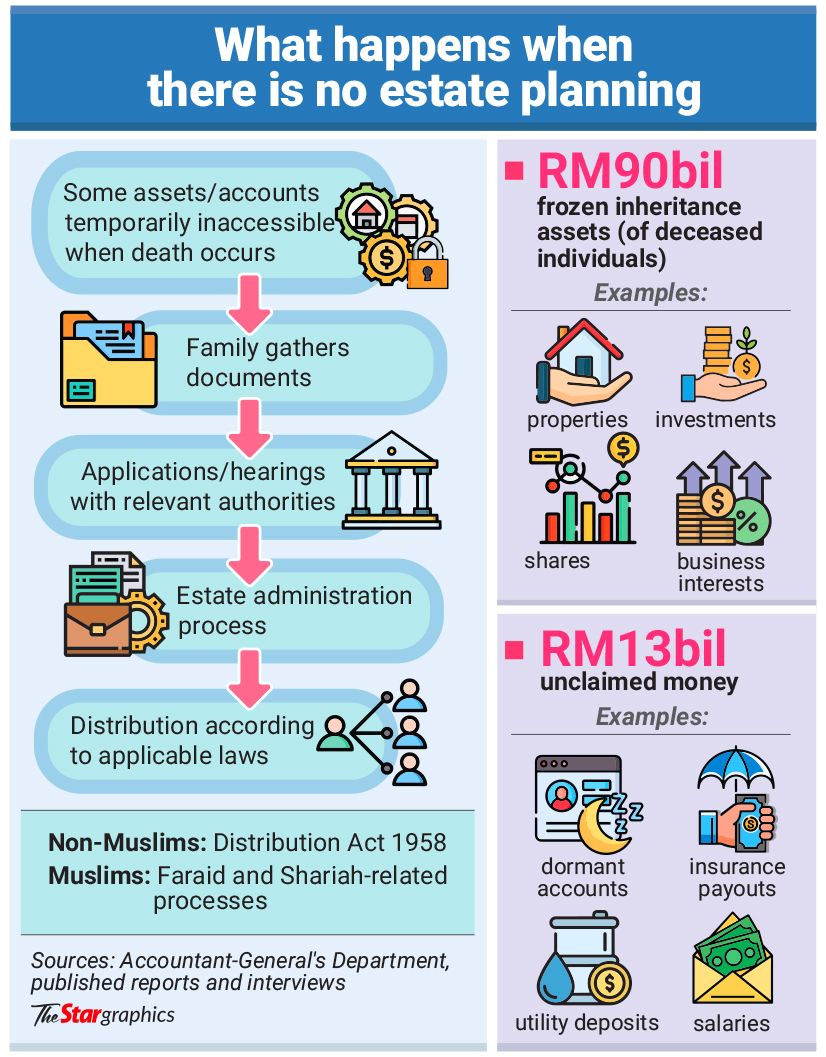
“In practice, assets are often frozen upon death, and the will still needs to go through the courts to obtain a Grant of Probate before anything can be distributed,” she said.
A Grant of Probate is a court document that gives an executor – usually a trusted family member, friend or named lawyer – the authority to manage and distribute a deceased person’s estate according to the will.
Wong said some people also wrongly assume verbal promises or informal notes to be sufficient.
“Spoken instructions and casual, unwitnessed writings carry no legal weight and are one of the biggest causes of family disputes after someone passes away,” she said.
Wong advised Malaysians to start with a legally valid will, review their Employees Provi-dent Fund and insurance or takaful nominations regularly, and keep proper records of assets and liabilities.
“Estate planning does not have to be overwhelming. Getting proper guidance early can save your family a great deal of stress and complications down the road,” she said.
Lawyer Joshua Kong said a common legal problem families face when someone dies without proper estate planning is disagreements over how inherited properties should be handled.
“The root of the problem is that a property suddenly has multiple new legal owners after the death, and these new owners disagree on whether it should be sold, or for how much,” he said.
Kong said a properly considered and drafted will could potentially prevent years of legal disputes among surviving family members.
“A will can dictate how the deceased’s properties are to be dealt with, including how it should be sold and who gets the proceeds of the sale,” he said.
If there is no will, Kong said distribution of assets for non- Muslims will instead follow the Distribution Act, which determines how an estate is divided among surviving family members.
He said disputes involving inherited properties could become increasingly complicated over time, especially when beneficiaries themselves die and their shares are transferred to the next generation of heirs.
“Those next of kin may have different ideas on how to deal with the property, and the cycle continues,” he said.