



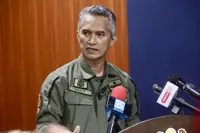
JOHOR BARU: Travellers will be able to cross between Johor and Singapore in just six minutes once the Rapid Transit System (RTS) Link begins operations, says Datuk Seri Saifuddin Nasution Ismail.
The Home Minister said the 4km rail link, expected to handle up to 10,000 passengers per hour in each direction, has reached 90% completion as of April 30.
He said preparations for the launch are now being intensified, particularly in security, technology and manpower.
“A total of 794 staffing warrants have been approved, involving 640 personnel from the Border Control and Protection Agency (AKPS), 47 from the Customs Department and 107 police officers.
“Recruitment is being carried out in stages to ensure there will be no manpower constraints when operations begin,” he told reporters after visiting the RTS Link project site at Bukit Chagar here yesterday.
Saifuddin Nasution said 478 newly appointed officers will undergo training at the Segamat Police Training Centre from June 22 to Sept 27.
Upon completing training, they will first be deployed to the Sultan Iskandar Building and Sultan Abu Bakar Complex before being stationed at the Bukit Chagar Customs, Immigration and Quarantine (CIQ) Complex beginning Oct 1.
He added that the Bukit Chagar CIQ facility will be equipped with 18 baggage scanners, 22 body scanners and 10mm-wave walkthrough scanners, which are currently undergoing installation and testing.
“Our intention is not to make travel difficult for people. Our goal is to ensure the screening process is fast, accurate and carried out with full integrity, while facilitating passenger movement without compromising national security,” he said.
On cross-border coordination, Saifuddin Nasution said technical negotiations between Malaysia and Singapore on standard operating procedures for the RTS Link’s co-located CIQ facilities are progressing smoothly.
Under the arrangement, Singapore enforcement agencies will operate in Malaysia, while Malaysian officers will be stationed in Woodlands.
“They will carry out immigration inspections, security duties, incident management, operational communications and emergency response. All these need to be coordinated,” he said.
However, he noted that both countries must first resolve their respective domestic legal matters before the co-located concept can be implemented.
On contingency planning, Saifuddin Nasution said the vendor behind the National Integrated Immigration System (MyNIISe) has been instructed to adopt a pre-mortem approach ahead of RTS Link operations.
“They must think ahead about what could go wrong and prepare mitigation plans before problems occur, instead of only conducting a post-mortem afterwards,” he said.
He added that the rollout of MyNIISe, which will replace the decades-old Malaysian Immigration System (MyIMMs), is aimed at reducing recurring system disruptions.
“Replacing the old system with a new one will involve a transition and integration phase. There will inevitably be glitches. No system is perfect during such a process.
“What is important is the Home Ministry’s commitment to mitigating those disruptions,” he said.
Commenting on the two-hour nationwide immigration system disruption on April 22, Saifuddin Nasution said the incident involved the old system.
“We know these disruptions happen because we are still relying on the old system until the new one becomes fully operational.
“I understand if the public still has concerns because the existing system has been used for decades, but give us the opportunity to implement this new system,” he said.
Last month, tens of thousands of travellers were stranded in long queues at entry points nationwide after a major glitch caused the country’s immigration system to crash.


