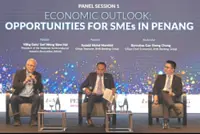
GEORGE TOWN: Malaysia’s relative political and social stability has become a strategic advantage in an increasingly fragmented global landscape, says Steven Sim Chee Keong.
The Entrepreneur and Cooperatives Minister said Malaysia today enjoys a “climate of stability” compared not only with conflict-hit regions such as Palestine and Ukraine, but also relative to many countries within the region itself.
“We have a relatively stable climate. Political stability, social stability,” he said in his keynote address during an Entrepreneur and Cooperatives Ministry (MECD) town hall session on Saturday (May 9).
Sim said such stability has placed Malaysia in a favourable position amid global economic uncertainties, particularly as nations compete to secure trade routes, tariff advantages and stronger economic alliances.
“In today’s world, anyone who can pick up the phone and make deals on tariffs and trade has an advantage. Malaysia’s neutrality, centrality and moderation over the years have become a premium in the world,” he said.
He said that Malaysia’s strategic geographical location further strengthened its global economic relevance, positioning the country between some of the world’s most influential economic zones.
To the East, he pointed the Guangdong-Hong Kong-Macau Greater Bay Area, which he described as a global powerhouse for manufacturing, capital and scalability with a combined GDP exceeding US$2 trillion.
“To the West, we have the San Francisco Bay Area, home to Silicon Valley and one of the world’s leading centres for innovation and technology,” he said.
Sim added that Malaysia benefits from its proximity to the Bay of Bengal, a major global trade route linking Southeast Asia with South Asia and the Middle East.
He said Malaysia’s greatest long-term strength, however, lies in its human capital and multicultural society.
“We were among the earliest countries in the region to industrialise. We have more than 50 years of collective experience in manufacturing, technology and innovation,” he said.
Sim said Malaysia’s multilingual and multicultural workforce offers a unique advantage to global investors, particularly in facilitating business ties across different regions and markets.
“All of us can speak Bahasa Melayu, which is one of the most-spoken languages in Southeast Asia. Many Malaysians also speak English, while a significant portion can speak Chinese, Indian languages or even Arabic.
“But beyond language proficiency, we also have cultural fluency. That makes Malaysians highly adaptable in international business environments,” he said.
He added that Malaysia, particularly Penang, has long-established industrial and trade connections with major economies, giving the country a solid foundation to remain competitive globally.
“We have the climate, the geography and the human capital. I think we have what it takes. We just need to get our act together,” he said.