

Universiti Kebangsaan Malaysia (UKM) Prof Dr Salawati Mat Basir said that the Strait of Malacca comes under the influence of Malaysia, Indonesia and Singapore.
As such, she said that governing the strait required a delicate balance between the sovereignty of the nations involved and the maritime transit rights of the rest of the shipping world.
“It is the most efficient shortest path between the Indian and Pacific Oceans and international law ensures it cannot be treated like a private road,” she added.
She said that both maritime and air passage through the strait cannot be suspended or prohibited under the United Nations Convention on the Law of the Sea (Unclos).
“Under Unclos, territorial states such as Malaysia, Indonesia, Singapore and Thailand are legally prohibited from impeding or suspending the passage of foreign ships or imposing tolls or taxes,” she added.
There also cannot be any discrimination against vessels based on their flag destination or cargo, she added.
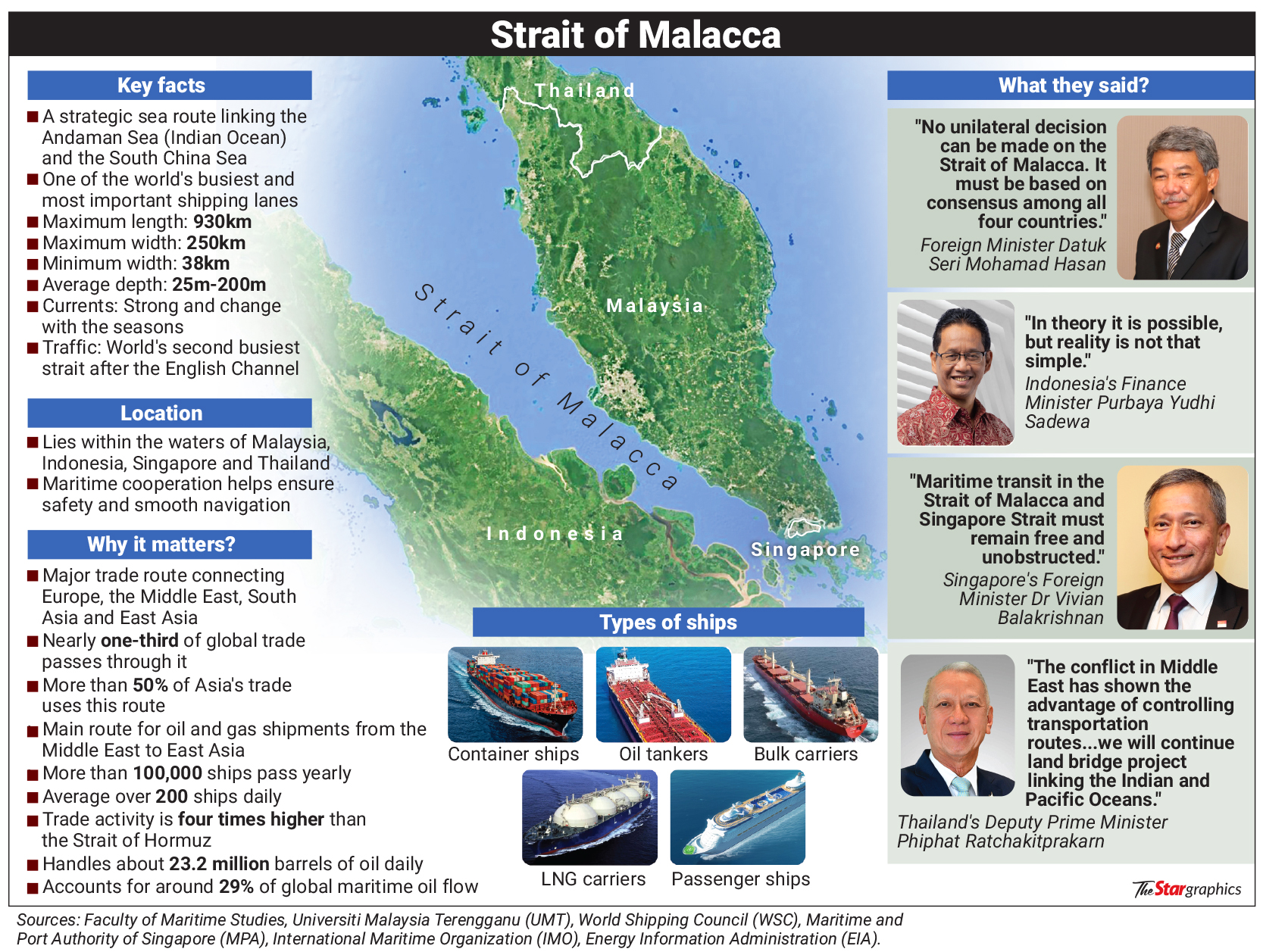
“The Strait of Malacca handles nearly 21 million barrels of oil per day, which is about 20% of the global supply and also 20% of the world’s liquefied natural gas.
“It also has a long detour around Indonesia but Hormuz is a dead end,” she said.
In terms of vessel volume, she noted that between 100 and 500 vessels passed through the narrow waterway each day last year, making it more important than Hormuz.
“This is because it carries approximately between 22% and 40% of all global maritime trade, which includes one quarter of the world traded goods.
“So you cannot apply the same aspects taking place at the Hormuz because this will bring more danger,” she added.
The Strait of Malacca is one of the world’s most critical maritime choke point, stretching some 900km between Peninsular Malaysia and Sumatra, Indonesia.
Meanwhile, political analyst Dr Tunku Mohar Tunku Mohd Mokhtar said the Strait of Malacca plays a significant role in global trade and should therefore remain free for navigation.
“East Asia relies heavily on the strait for its energy supply and nearly a quarter of global trade transits through it.
“Any closure or blockade would raise transportation costs and consequently the price of goods,” he said.
On April 23, Defence Minister Datuk Seri Mohamed Khaled Nordin said any decisions concerning the Strait of Malacca must be made collectively by all countries involved.
It was also reported that Indonesian Foreign Minister Sugiono assured that no tariffs would be imposed on vessels transiting the strait, as this would be against Unclos.
He added that Unclos recognises Indonesia as an archipelagic state and does not allow the imposition of tariffs on any straits within its territory.