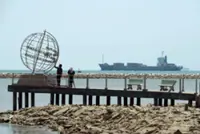
KUALA LUMPUR (Bernama): The commitment by the four littoral states of Malaysia, Indonesia, Singapore and Thailand to resist any attempt to weaponise the Strait of Melaka is now highly critical, as maritime law is being stamped upon and free navigation disrupted, as is happening in the Strait of Hormuz.
Any disruption to the Strait of Melaka, a strategic maritime chokepoint which handles 30 per cent of global trade, could raise costs, further depress international commerce and adversely impact economies.
It is a key artery of international commerce, even more so now due to the military conflict in West Asia, which has disrupted shipping in the Strait of Hormuz, which is another strategic chokepoint.
The vital importance of the 900 km Melaka Strait, which borders the four neighbouring ASEAN countries, is heightened by its role in connecting the Indian and Pacific Oceans and serving as the shortest sea route between East Asia and markets in West Asia and Europe.
It is a critical global shipping lane, handling around 94,000 vessel transits annually, or roughly 257 vessels per day, and carrying an estimated 30 per cent of global seaborne trade by value as well as a quarter of global oil shipments.
Tankers account for 29.4 per cent of transits in the Strait of Melaka, followed by container ships at 24.1 per cent and bulk carriers at 19.7 per cent. The remaining 26.8 per cent comprises general cargo, vehicle carriers, liquefied natural gas tankers, and other vessel types.
The strategic importance of the waterway also raises broader legal and systemic concerns, particularly regarding the application of the United Nations Convention on the Law of the Sea (UNCLOS), as sustained disruptions could test established norms governing freedom of navigation and maritime trade.
A shipping industry commentator and maritime scholar, Nazery Khalid, said the Strait of Hormuz’s continued closure will create a domino effect across global supply chains.
"As ships denied passage through the Strait of Hormuz continue to pile up in the Gulf of Oman and the Persian Gulf, there will be a domino effect on other global ports connected to the ports in the two gulfs.
"These include ports along the Strait of Melaka such as Port Klang and Singapore, which have extensive connectivity with ports in the two gulfs,” he added.
Nazery said disruptions in shipping flows would lead to cargo backlogs and bottlenecks across interconnected supply chains, reflecting the highly integrated nature of global maritime trade.
"The closure of the Strait of Hormuz is already disrupting global energy supplies significantly, and much of the global oil and gas shipments pass through the Strait of Melaka en route to East Asia,” he said, adding that the strait is already feeling a secondary impact from the disruptions in the Gulf region.
Nazery elaborated that there was increased naval activity, including the interception of vessels linked to Iran.
This has further heightened uncertainty about shipping routes through the Persian Gulf and the Gulf of Oman, adding pressure to global logistics networks.
Meanwhile, Federation of Malaysian Freight Forwarders (FMFF) president Datuk Dr Tony Chia Han Teu said instability in West Asia, including risks of escalation in military conflict in the Red Sea, represents a broader structural threat to global shipping.
"When vessels avoid the Red Sea and reroute via the Cape of Good Hope, transit times increase by 10 to 15 days. This reduces effective capacity and drives up freight and insurance costs,” he said.
He added that simultaneous instability across multiple maritime corridors is creating a "dual chokepoint pressure” on global logistics.
"This creates a structural risk premium in both oil prices and shipping costs,” he said.
The situation has also revived attention regarding the so-called "Malacca Dilemma”, a term coined by Chinese officials in 2003, referring to China’s reliance on the strait for trade and energy flows.
China, the world’s second-largest economy by nominal gross domestic product and the largest exporter, is Malaysia’s biggest trading partner for 17 consecutive years, with bilateral trade reaching about US$191.66 billion (US$1 = RM3.96) in 2025.
Key trade flows through the strait include electronics, machinery and petroleum products, making it a vital corridor for regional supply chains, including China’s manufacturing and automotive sectors.
While alternative routes such as the Sunda and Lombok Straits exist, shipping through these passages would result in significantly longer voyages and higher logistics costs.
-- BERNAMA