



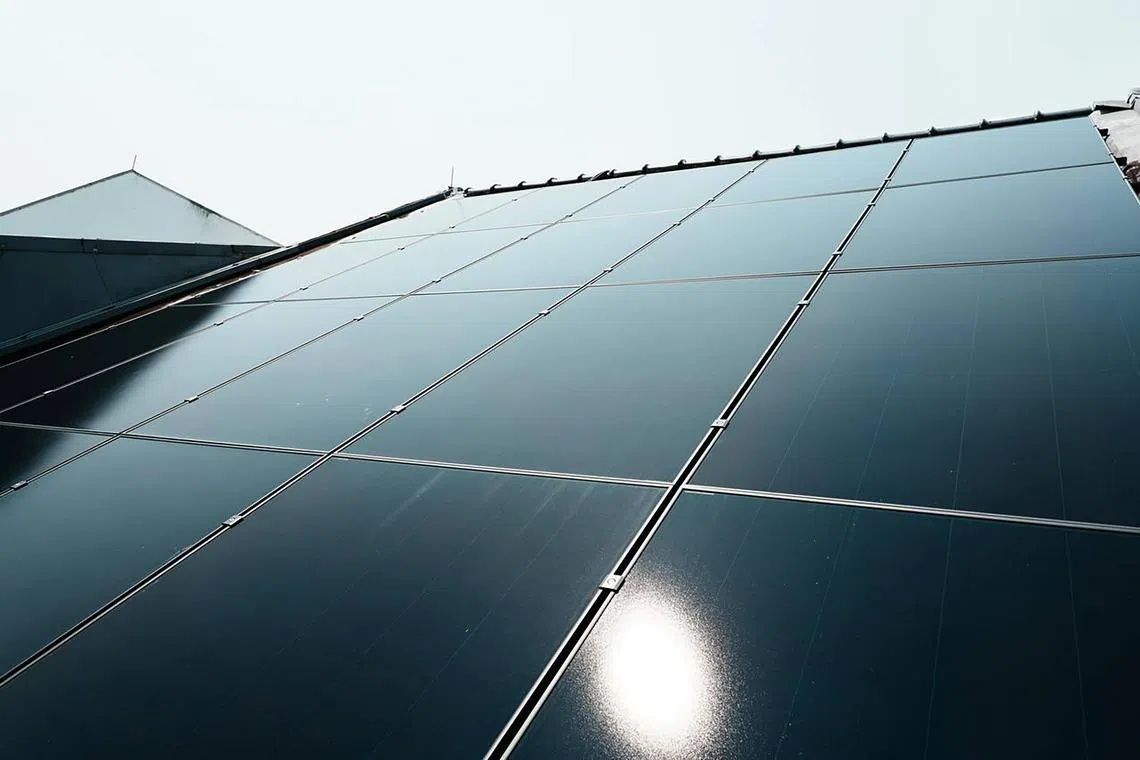
SINGAPORE (The Straits Times/ANN): More landed households are installing rooftop solar panels, with the ongoing energy crisis and escalating fuel prices providing the final push for them to tap the sun’s energy to power their homes and electric vehicles (EVs).
Most of the eight solar panel companies here told The Straits Times that they have received more enquiries and orders since the Middle East conflict started on Feb 28.
Rising energy prices have sent electricity tariffs higher since April 1, and a further increase is expected in July. Residents cite lower electricity bills, falling prices of solar panel installations, volatile energy prices, ownership of EVs and sustainability as factors for turning to solar, with some even earning revenue from feeding excess energy to the grid.
Solar energy company Sunollo’s chief executive Nathalie Risteau said her firm has received about 110 per cent more residential enquiries since March 1, compared with January and February.
Enquiries with FOMO Energy were also up by 60 per cent to 70 per cent since the start of March, from previous months, the solar energy firm’s business development manager Dionne Sim said.
“With global fuel prices becoming more unpredictable, home owners are looking for ways to regain control over their energy costs and solar is increasingly seen as a practical hedge,” said Ms Sim.
Uptake in solar panel installations across residentials
Energy Market Authority (EMA) director of Solar & Grid solutions Violet Chen said that over the years, Singapore has seen “significant growth” of solar deployment at private residences.
The latest available figures show that the number of homes with solar has increased from 1,749 in 2021 to 6,912 in 2025, she said. The total installed capacity stood at 115.3 megawatt-peak (MWp) in December 2025, up from 77.8MWp in December 2024. An installed capacity of 115.3MWp can power 25,415 four-room HDB flats for a year.
“This is driven by strong economics for rooftop solar PV (photovoltaic) systems,” said Ms Chen.
Home owners may now achieve payback in under five years, given the sharp fall in the cost of solar panels, she noted. Payback period refers to the time taken for energy savings from the system to recover the upfront costs of the installation.
“Solar panels can last 20 years or more, so after five years, you basically get free electricity for another 15 years,” she said.
Dr Thomas Reindl, deputy chief executive at the Solar Energy Research Institute of Singapore, said that Singapore’s limited land space means that there is a need to deploy solar on as many possible surfaces as possible.
“Even if every single installation is small, collectively they still generate a large amount of electricity,” he said.
Singapore has limited potential for other forms of renewable energy, such as tidal or wind power, making solar the main domestically viable option, although its potential remains small relative to the nation’s total energy needs.
While the city-state is exploring other energy sources, such as hydrogen and geothermal energy, it relies on imported natural gas for over 95 per cent of its electricity.
Ms Risteau from Sunollo said that higher electricity prices tend to spur greater home owners’ interest in solar as the savings become more immediate and easier to grasp.
She added: “What was previously seen as a sustainability-led purchase increasingly becomes a practical household financial decision.”
Mr Benedict Goh, chief executive of solar firm Utica, said that while home owners are unlikely to react hastily to spikes in electricity prices, the recent war has accelerated the decision-making process for some of them.
“Under normal circumstances, owners may take more than three months to decide after receiving our proposal,” he said. But in March, his firm saw about a 30 per cent increase in confirmation of installation from enquiries made in the preceding two months, as compared with March 2025.
Mr Ivan Lim, director of solar energy firm Solar Lab, said the Middle East conflict has indirectly increased awareness of energy security and price volatility among home owners.
“This has nudged home owners who were previously on the fence to move forward with solar adoption,” he said, adding that he received three times more enquiries in March than in January and February. Installations have also doubled.
Home owner Mathew Pereira said he had been thinking of installing solar panels for his three-storey house since 2020, but held back given the higher upfront costs back then, when he was quoted forJotham Chan about $30,000.
Incentivised by the lower electricity bill over the long term as well as falling prices of solar panel installations over recent years, the 69-year-old retired journalist took the plunge, triggered by the current energy crisis.
“For me, (the Middle East conflict) was just a confirmation that it was the right time to install the solar panels,” he said.
He paid about $19,000 to install 35 solar panels in early April, and estimated to break even in about 3½ years – with the intention of getting an EV.
He added that the savings from the system could also help to offset his water and refuse removal costs.
Mr Nicholas Neo, who installed 28 solar panels with battery storage in March for $30,000, said: “I don’t know how far the energy prices will rise, so this solar energy helps me to lock in ‘free energy’.”
The 47-year-old owner of a solar film company added: “While I had not planned to install solar panels because of the war, the current situation makes having them more significant.”
For others, like Ms Gemma Tay, harnessing solar energy has cut her electricity bill by more than half for the past year, from $440 a month to $210. And this includes charging her electric car, which she now uses more than her petrol-run car.
Before she switched to an EV in January 2025, the 49-year-old banking consultant spent about $400 a month on petrol.
The 33 solar panels she installed for less than $20,000 in May 2025 is a long-term investment that would provide cost savings for her family, Ms Tay said.
Mr Jotham Chan, head of residential at sustainable energy solutions provider Eigen Energy, said the rise of EV ownership has led more home owners to install EV chargers at home and realise that having solar panels could make financial sense.
“Generating your own electricity to charge your car makes the economics even more compelling,” said Mr Chan.
Excess solar-generated electricity can also be sold back to grid.
Mr Neo, for example, estimated he would use only 30 per cent of the energy generated from his panels, and can export the remaining to the national grid.
Besides landed properties, some condominiums are also looking into tapping solar.
La Casa in Woodlands currently has a study under way to assess the feasibility of adopting solar panels, said its management council chairman Mike Shee.
“We want to understand better whether the solar panels will benefit the condominium in terms of saving electricity in the common areas,” he said, noting that rising electricity prices, especially due to the ongoing Middle East conflict, are part of the condominium’s considerations beyond going green.
A constraint other condominiums have faced is limited rooftop space, with much of it already occupied by water pumps and other equipment, he noted.
According to a document by the Building and Construction Authority (BCA), less than 2 per cent of management corporation strata titles (MCSTs) have installed solar panels.
The document, which was uploaded on government feedback unit Reach’s website in March, is part of BCA’s review of the Building (Strata Management) Act to see how it can improve governance, maintenance and financial sustainability of strata developments.
The document noted that a special resolution of 75 per cent approval – which may be difficult for MCSTs to meet – is needed for solar panels to be installed on common property.
“BCA is exploring reducing the resolution requirement to facilitate MCSTs’ installation of solar panels through third-party arrangements,” the document stated, adding that this could help reduce electricity costs for MCSTs without upfront investment from sinking funds.
Dr Reindl said that individuals can contribute to the national target of decarbonisation by adopting solar power and help Singapore to reach its net-zero goals by 2050.
Achieving this would require the energy sector, which makes up about 40 per cent of the nation’s total emissions, to cut its emissions.
“This is a very ambitious target for a high-tech nation and everybody needs to put his/her shoulder to the wheel… Every green electron counts,” he said.
A scenario of how a payback period is calculated:
Using Mr Pereira’s solar panel installation as an example, this is how his estimated payback period was calculated.
The household of Mr Pereira – whose solar panels can generate about 1,700 kilowatt-hour (kWh) of power monthly – consumes about 1,200kWh of electricity a month.
Before installing solar panels, his monthly bill would be about 1,200kWh x 30 cents (electricity tariff) = $360.
After installing solar panels, if he evenly divides his consumption into half, between day and night usage, he will utilise 600kWh in the day for his monthly usage and export the surplus 1,100kWh to the grid. For his night-time energy needs, he will need to buy 600kWh of electricity.
It is expected that he earns about 20 cents per kWh of solar energy he exports.
In this case, How much he will save in a month from consuming his own solar energy: 600kWh x 30 cents = $180
How much he will receive in a month from exporting his excess solar energy: 1100kWh x 20 cents = $220
Total savings in a month: $180 + $220 = $400
Considering that his solar panel system costs about $19,000, his payback period would be about $19,000 ÷ $400 = 47.5 months (about 3.9 years).
Assuming that he uses all of his solar energy, his monthly savings would be 1700kWh x 30 cents = $510.
His payback period would be about $19,000 ÷ $510 = 37.3 months (about 3.1 years)
There are several factors affecting payback period, including system size, electricity usage patterns and overall electricity consumption of the user.
According to EMA’s website, the average payback period is about five to seven years for residential solar installations. Consumers with higher electricity consumption levels and larger solar panel systems may see shorter payback periods.
GetSolar’s co-founder Bolong Chew said that besides helping home owners to hedge against rising electricity costs, solar panels at home also give them more predictability and control over their energy expenses, reducing reliance on the grid. Enquiries received by the solar start-up – particularly from landed households – doubled in March, compared with February, he added. -- The Straits Times/ANN

