
PETALING JAYA: When Covid-19 hit Malaysia, the numbers came fast - infections, deaths, hospital beds, ventilators.
Every day, authorities such as the Health Ministry and the World Health Organization released a fresh set of statistics.
The figures made headlines everywhere, but The Star wanted to dig deeper and find the stories hiding inside them to help readers make sense of it all.
As it happened, an effort to learn how to do just that was already under way.In early 2019, about a year before the pandemic started, chief content officer Datin Paduka Esther Ng asked senior news editor Razak Ahmad to explore a new storytelling tool for the digital age.
Known as data journalism, the approach involves analysing data on a specific topic to unearth interesting trends that could be turned into stories.
Online, data stories often feature multimedia and interactive graphics that allow readers to explore the data themselves. Razak attended training courses and learnt from every resource he could find, including YouTube videos.
“I realised that journalists don’t need to be experts in math, statistics, or coding to learn the basics,” he said.
“There are many tools available today designed for non-specialists to create data stories easily. What’s important is a willingness to step out of your comfort zone and learn something new.”
A small team was then formed, made up of reporters, editors and graphic designers. Known as StarPlus, the unit was tasked with producing data-driven and multimedia stories for The Star.
The team was still experimenting with data stories when the pandemic arrived.
“Covid-19 threw us into the deep end. Working closely, we managed to create nearly 100 data-driven stories on the pandemic alone," said Razak.
The most important stories of Covid-19 were the human ones - the nearly 40,000 lives lost, the livelihoods upended, as well as the bravery and sacrifices of frontliners.
But the daily stream of data held many other interesting stories that were waiting to be told. One example was when the pandemic worsened.
During the third wave in 2021, the Health Ministry disclosed that widespread community infections had become the norm, meaning the virus had spread so fast that many cases were no longer traceable to known clusters.
The team analysed the daily case figures and turned the numbers into a graphic that showed the worrying shift.
Another example was using data to measure the extent of the drop in foot traffic at public places during the movement control order (MCO). Using Google Maps’ “popular times” feature, the team found that foot traffic at Kuala Lumpur’s Suria KLCC plummeted by 74% on the first day of the MCO, with Central Market down by 70%.
Data also allowed the team to explore various aspects of the pandemic's economic toll. For example, many Malaysians lost their jobs and faced financial hardship. But for those with cash to spare, worries about the economy led them to save. This was a trend The Star picked up from an analysis of Bank Negara statistics. The numbers revealed a 17% rise in Malaysians' bank savings deposits in April 2020 due to the MCO, the sharpest rise in 12 years.
When the pandemic eased, the team went on to apply their “data lens” to everything from the Budget to pop culture.By analysing every Budget speech since 1960, the team dug up interesting facts and trivia about the tabling of the country’s annual spending plan.These included a ranking of the country’s budget speeches by length.The longest was Tun Tan Siew Sin's in 1966, which ran nearly three hours.The shortest was Tun Daim Zainuddin's in 2000, wrapped up in 45 minutes.
StarPlus even tracked the colour of the Finance Ministers' Baju Melayu during the tabling of the Budget each year, concluding that blue dominates on Budget Day.
Another story used data from Spotify to tune in to what Malaysians love listening to.The team found that each year, as Christmas approaches, listeners across Malaysia and many other Asean countries turn to one song in particular – Mariah Carey’s ‘All I Want for Christmas Is You’
Since 2020, data-driven and visual stories produced by StarPlus have won one gold and five silver awards at the annual Malaysian Press Institute-PETRONAS Malaysian Journalism Awards.
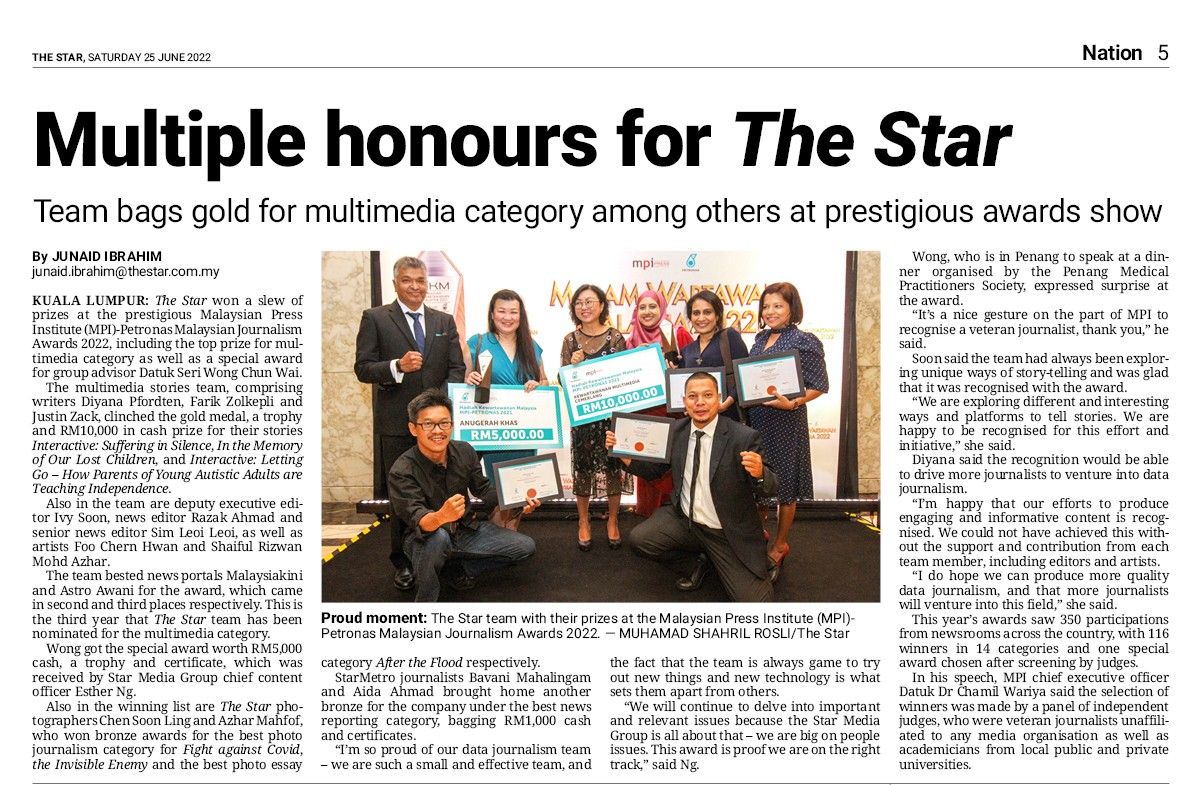
Most of the award-winning stories were the result of collaboration between the data team and journalists from other sections in The Star.
“Journalists from each section are experts in their respective beats, so working together allows us to share our skills, brainstorm and exchange ideas more freely. The stories we end up with are always better as a result,” said Razak.
Curious how data becomes a story? Watch the process in action by reading story at TheStar.com.my. Scan the QR Code to watch how data becomes a story