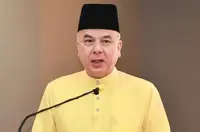
KUALA LUMPUR: Past mistakes of building first and governing later must not be repeated with the rise of current technologies such as artificial intelligence (AI), says Sultan of Perak, Sultan Nazrin Shah.
“And in our own era, we have repeatedly learned, and then seemingly forgotten, the hardest lesson of all: that we tend to build first and govern later. The atomic bomb was detonated before the world had any framework for its regulation.
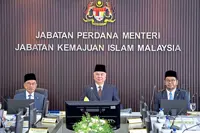
“We must not repeat that error with AI, genetic engineering or the other converging technologies of this century. They demand governance in advance, not in retrospect,” he said in his keynote address before launching the Putrajaya Forum held during the Defence Services Asia and National Security Asia 2026 exhibitions on Tuesday (April 21).
On emerging technologies including AI and quantum computing, he said that while such tools enhance security, it also carried risks.
“The deployment of AI in military contexts could inadvertently precipitate conflict. Through automation bias, humans could place too much trust in machines, allowing it to make life-or-death decisions that break moral and legal rules.
“Consider the implications: a cyberattack on a regional financial system could disrupt economies across borders within minutes while a breach of sensitive data could compromise national sovereignty without a single shot being fired.
“Thus, the very tools that promise progress also carry the seeds of instability. In some ways, of course, our present dilemma is not new,” he said.
Sultan Nazrin said the region's extraordinary diversity, in language, religion, culture and governance, is precisely what makes it vulnerable to AI systems calibrated on the assumptions of others.
"An algorithm that does not see us accurately will not serve us well and may even harm us.
“Between 2020 and 2024 alone, the region released thirty-five LLMs (large language modules) with specific Southeast Asian applications.
“With 700 million people speaking over a thousand languages, AI translation alone could do more to unite our region than decades of diplomacy.
“And we do not lack the talent to build these tools ourselves. We simply need to provide the opportunities, and to reward that talent rather than watch it slip away,” he said.