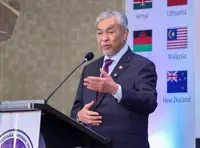
KEPALA BATAS: Conflict in the Middle East and disruptions to key global trade routes have created opportunities for Malaysia to strengthen its position as a stable and trusted halal hub, says Deputy Prime Minister Datuk Seri Dr Ahmad Zahid Hamidi.
He said the uncertainty caused by geopolitical tensions had exposed weaknesses in global supply chains and highlighted the need for Malaysia to build a stronger, more resilient halal ecosystem.
"The conflict in the Middle East, particularly involving strategic routes such as the Strait of Hormuz, has had a major impact on global supply chains.
"This disruption has not only affected the energy sector, but has also created a domino effect in the halal industry, from rising logistics costs and shipment delays to uncertainty over market access," he said here on Tuesday (April 7).
Ahmad Zahid said halal products, especially fresh food and temperature-controlled goods, were highly dependent on an efficient and stable supply chain.
He added that rising energy prices and raw material costs were also increasing production costs across the sector.
"In some sectors, fertiliser alone can account for up to 60% of production costs, directly affecting the country’s overall halal food value chain," he said.
Despite the challenges, he said Malaysia should view the uncertainty as a strategic opening.
"This global uncertainty has in fact created room for Malaysia to strengthen its position as a halal hub that is stable, trusted and resilient.
"Our ability to diversify export markets, strengthen domestic supply chains and improve logistics efficiency will be key to ensuring the country’s halal industry continues to grow, even in a challenging global environment," he said.
He added that Malaysia must reduce its dependence on external systems and focus on building stronger internal capacity.
"This is the time for us to move away from merely depending on the global system and instead build stronger, more organised and more resilient internal capacity," he said during the groundbreaking ceremony for phase two of the Penang Regional Development Authority (Perda) Halal Park development project in Kubang Menerong here.
The RM33mil project, spanning 4.05ha, is part of a broader 48.56ha halal industrial development by Perda aimed at strengthening the state’s halal industry infrastructure.
The new phase will include 22 single-storey light industrial units, an administration office, a multipurpose hall, and a food complex with five shop units, among other amenities.
Construction is expected to begin in July and be fully completed by July 2028.
Phase One, occupying 16.19ha, was completed in 2015.