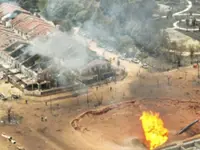
PETALING JAYA: A year after a massive gas pipeline explosion rocked Putra Heights, a former PETRONAS engineer and community leader called for stricter enforcement of safety buffer zones and the deployment of advanced monitoring technology to prevent future tragedies.
The incident, which occurred on the second day of Hari Raya Aidilfitri last year, sent towering flames and forced the emergency evacuation of nearby residents.
USJ 9 Al-Falah mosque chairman Tan Sri Syed Zainal Abidin Syed Mohamed Tahir said the anniversary serves as a crucial reminder of the risks posed by urban encroachment near hazardous infrastructure.
ALSO READ:
- Putra Heights blast still seared into firefighters’ memory
- Putra Heights blast victims still in limbo
- Hope shines amid despair
“I was at my home near the mosque in USJ9 when I saw the flames rising from Putra Heights.
“My first reaction was pure disbelief and I hoped there were no fatalities because based on our past experience, the heat generated from an explosion like that can extend beyond the community,” he told The Star.
Syed Zainal, a former non-independent and non-executive director at PETRONAS Dagangan Bhd, explained that the 2,623km gas pipeline network in Peninsular Malaysia, constructed with a designed lifespan of up to 50 years, was built with strict safety parameters.
“The pipes are buried 2-3m underground, coated for protection and undergo annual internal inspections known as pigging to check for corrosion and leaks,” said Syed Zainal, who worked as a project engineer for PETRONAS Gas Bhd on the construction of the gas pipelines in Subang Jaya between 1988 and 1990.
While PETRONAS maintains a 20m buffer zone where encroachment is strictly prohibited, he noted that enforcing these boundaries in rapidly developing urban residential areas remains a complex challenge.
“Excavation risks are particularly difficult to control. An excavator’s depth requires careful monitoring,” he said, pointing out that while PETRONAS monitors the lines, the authority to act against illegal land-clearing and digging largely falls on local municipal councils.
To adapt to growing urban density, he proposed overhauling current safety standards for pipelines situated near future residential areas.
“We need higher safety factors. This could mean increasing the burial depth, applying thicker pipe coatings, expanding the buffer zone from 20 to 40m and installing higher, more visible fencing,” he suggested.
He also urged authorities to invest in smarter technology.
“We should be deploying sensors to detect soil movement, which is far more critical than monitoring people. Satellite monitoring for earth shifts and reinstating monthly helicopter patrols would also provide early warnings,” he added.
Syed Zainal also said PETRONAS should be given more authority to take action against those who encroach on its properties.