PETALING JAYA: Efforts to improve electronic waste (e-waste) management are being stepped up, with plans to expand collection facilities and make disposal more accessible to the public, says the Natural Resources and Environmental Sustainability Ministry.
The ministry said access to collection centres is key to improving household e-waste recovery rates, as well as encouraging greater public participation in proper disposal practices.
To this end, it is working to expand collection facilities while also strengthening public awareness on the safe disposal and recycling of e-waste.
The ministry was responding to findings that Malaysia generates the third-highest amount of e-waste per capita in Asean, according to the United Nations Institute for Training and Research.
In the Global E-waste Monitor 2024 report, the institute revealed that each person in Malaysia produces an average of 12.2kg of e-waste annually, well above the global average of 7.8kg.
Across Asean, Singapore tops the list with 20.3kg per capita, followed by Brunei (19.9kg), while Thailand ranks fourth at 10.5kg.
Globally, the report estimates that 62 million tonnes of e-waste were generated in 2022.
Currently, Malaysia has 23 full e-waste recovery licensed facilities and 110 partial e-waste licensed facilities nationwide.
As of 2025, there are 157 centres registered with the Department of Environment nationwide for household e-waste collection, the ministry said.
“Going forward, the ministry plans to expand collection infrastructure through collaboration with local authorities, retailers, shopping complexes, licensed recovery facilities and industry players, ensuring more convenient collection points in high- density areas and locations in need.
“We are also working closely with local authorities, retailers and licensed recycling operators to support this expansion,” the ministry said.
It added that the upcoming implementation of the Extended Producer Responsibility (EPR) framework will further strengthen the role of producers in ensuring easier disposal of e-waste through support for recycling.
“Under the EPR framework, producers and relevant stakeholders will play a greater role in developing take-back systems and financing collection networks,” it said.
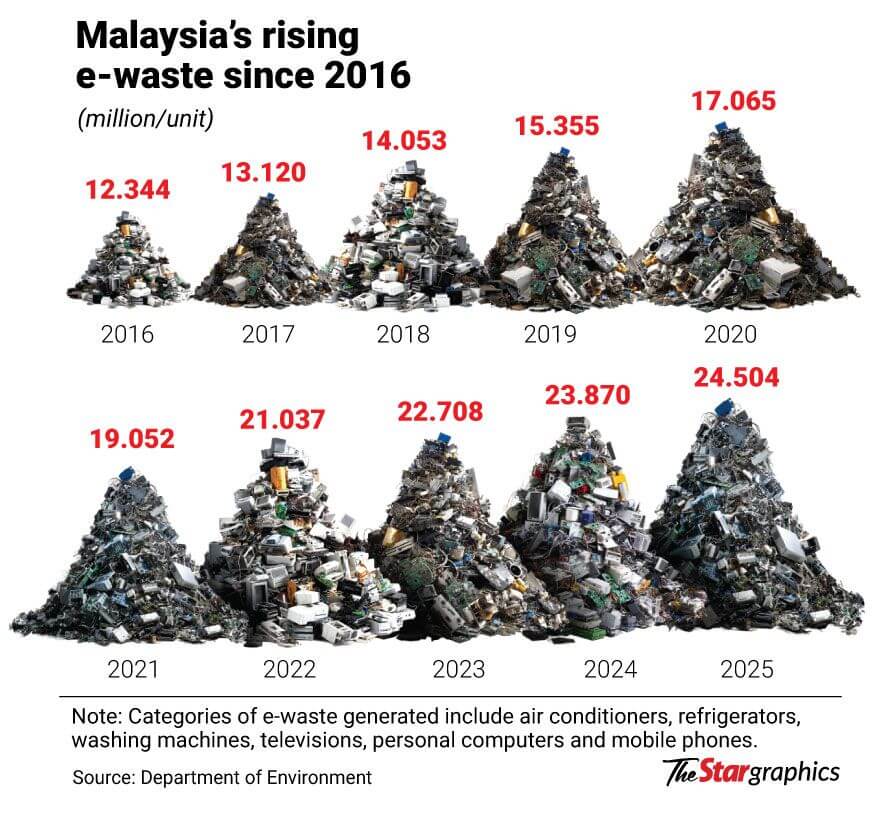
The ministry acknowledged that Malaysia’s growing appetite for affordable technology, rapid device turnover, urbanisation and limited awareness of proper disposal practices are driving the surge in e-waste.