
PETALING JAYA: Air conditioner units will now be rated by how well they perform in real life, but experts say the new ratings will take time to be accepted by consumers.
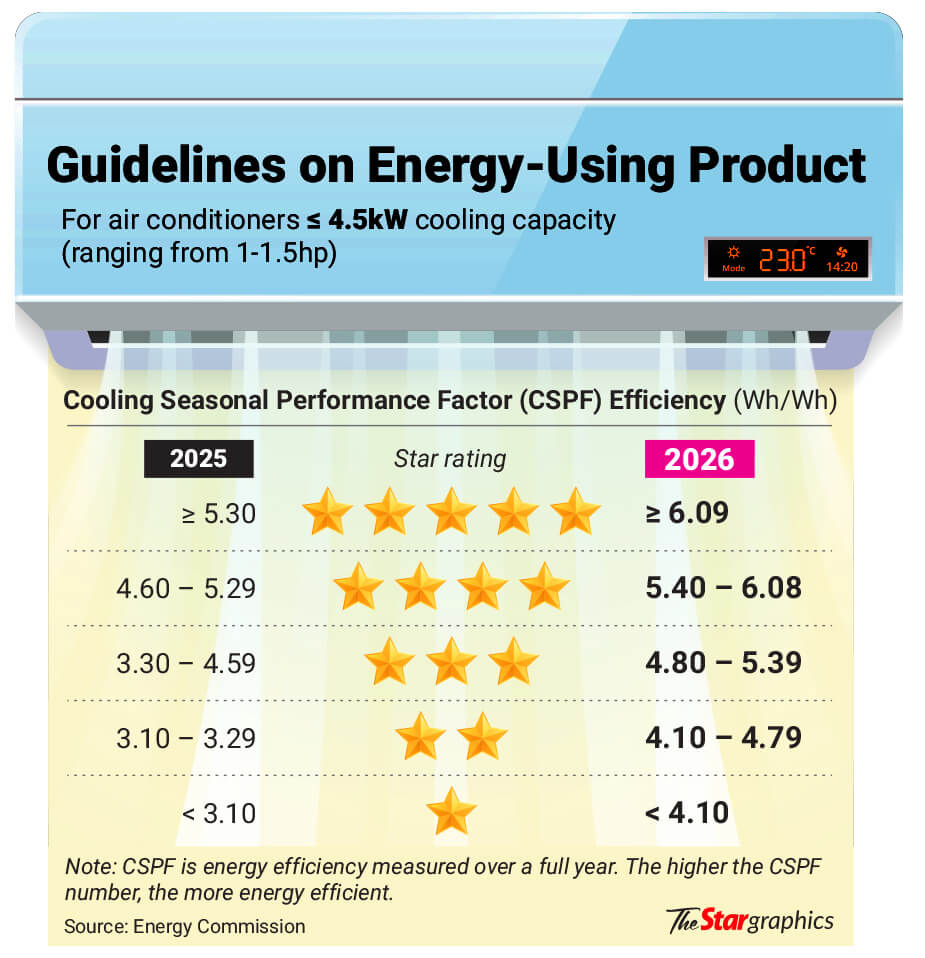
Under the framework updated in January, a unit will be judged by how efficiently it cools a room relative to the electricity it consumes over a year, with higher values indicating better energy efficiency, rather than fixed laboratory conditions.
The change means the star rating now reflects real-life cooling performance more accurately rather than just controlled test results.
The rating is aimed at helping households better identify more energy-efficient air conditioner units which are usually pricier.
Previously, air conditioners were rated largely based on fixed laboratory testing conditions, where five stars indicated the most energy-efficient units under the earlier benchmark.
While the system still uses the familiar one to five-star labels, the performance benchmarks have been tightened.
The changes aim to curb rating inflation, drive manufacturer innovation and support national energy-efficiency goals as air conditioner ownership continues to rise.
ALSO READ: Consumers now more aware of energy efficiency
Universiti Tenaga Nasional senior lecturer Dr Amar Hisham Jaafar, who led a national research project on the local electrical appliance market, said the revised labels under the new Guidelines on Energy-Using Product framework made it easier for consumers to distinguish genuinely efficient products.
“Air conditioners are already a common household appliance. The Statistics Department reported that 68.8% of households owned air conditioners in 2024.
“When air conditioners are used daily, mainly at night, electricity cost becomes a long-term household commitment rather than a one-off purchase decision,” he said.
Amar Hisham said the revised rating system will help households opt for models which could deliver the same level of comfort using less electricity.
“When a label is credible and the performance criteria tightened, it becomes easier for consumers to distinguish genuinely efficient products from those that only look attractive based on price,” he added.
He said households that relied heavily on air conditioning are likely to consider higher-efficiency models, even if it costs more initially, as energy savings will accumulate over time.
“The revised schedule raises the benchmark for new products entering the market. It does not mean that existing air conditioners suddenly become inefficient overnight.
“Air conditioners typically last between 10 and 15 years if properly maintained. Regular servicing, cleaning the filters and setting reasonable temperatures can help households keep the unit running efficiently,” he said.
On the revised rating system, Amar Hisham said labels alone might not be enough to change buying behaviour, mainly among lower-income households.
“Labels work best when they are combined with public understanding and practical support.
“Clearer explanations of how star ratings translate into electricity use and monthly costs will help consumers make better purchasing decisions,” he said.
Federation of Malaysian Consumers Associations (Fomca) chief executive officer Saravanan Thambirajah advised consumers to better understand lifetime ownership costs rather than focusing solely on sticker prices.
“For households that use air conditioners frequently, the difference in electricity consumption between low-efficiency units and four- to five-star models can be significant.
“Families can realistically expect savings of about 20% to 40% on cooling-related electricity use, depending on usage patterns.
“Over several years, that can translate into hundreds or even thousands of ringgit,” he said.