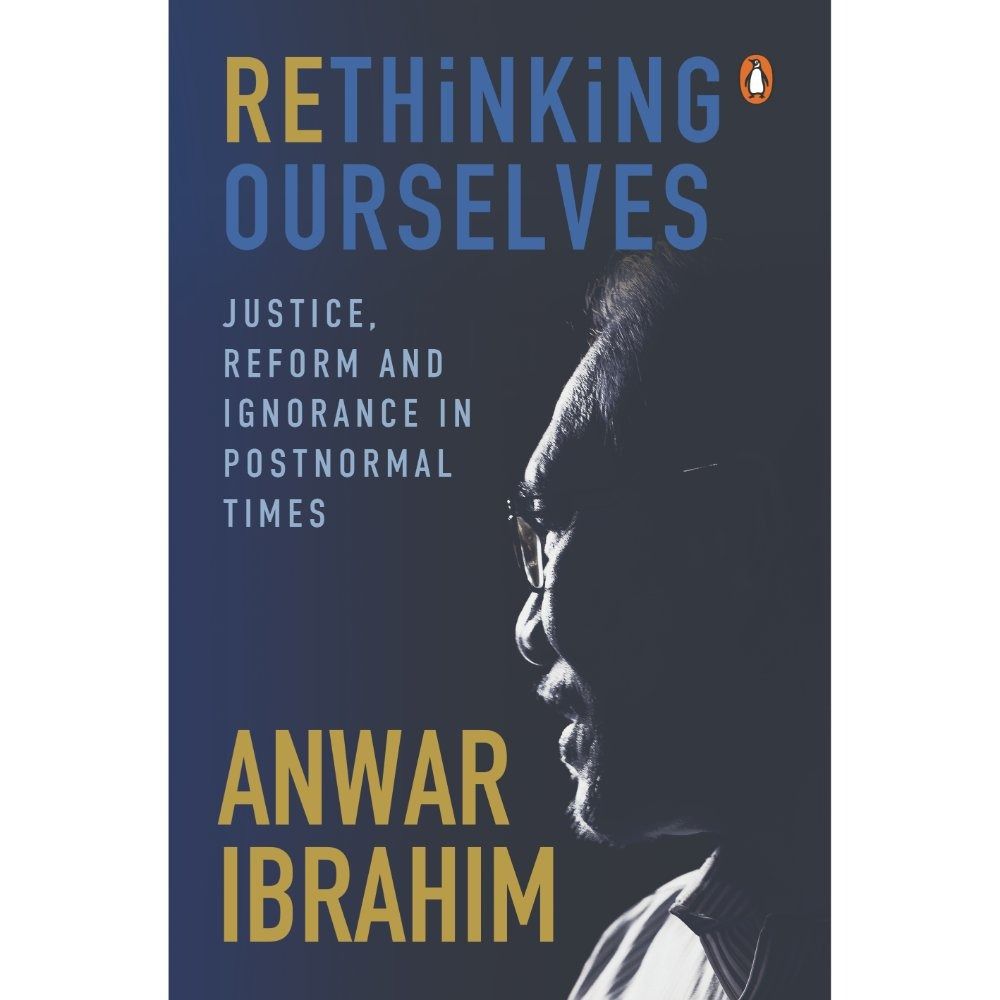
Rethinking Ourselves reads as a memoir and an intellectual journey. These autobiographical strands give emotional weight to his ideas about justice, freedom, struggle, and dignity.
Rethinking Ourselves is a deeply reflective and intellectually ambitious work from Datuk Seri Anwar Ibrahim — one that blends autobiography, political philosophy, and a manifesto for moral and societal reform.
From the off-set, the title of the book sets the tone for readers to expect a dose of high-brow discourse.
While much of the content seems like an abstract academic exercise, Anwar intertwines lived experience with deep contemplation.
When one starts to turn the pages, the Prime Minister begins to share the time he spent in prison and how he has shaped his political beliefs and principles, much of it has not been said before.
During his incarceration in 1998, books on social justice, freedom and democracy, development and progress, were at the top of his reading list, mostly the work of philosophers and thinkers.
There was also an assortment of books of all shapes and ideas at the time of his imprisonment in 1974.
During his time at Sungai Buloh Prison, which he called his sojourn, between 2015 and 2018, his mind was firmly focused on the nature of oppression and the fragile state of democracy.
His book includes the result of his jottings from prison, sometimes in illegible hand scribbles. Much of the book’s power stems from its grounding in Anwar’s own life.
He wrote that after his release from prison in 2004, “I was confronted with a political scenario that was completely different.’’
“Cash is king" was the mantra of the ruling kleptocrats, celebrating with glee and gusto the looters of the state, as the then prime minister himself noted with hubristic pride.
“Corruption not only thrived, but it was also full, blatant display. It was our gilded age of opulence, paraded unashamedly. Elites walked around as if they were demigods, untouchable, and answerable to no one.’’
The 1Malaysia Development Berhad (1MDB) humiliation, he wrote, was a symptom of the disease.
And given that Malaysia had inherited RM34bil in principal debt and RM17bil in interest commitments as a result of the 1MDB fiasco, we are certainly living in unusual times.
The gist of the book is simply – “we can’t return to normal, because the normal that we had was precisely the problem” – a graffiti on a Hong Kong subway station that remains etched in Anwar’s mind.
The central theme of the book is consistent with the concept developed by his good friend, scholar Ziauddin Sardar, who introduced the term – postnormal times (PNT) to describe our current era as a turbulent, where old certainties have collapsed, characterised by complexity, chaos and contradictions.
Against this backdrop, traditional problem-solving has become ineffective and it requires new approaches.
Anwar elaborates that traditional frameworks of politics and social order no longer suffice in a world where technological acceleration and moral challenges are reshaping how societies function.
At its core, the 292-page book invites readers to reconsider not only how we think about society and governance but how we understand ourselves and our roles within an age of rapid global change.
Rethinking Ourselves reads as a memoir and an intellectual journey. These autobiographical strands give emotional weight to his ideas about justice, freedom, struggle, and dignity.
The general themes of the book is essentially on justice and reform, where Anwar argues that true justice extends beyond legal rhetoric especially in societies grappling with corruption, inequality and institutional failings.
He also redefines ignorance not merely as lack of knowledge, but as structural and systemic barriers that prevent societies from confronting the truth.
As with the main theme of PNT, he frames today’s world as one that demands adaptive, ethical leadership capable of navigating uncertainty without sacrificing human values.
He insisted on the need to “rethink our world and to rethink ourselves.”
The gem of the book is Anwar’s use of personal narrative, which provided the book the emotional resonance.
The challenge to the book is that its intellectual density and philosophical depth may make it less accessible to the general reader, especially those without a background in political theory.
It’s not an easy read but as one reviewer put it the book’s intentions are admirable but its impact could be greater if its ideas were translated more directly into accessible language and practical frameworks for grassroots engagement.
But without doubt, Rethinking Ourselves stands as a significant contribution to contemporary political thought from South-East Asia, a region whose voices are often underrepresented in global intellectual discourse.
It positions Anwar not just as a political leader but as a reflective thinker grappling with the moral demands of our times, or perhaps in unpredictable times.