IPOH: Perak will continue exporting non-radioactive rare earth elements (NR-REE) until the federal government decides otherwise, Mentri Besar Datuk Seri Saarani Mohamad says.
This follows the federal government’s move to impose a moratorium on the export of NR-REE from 2025 to 2027 to support the growth of the midstream industry, announced on Nov 14.
Saarani explained that under federal policy, raw materials are generally not allowed to be exported, except in Perak’s case.
“Perak is still in the pilot project phase, so we were given special permission to export.
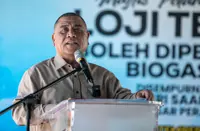
“Otherwise, the extracted material would go to waste. From time to time, Perak has been granted this approval until the authorities decide to stop it,” he told reporters after officiating the Aspirasi Geospatial Perak 2025 programme, themed ‘GIS Nadi Transformasi Sosioekonomi Berdaya Tahan’, on Wednesday (Dec 3).
“For now, we are still allowed to export, while at the same time working to develop our own NR-REE industry — not only in the upstream sector, but also the midstream sector to separate the elements, and importantly, the downstream sector.
“We want to develop local industries that can produce products from these materials,” he added.
When asked whether existing agreements with China would be affected by the federal government’s decision, Saarani said they would not.
On the possibility of other countries being allowed to enter the market and export NR-REE, Saarani said this would depend on what they could contribute.
“If they want to come and share their technology, yes, we welcome them. But if they only want to take our natural resources, then no.
“They must negotiate with us and help develop the industry together, including through technology sharing, because we want to maximise the value of our natural resources,” he said.
On the programme, Saarani said the state had launched dashboardperumahan, also known as Hartanah@Perak, a geospatial-based digital reporting platform that provides more detailed, transparent and easily accessible information on housing development across the state.
He said the dashboard, developed in collaboration between the Perak State Economic Planning Unit (UPEN/PerakGIS) and the Perak Housing and Property Board (LPHP), maps and profiles housing projects by displaying planning data, construction status, locations, housing categories, as well as information on delayed and abandoned projects.
“Through this dashboard, the state government can monitor the progress of the Perak Sejahtera 2030 housing targets more comprehensively, while also serving as a clear reference source for local councils, technical agencies and the public,” he said.
He added that this approach is crucial to ensure Hartanah@Perak functions optimally and supports the state government’s goal of positioning Perak as a modern, competitive state driven by data and technology.