
GERIK: The Education Ministry launched the country's first floating school at Tasik Banding in October to enhance educational access for Orang Asli children.
Minister Fadhlina Sidek said the initiative, introduced under the ministry's Special Programme (ProKhas), provides an alternative learning space.
She mentioned that the floating school was designed as a community-based intervention to address long-standing challenges, specifically in attracting Orang Asli children to school and in understanding the barriers that prevent them from accessing formal education.
"Alhamdulillah, the response has been very positive so far. We are still working to bring more children from the interior to join. When they see their friends attending school, we hope their interest will grow.
"This is where our commitment begins to ensure no child is left behind. The floating-school approach is also about building trust with the community. We certainly have more significant plans ahead," she said after visiting the Tasik Banding Floating School recently.
Fadhlina said the teaching and learning process at the school was customised to students of different ages and abilities, with teachers applying differentiated pedagogical approaches to ensure more effective learning.
"Our teachers are trained in pedagogy and know how to manage mixed-level classrooms through differentiated instruction.
"We first divide students into two levels, then teachers conduct assessments to plan their educational progress step by step," she explained.
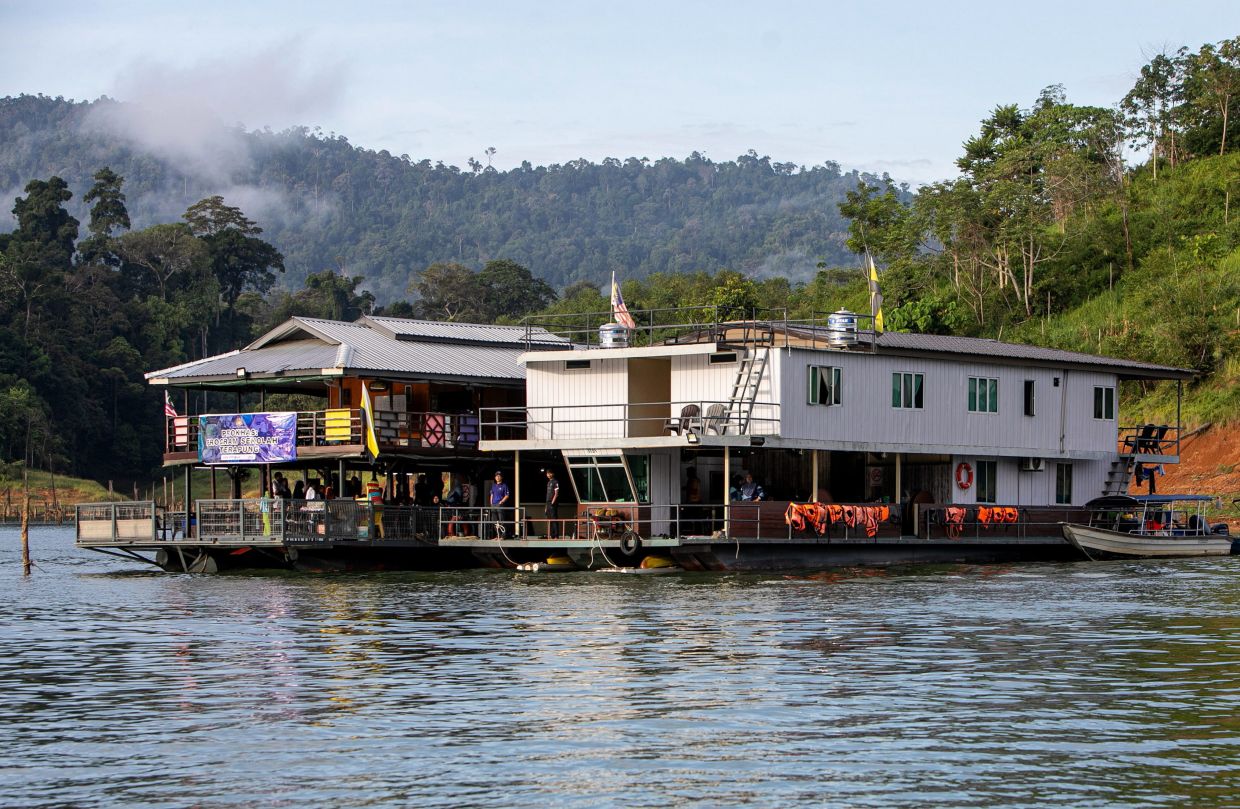
She added that the floating school was a permanent measure, as the ministry would continue refining the model to ensure it becomes a sustainable long-term solution.
One of the teachers stationed there, Muhammad Syauqi Zainal Abidin, said the programme involves three villages, namely Kampung Charuk Bus, Kampung Tebang and Kampung Chiong, and currently serves 47 students aged six to 16 since its launch on Oct 13.
"Classes run every Monday to Wednesday, taught by two teachers from Sekolah Menengah Kebangsaan (SMK) RPS Kemar K11. Students are split into two groups - juniors and seniors.
"We start with simple worksheets to help them recognise letters and vowels, then gradually increase the difficulty to syllable reading. The approach is play-based, using games and singing," he said.
Before the floating school, Orang Asli students had to take a 20-minute boat ride, followed by a land journey, to SMK RPS Banun, incurring extra costs and forcing many to stay in hostels far from their families.
A student, Rosilawati a/p Lambok, 14, from Kampung Charuk Bus, said she was happy the government had created the school, as it was much closer to home than her previous need to travel to Manjung for schooling.
"I'm happy because it's near my house. The atmosphere is fun, I get to meet friends, and I really enjoy the colouring activities," she said. – Bernama