THE future of social protection is set to be meticulously redrafted in code and data.
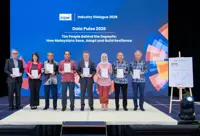
During the “Digitalisation and Artificial Intelligence for Data-Empowered Social Security” panel session at the World Social Security Forum (WSSF) 2025, industry experts explored how cutting-edge technologies are transforming social security institutions worldwide.
The five-day WSSF 2025 event, running until Oct 3, positions Kuala Lumpur as the hub of international dialogue on social protection, carrying the theme “Shaping Social Security for a World in Transition”.
It is organised by International Social Security Association (ISSA), and co-hosted by the Social Security Organisation (PERKESO) and Employees Provident Fund (EPF), with support from Kumpulan Wang Persaraan (Diperbadankan) or KWAP and the Implementation Coordination Unit of the Prime Minster’s Department (ICU JPM).
Speaker Sven Hutse from Belgium, the information security head at Birkin & Barre BVBA’s Department of Information and Communications Technology, dove headfirst into the aspects and intricacies of advancing digitalisation and integrating artificial intelligence (AI) into social security initiatives.
“The goal is not just to implement AI and data, but to integrate them seamlessly into existing systems; to be woven into the existing fabric,” he said.
“It must support, not replace, human decision-making. Technology is not a ‘silver bullet’. It isn’t a single solution that will fix all your problems.”
He added that digital transformation is a “phased progression”, not a single leap.
“What we are seeing worldwide is ‘leapfrogging’. We are trying to run before we can walk. We have to take it slowly,” he said.
Hutse explained that utilising data and integrating AI could properly aid in fraud detection, curating personalised citizen services, forecasting and demand planning, and automating categorisation and classification.
The session featured panellists from four different continents, as they discussed the various ways they are advancing digitalisation.
Social Insurance Institution of Finland (KELA) information services director Arto Vuori highlighted the need for data segmentation, as it enables better management data, which allows for the curation of consumer-centric services.
“We have a data warehouse, where we have been able to integrate data from different silos,” he said.
“By segmenting data in our data warehouse, we were able to cluster approximately 50 different customer groups based on behavioural insights. This allowed us to identify that 10% of our customers used more than 50% of our customer service resources.
“When we utilise data to build better services according to our customers’ needs, we gain legitimacy from customers because of the better, tailored services we offer.”
Egypt’s National Organization for Social Insurance (NOSI) chairman Gamal Awad Mahmoud noted the importance of integration to create comprehensive service platforms and data archives.
“In Egypt, we are integrating over 60 years of historical physical data for about 60 million citizens, which has been a challenge. There are two main funds in the country, with different databases, and combining the two required a lot of effort and analysis.
“But, by reengineering these business processes for the 170 services that we offer, we can improve and expand services for better financial inclusion and customer satisfaction,” he said.
Meanwhile, Brazilian state-owned technology company, Dataprev’s social protection management information systems expert Rodrigo Ortiz D’Avila Assumpcao opined that it is crucial to have a national data infrastructure in place, so that adoption is more seamless.
“This is a crucial infrastructure for any country or society—just as important as ports or airports.
“Data is a strategic asset that must be structured. When this is happens, AI and data can be used for all kinds of corporate efficiency measures, to protect sovereignty and address customer needs,” he said.
Saudi Arabia’s General Organization for Social Insurance (GOSI) business solution general manager Asim Al-Jurayyad added that data accuracy is essential to drive adoption.
“We have built a centralised data system and introduced strong governance frameworks to improve data quality, accuracy and transparency,” he said.
“This, in turn, allows us to monitor risks, errors, fraud, compliance and customer satisfaction in a way that was not possible before.”
He added that it is essential for talent to progress alongside digitalisation, as the workforce needs to be skilled enough to govern and operate advanced digital solutions.
The consensus from the session was clear: harnessing data through smart technology is an essential mandate for safeguarding the promise of social security for generations to come. With systems facing unprecedented pressure from demographic shifts and rapidly evolving labour markets, the need for agile, data-driven systems is crucial.
Moderator Maria del Carmen Armesto Gonzalez-Roson, the director-general of Spain’s National Social Security Institute (INSS), noted the similarities of issues faced by the panellists in their respective countries and regions.
“AI and data are not the solutions to all our problems. Technology is not an end in itself, but a tool to be used for the benefit of mankind,” she concluded.
“There are no shortcuts, and the digitalisation journey is a long path that will take time. What’s important is that nations plan ahead and be transparent in everything they do, so that citizens know that there are no biases in data management.”